No Data Yet

Hong Kong-listed artificial intelligence stocks tumbled on July 17, with Zhipu (02513.HK) plunging 12.14%, as a global technology selloff deepened following overnight losses on Wall Street. "The direct trigger is overseas deleveraging in trading positions, which is now transmitting to Asian markets," said a strategist at Sinolink Securities. "South Korea's new restrictions on single-stock leveraged ETFs are compounding the pressure on tech names." Other AI-related stocks followed the decline. Montage Technology (06809.HK) fell 3.59%, GigaDevice (03986.HK) dropped 3.50%, and Cambridge Technology (06166.HK) slid 3.29%. The selloff came a day after the Hang Seng Index had rallied 1.33% to 25,008.6, with semiconductors as the session's sole laggard — Montage had already lost 23% in the prior session alone. The declines tracked the Nasdaq Composite's 1.47% drop on July 16, where semiconductor heavyweights SK Hynix fell more than 13% and Western Digital lost 9%. South Korea's Financial Services Commission on July 16 tightened margin requirements for single-stock leveraged ETFs, raising the minimum保证金 from 10 million won to 30 million won and banning new listings of such products. The 2026 World Artificial Intelligence Conference opened in Shanghai on July 17, though the event failed to stem selling in AI stocks. The Hang Seng Tech Index was on track to reverse the prior session's 1.98% gain as the rotation out of technology names accelerated. This article is for informational purposes only and does not constitute investment advice.

Southbound Stock Connect flows diverged sharply on July 13, with HKD4.7 billion entering KNOWLEDGE ATLAS (02513.HK) while HKD3.2 billion exited KB LAMINATES (01888.HK). On the Shanghai-Hong Kong leg, KNOWLEDGE ATLAS recorded the highest net inflow at HKD2.4 billion, while KB LAMINATES saw the largest net outflow at HKD817.4 million, exchange data showed. The Shenzhen-Hong Kong leg followed a similar pattern, with KNOWLEDGE ATLAS attracting HKD2.4 billion and KB LAMINATES shedding HKD2.4 billion. The divergent flows coincided with sharp stock price dislocations. KB LAMINATES tumbled 18.7%, KINGBOARD HLDG (00148.HK) fell 19.2%, and YOFC (06869.HK) dropped 12.6%. KNOWLEDGE ATLAS edged up 0.3%. BABA-W (09988.HK) and SMIC (00981.HK) also drew net inflows of HKD583.6 million and HKD479.5 million, respectively. Total Southbound Trading turnover reached HKD127.23 billion, with net outflows at zero — the selling in laminates and fiber stocks was offset by buying in AI and semiconductor names. The extreme divergence points to a sector rotation among mainland investors rotating out of traditional manufacturing into AI-related plays, with KNOWLEDGE ATLAS emerging as the primary beneficiary. Short selling data showed elevated activity in the outflow names. KB LAMINATES had HKD345.7 million in short sales, representing 4.1% of turnover, while YOFC saw HKD534.9 million shorted at an 8.8% ratio. KNOWLEDGE ATLAS short selling was minimal at HKD137.3 million, or 0.9% of turnover, suggesting the buying was driven by genuine long demand. The scale of the rotation raises questions about whether the selloff in laminates and fiber names reflects company-specific triggers or a broader shift in mainland fund allocation. KB LAMINATES and KINGBOARD HLDG both lost about a fifth of their market value in a single session, moves typically associated with earnings disappointments or regulatory actions. Investors will watch for corporate disclosures in the coming days to confirm the trigger. This article is for informational purposes only and does not constitute investment advice.

**Tang Jie's "Touch High Plan" commits Knowledge Atlas to AGI development over near-term revenue, a bet the market rewarded with a 7% surge.** Knowledge Atlas (02513.HK) surged as much as 7.1% to HK$1,757 on Monday after co-founder Tang Jie published an internal letter pledging the company would prioritize artificial general intelligence over short-term application monetization. "Not reaching the summit means failure," Tang Jie wrote in a nearly 4,000-word letter titled "The Giant Wave Has Arrived," outlining a two-year strategic initiative called the "Touch High Plan" focused on long-horizon task planning, autonomous agents and self-evolving AI systems. The stock opened 4.9% higher and extended gains on turnover of HK$3.66 billion, with 2.1 million shares changing hands. The rally comes after the stock fell from above HK$1 trillion in market capitalization to about HK$730 billion following the July 8 lock-up expiration, mirroring the post-lockup slide at rival MiniMax. Tang's letter is a deliberate attempt to frame Knowledge Atlas as an AGI company rather than an AI coding tool provider, a distinction that carries vastly different valuation multiples. OpenAI and Anthropic command trillion-dollar valuations based on future potential, while MiniMax was re-priced as a consumer AI app company after its lock-up expiration, with its market cap falling below HK$100 billion. **The Coding Trap** Knowledge Atlas's market capitalization once exceeded HK$1 trillion, driven largely by its coding capabilities. The company's MaaS platform reached 1.7 billion yuan in annual recurring revenue, a 60-fold increase over the past year, and its open-source GLM-5.2 model trails only Claude Opus 4.8 and GPT-5.5 on core benchmarks. But Tang barely mentioned coding in his letter, according to analysts who reviewed it. "Once a story starts to be realized, it is no longer the future for capital markets," said a Hong Kong-based technology analyst who asked not to be named discussing private strategy. "Tang is trying to get ahead of the valuation question before the market forces one on him." The concern is well-founded. MiniMax's stock plunged after its lock-up expiration in early July as the market applied traditional SaaS valuation metrics — ARR size, growth rate, user retention — to what had been priced as a frontier AI company. Its market cap fell below HK$100 billion. The broader backdrop compounded the pressure: global AI concept stocks faced a Q2 2026 selloff as expectations of Federal Reserve rate hikes rose and enterprise IT budgets contracted. **The AGI Bet** Tang's "Touch High Plan" commits the company to three milestones: long-horizon task planning spanning weeks and months, autonomous agent systems capable of self-directed collaboration, and self-evolving AI where models train other models. He framed the evolution as moving from "One Person Company" to "No People Company" — AI progressing from writing code for programmers to running entire organizations. None of these capabilities have been commercialized at scale by any company globally. The strategy mirrors moves by OpenAI, which shifted its product focus to Operator and Deep Research after GPT-5, and Anthropic, whose updates this year center on Computer Use and agent loops. Tang cited Google DeepMind's "From AGI to ASI" report in his letter, arguing that superintelligence could emerge from continued compute scaling even without breakthroughs in model architecture. Knowledge Atlas did not disclose the budget for the Touch High Plan or provide a timeline for commercialization. Tang stated the company will not pursue short-term application monetization, a stance that may test investor patience if technological breakthroughs take longer than expected. For investors, the bet is binary: either Knowledge Atlas delivers on its AGI roadmap and justifies a valuation comparable to OpenAI's reported $300 billion or Anthropic's $60 billion, or it follows MiniMax's path of valuation compression as the market shifts to revenue-based metrics. The next catalyst is the company's interim results, where investors will look for signs of R&D spending discipline and any early agent-related revenue. This article is for informational purposes only and does not constitute investment advice.

MINIMAX-W slumped as much as 9.8% and Knowledge Atlas dived 8.5% after lock-up expiries triggered share placements and convertible bond issuances. "The underperformance of some new listings likely reflects a more cautious market backdrop and broader uncertainties surrounding global trade and geopolitics," said Chokwai Lee, a director at Morningstar. MINIMAX-W (00100.HK) fell as low as HKD 268.2 from its previous close, with turnover reaching HKD 1.3 billion. The company announced a proposed share placement alongside the issuance of zero-coupon guaranteed convertible bonds, with the two fundraising exercises not conditional upon each other. The combined proceeds were expected to exceed HKD 16 billion. Knowledge Atlas (02513.HK) dropped to HKD 1,859 on turnover of HKD 3.915 billion after unveiling its own share placement. The simultaneous fundraising by two of Hong Kong's largest AI companies raises dilution concerns that could weigh on the sector. MiniMax Group had plunged as much as 18% a day earlier as its first large post-listing lock-up period expired, freeing up roughly 45% of its issued share capital for public trading. Knowledge Atlas, also known as Zhipu AI, launched a roughly $4 billion Hong Kong share placement on Wednesday. The stock had climbed 11.3% on Thursday before Friday's decline. JPMorgan recently raised its price target on Knowledge Atlas to HKD 2,000 while cutting MINIMAX-W to HKD 300, citing a winner-takes-all trend in open-weight AI commercialization. Luxshare Precision Industry, an Apple supplier that makes parts for smartphones, laptops and data centers, led losses among IPO debutants in Hong Kong on Thursday after raising HK$24.27 billion in the city's biggest listing this year. The stock dropped as much as 9.6% to HK$57.2 compared with its offer price of HK$63.28. Cornerstone investors in Luxshare's listing included Temasek-linked funds, GIC, and the Abu Dhabi Investment Authority. Chinese technology and advanced manufacturing firms have been rushing to list in Hong Kong to fund expansion and research in electronics, chips and artificial intelligence. A record wave of lock-up expirations after a strong first half for new listings is weighing on the market. Most of the six other Hong Kong debutants on Thursday also received lukewarm welcomes, with electronic test equipment maker Rigol and circuit-board tool maker DTech sliding below their offering prices. The declines put both stocks under pressure as investors reassess valuations against a wave of supply. MINIMAX-W and Knowledge Atlas will need to demonstrate clear AI monetization paths to regain investor confidence, with both companies facing increased scrutiny over their capital allocation strategies. This article is for informational purposes only and does not constitute investment advice.

Knowledge Atlas Technology JSC raised HKD31.4 billion in a Hong Kong share placement, the largest fundraising in the city this year. "Raising $4 billion gives Zhipu significant firepower to compete, but it also increases pressure on the company to demonstrate that heavy AI investment can translate into sustainable commercial returns," Glenn Yin, research director at brokerage ACCM, said. The company, known as Zhipu AI, sold 19.78 million new shares at HKD1,588 apiece, a 13 percent discount to Wednesday's close of HKD1,825. The accelerated bookbuild increased share capital by about 4.25 percent. Shares had surged 13.4 percent on Wednesday and are up nearly 1,500 percent since the company's January Hong Kong debut. The proceeds will fund research and development, including computing power and hiring, as well as business expansion and strategic investments. The deal comes as Chinese authorities consider restricting overseas access to the country's most advanced AI models, a move that could affect how Zhipu sells its technology abroad. Zhipu is one of China's best-known AI model developers and is viewed as a domestic challenger to OpenAI. The company earlier this year raised HKD4.35 billion in its Hong Kong initial public offering and last month announced plans to raise 15 billion yuan through a proposed listing on Shanghai's STAR Market. The placement was led by China International Capital Corp. as sole overall coordinator. JPMorgan recently raised its price target on Knowledge Atlas to HKD2,000, citing a "winner-takes-all" trend in open-weight AI commercialization. The fundraising comes as a wave of Chinese technology companies tap Hong Kong's capital markets. Nexchip Semiconductor this week priced an IPO to raise about HKD6.98 billion. Separately, Shanghai Iluvatar CoreX Semiconductor is seeking about $850 million through a Hong Kong share sale, while Shanghai Biren Technology raised about $900 million through a placement. The HKD31.4 billion raised gives Zhipu substantial resources to scale its AI infrastructure at a time when competition with US technology companies is intensifying. Investors will watch whether the company can convert its large language model leadership into sustainable revenue growth, with its next earnings report serving as a key test. This article is for informational purposes only and does not constitute investment advice.

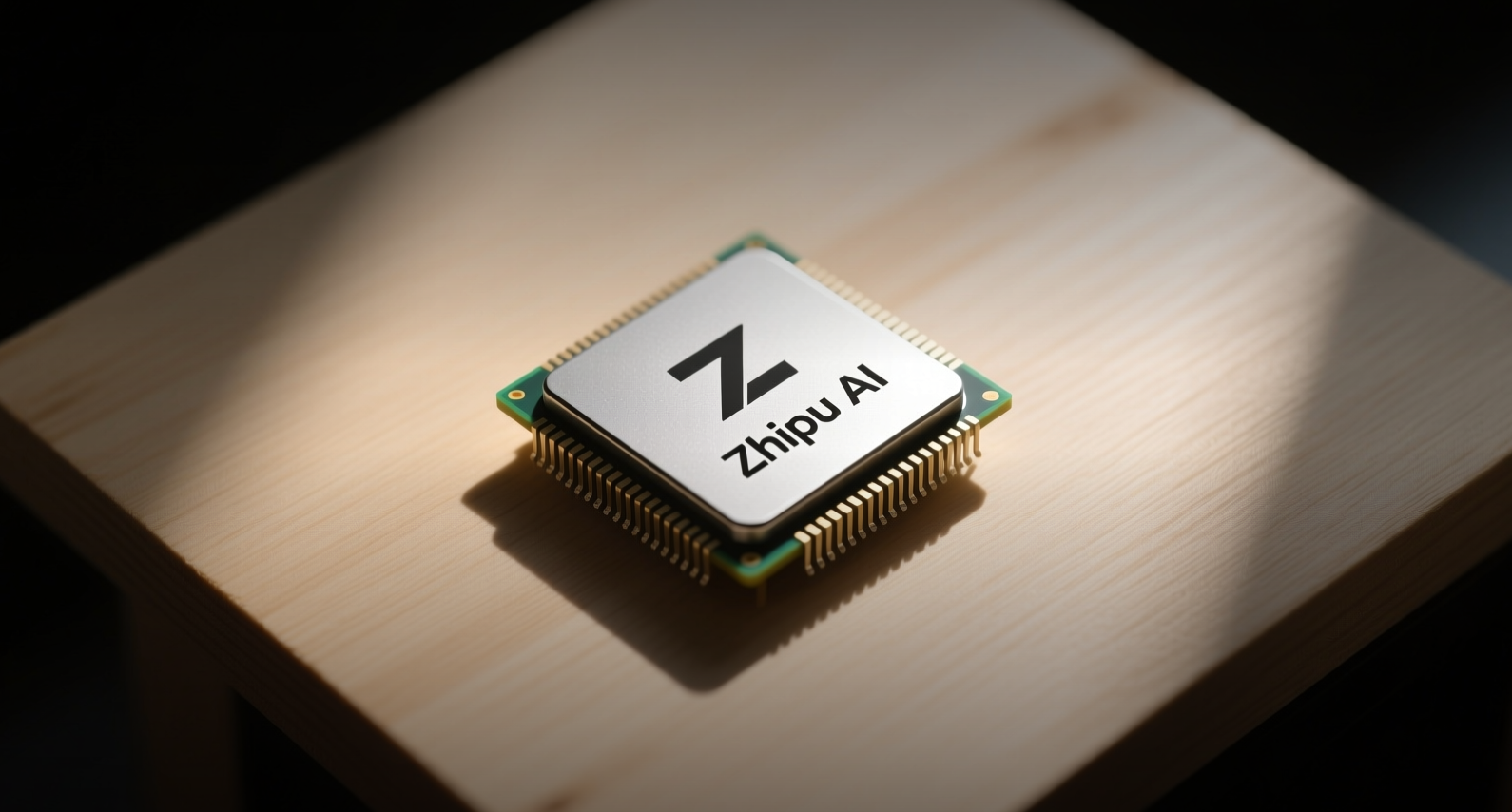
Knowledge Atlas Tech Joint Stock (02513.HK), the listed entity behind Chinese AI startup Zhipu AI, is exploring development of a custom ASIC chip to power its GLM family of large language models, according to a report from The Information. The company has held preliminary discussions with several Chinese chip design companies about creating a specialized AI processor tailored to its models, the report said, citing people familiar with the matter. No development partner has been selected, and the project remains in an early phase that could take more than two years to complete. Shares surged 13.6% to HKD 1,829 in Hong Kong trading on July 7, with turnover reaching HKD 11.2 billion on 6.7 million shares traded. The Hang Seng Index rose about 2% the same day. Short selling accounted for HKD 251.7 million, or 5.2% of total volume. The chip initiative comes as demand for Zhipu AI's recently launched GLM-5.2 model strains computing capacity. Daily token usage jumped 27-fold during the first week after the model's release, the report said, intensifying the need for more efficient inference hardware. **Why Custom Silicon Matters** Unlike general-purpose graphics processing units, application-specific integrated circuits are built for dedicated workloads, allowing companies to improve energy efficiency and lower long-term operating costs for AI inference. An in-house ASIC could also reduce Zhipu AI's reliance on Nvidia's advanced chips, which have become harder to procure as U.S. export restrictions tighten access to products such as the H100 and B200. The strategy mirrors moves by Google, which developed its Tensor Processing Unit; OpenAI, which is working with Broadcom on custom silicon; and Chinese peers Alibaba and ByteDance, which have both built proprietary AI processors. For Chinese AI companies, the push toward domestic chip alternatives has accelerated as Washington expanded semiconductor export controls in each of the past two years. **Investment Implications** If Knowledge Atlas moves forward with production, the chip would likely be manufactured at a Chinese foundry, the report said, though no fabrication partner has been named. The next milestone will be the selection of a chip design partner, which would signal the project has progressed beyond the exploratory stage. Knowledge Atlas trades at a market capitalization of roughly HKD 110 billion based on the July 7 close. The stock has more than doubled this year as investor enthusiasm for Chinese AI names surged following the release of DeepSeek's R1 model in early 2026, which demonstrated competitive performance at a fraction of the training cost of U.S. rivals. This article is for informational purposes only and does not constitute investment advice.

HSBC Global Investment Research raised Knowledge Atlas's price target to HKD1,900 from HKD920, citing the GLM-5.2 model's improved coding capabilities and cost efficiency that narrowed the gap with US rivals. "GLM-5.2's long coding capability is now comparable to Claude Opus 4.7, while computing cost per token fell 2.9 times versus the prior version," HSBC Global Investment Research said in a note dated June 25. The broker raised its annualized recurring revenue forecast for December 2026 to USD1 billion from USD340 million, aligning with the company's own guidance. Knowledge Atlas is now expected to break even in 2028, a year earlier than previously forecast. The stock fell 5.4% to HKD2,222 on Thursday, with HKD42.1 million in short selling representing 0.94% of turnover. The new target implies about 14% downside from the current price. The upgrade reflects growing confidence in Knowledge Atlas's ability to monetize its AI models despite intense competition. The company's proposed A-share listing and potential Hong Kong share placement could ease cash flow constraints as it invests in agentic AI development. HSBC previously considered the USD1 billion ARR target overly aggressive. The revision followed GLM-5.2's rebound to sixth place in the Artificial Analysis Intelligence Index, as well as progress on inference compatibility with domestic chips that partly alleviated supply concerns. The model's context window expanded to 1 million tokens, positioning it closer to frontier models from OpenAI and Anthropic. The broker maintained its Hold rating, citing risks including competition from Moonshot AI and DeepSeek, potential price cuts by OpenAI, and share lock-up expiries in July 2026 and January 2027. Knowledge Atlas, which trades under the name Knowledge Atlas Technology, has a market value above HKD1 trillion after its shares surged more than 2,000% since its Hong Kong IPO in January. The target hike signals that at least one major broker sees a credible path to monetization, but the Hold rating and below-market target suggest valuation remains stretched. Investors will watch the company's A-share listing progress and the July lock-up expiry for the next directional signal. This article is for informational purposes only and does not constitute investment advice.

JPMorgan raised its price target on Zhipu by 29% to HK$1,800, citing the Chinese AI company's GLM-5.2 model for higher revenue forecasts. "GLM-5.2's improved capabilities and pricing power support a stronger revenue trajectory," JPMorgan said in a June 22 research report. The bank reiterated its Overweight rating on Zhipu (02513.HK). The new target of HK$1,800 is based on 30 times estimated 2030 earnings, discounted to present value, up from the previous target of HK$1,400. The 29% increase reflects higher revenue projections tied to the upgraded model. The upgrade comes as Chinese AI developers narrow the performance gap with US rivals. Zhipu's GLM-5.2, an open-source model released this year, has drawn attention from Silicon Valley for its competitive capabilities against frontier systems from OpenAI and Google. The model's improved performance allows Zhipu to command stronger pricing, according to JPMorgan. Zhipu listed on the Hong Kong Stock Exchange in January 2026, with Chairman Liu Debing ringing the opening bell. The company competes with a growing field of Chinese AI developers including DeepSeek, Baidu and Alibaba, all racing to build models that can match US leaders. DeepSeek's R1 model, released in January 2025, erased $1 trillion from US capital markets in a single day and demonstrated that Chinese AI could compete at the frontier. The open-source segment has become a key battleground. Chinese developers have released several competitive models this year, narrowing what was once a wide gap with American labs. GLM-5.2 is among the latest entries, and its reception in both China and abroad will test whether open-source Chinese AI can gain traction with global developers. The 29% target increase signals that JPMorgan sees accelerating revenue momentum from GLM-5.2. Investors will watch for Zhipu's next earnings report for evidence of pricing power and margin expansion. This article is for informational purposes only and does not constitute investment advice.

Knowledge Atlas Technology Corp. shares surged as much as 42% to HKD 2,980 on Monday, pushing its market cap past HKD 1 trillion. "The gap between Chinese and US large language models may not take that long to close," Tang Jie, founder and chief executive officer of Knowledge Atlas, said in response to Elon Musk's forecast. The stock was last at HKD 2,562, up 22%, with turnover reaching HKD 6.1 billion. The seven-session winning streak has more than doubled the company's value since its Hong Kong listing in January. CLSA initiated coverage with a hold rating and a price target of HKD 1,500, implying downside from current levels. The rally shows investor conviction that Chinese AI companies are closing the gap with US rivals faster than expected. Musk, chief executive officer of Tesla Inc., said on social media that China's LLMs could reach the level of Anthropic's Fable model by the first quarter of 2027, a timeline that people familiar with the industry view as conservative, estimating the gap at less than seven months. Knowledge Atlas, known for its GLM-5.2 model, listed on the Hong Kong Stock Exchange in January under the ticker 02513.HK. The company's GLM-5.2 has narrowed the performance gap with leading US models, according to industry benchmarks cited by the company. The stock has gained more than 100% since its listing, driven by optimism over China's AI capabilities. The Hang Seng Index traded mixed on Monday, while the Hang Seng Tech Index moved in sympathy with Knowledge Atlas's surge. The Shanghai Composite edged higher, tracking AI-driven optimism across the broader China tech sector. The offshore yuan traded near 7.25 per dollar, little changed on the session. The debate over the China-US AI gap has intensified since DeepSeek's R1 model disrupted the market in January 2025, erasing US$1 trillion from American tech valuations in a single day, according to The Economist. Nvidia briefly lost 17% of its value, while the Nasdaq fell 3.1% in that session. Knowledge Atlas's latest gains suggest investors are betting the next breakthrough may come from China, reshaping the competitive dynamics of the global AI industry. The surge in Knowledge Atlas comes as Chinese AI companies attract growing investor attention following a series of model releases that have narrowed the technology gap with US peers. DeepSeek, Baidu's Ernie, and Alibaba's Qwen have all released models that compete closely with US counterparts on key benchmarks, often at a fraction of the development cost. The HKD 1 trillion market capitalization places Knowledge Atlas among the most valuable technology companies listed in Hong Kong, alongside Tencent Holdings (0700.HK) and Alibaba Group (9988.HK). The stock's rally also reflects broader enthusiasm for AI-related names in Hong Kong and mainland China, where investors are betting that domestic champions can capture a significant share of the growing AI market. This article is for informational purposes only and does not constitute investment advice.

JPMorgan named 9 China AI ecosystem stocks Overweight on June 18, with price targets reaching as high as HKD1,400. "China's AI opportunity spans the semiconductor supply chain, optical connectivity, and application layers," JPMorgan said in the research note. The Hong Kong-listed picks include BIDU-SW (09888.HK) at HKD225, KNOWLEDGE ATLAS (02513.HK) at HKD1,400, WEICHAI POWER (02338.HK) at HKD52, VGT (02476.HK) at HKD600, and ILUVATAR COREX (09903.HK) at HKD620. On the A-share side, ZHONGJI INNOLIGHT (300308.SZ) received a RMB430 target, NAURA (002371.SZ) at RMB700, AMEC (688012.SH) at RMB289, and CHANG ELEC TECH (600584.SH) at RMB110. The recommendations provide institutional backing for China's AI supply chain as the country pushes to develop domestic semiconductor and AI infrastructure. The nine stocks span three layers of the AI value chain: optical components for data center connectivity through ZHONGJI INNOLIGHT, semiconductor capital equipment through NAURA and AMEC, and AI applications through BIDU, KNOWLEDGE ATLAS, and ILUVATAR COREX. WEICHAI POWER and VGT add exposure to industrial AI and autonomous driving, respectively. JPMorgan's broad coverage of the China AI sector shows the bank expects growth to extend across multiple subsectors rather than concentrate in a single name. The bank did not disclose previous ratings or price targets for comparison. Among the picks, KNOWLEDGE ATLAS carries the highest target at HKD1,400, while WEICHAI POWER has the lowest at HKD52. The Overweight ratings across the group suggest JPMorgan expects broad-based AI-driven growth in China. Investors will monitor the next round of China AI policy announcements and company earnings for confirmation of the demand trajectory. This article is for informational purposes only and does not constitute investment advice.

Knowledge Atlas (02513.HK) surged 12.6 percent to HKD 1,660 after its STAR Market IPO tutoring status advanced to "Tutoring Acceptance." The Hong Kong-listed education technology firm earlier proposed to issue A shares and list on Shanghai's STAR Market to raise RMB 15 billion, with Guotai Haitong Securities acting as the tutoring broker, according to CSRC data. The stock opened flat before rallying in the afternoon to hit an intraday peak of HKD 1,739. Trading volume reached 3.82 million shares, representing HKD 6.03 billion in turnover. Short selling totaled $162.54 million, accounting for 2.7 percent of total turnover. Bank of America Securities initiated coverage on Knowledge Atlas with a Buy rating and a price target of HKD 1,250. The STAR Market, officially the Science and Technology Innovation Board, is China's Nasdaq-style board launched in 2019 to attract tech and innovative companies. The "Tutoring Acceptance" status indicates the CSRC has accepted the company's tutoring filing, a procedural step before a formal IPO application. The RMB 15 billion fundraising target would make it one of the larger STAR Market listings in the education technology sector. The company's next milestone will be the submission of a formal prospectus to the Shanghai Stock Exchange, which will trigger the review process. *This article is for informational purposes only and does not constitute investment advice.*