Edgen AI operates independently of, and is not controlled by Aspen Digital Financial Limited.
Knowledge Atlas draws HKD4.7B as Southbound flows diverge sharply
 Edgen Stock·Jul 13 2026, 11:11
Share to
Share to
Copy link



[1] HKD4.7B Southbound Trading Net Inflow to KNOWLEDGE ATLAS (https://www.aastocks.com/en/stocks/analysis/c ...)[2] Hong Kong-listed PCB-related stocks collectively declined, with KB Laminate Holdings falling over 17% and KB Group dropping more than 15%. - 富途牛牛 (https://news.futunn.com/en/post/75891300/hong ...)[3] Hong Kong Market Movers | PCB-related stocks plunge across the board; Jensen Huang denies rumors of Rubin Ultra delay; institutions note reduced crowding in AI hardware - 富途牛牛 (https://news.futunn.com/en/post/75892673/hong ...)
Related News
Jul 17 2026, 09:56
OpenAI's Altman takes blame for 12 months of misses, vows comeback
**OpenAI CEO Sam Altman publicly acknowledged the company's underperformance over the past 12 months, blaming himself as critics warn the AI investment cycle hinges on the startup's success.** OpenAI CEO Sam Altman took personal responsibility for the company's underperformance over the past 12 months, promising a turnaround as critics warn the startup's struggles could trigger a broader AI investment reckoning. "Past 12 months have not been our best ever, which is mostly my fault," Altman said in a post on X on July 17. He added that OpenAI is "about to have our best 12 months to date" and that the company's mission is to give people more freedom and wealth, not to drive adoption through fear. Altman's admission comes as Ed Zitron, a longtime AI critic, published a lengthy analysis labeling OpenAI the "systemically important institution" of the AI investment cycle. Zitron argued that investor confidence in data center buildouts, GPU demand growth, and AI startup profitability all rest on OpenAI's continued expansion. He identified three structural risks: inference costs remain too high, meaning user growth could amplify losses; capital expenditure is outpacing cash flow improvement; and OpenAI will require years of additional external financing. The stakes extend beyond OpenAI. Zitron warned that Oracle, CoreWeave, and other infrastructure providers that have received premium valuations based on AI demand expectations could face sharp re-ratings if OpenAI's growth disappoints. SoftBank, with its massive AI infrastructure and chip company bets, would also face scrutiny, he said. **Skeptics vs. Believers on AI's Trajectory** Not all market participants share Zitron's view. Howard Marks, co-founder of Oaktree Capital Management, said he has moved from initial skepticism toward greater recognition of AI's long-term value, comparing the technology to the internet and electrification as a general-purpose platform rather than a speculative bubble. Some academic research characterizes the current AI market as a mix of genuine technological progress and localized overvaluation — real advances alongside overheated capital spending in specific segments. Altman, for his part, pointed to upcoming product improvements. He discussed GPT Live, a feature that enhances ChatGPT's voice capabilities with real-time conversation, interruption handling, and the ability to switch to GPT-5.5 for complex queries. He said he now uses voice commands more than typing. For investors, the key metrics have shifted from how much companies spend on AI to how much they earn from it. Revenue growth, paid conversion rates, inference cost declines, data center utilization, and AI investment payback periods will determine whether current valuations hold. Altman's promise of a turnaround will be tested against these numbers in the quarters ahead. OpenAI remains private, but the ripple effects of its performance are felt across public markets through Microsoft, Oracle, Nvidia, and the broader AI infrastructure complex. This article is for informational purposes only and does not constitute investment advice.
Jul 17 2026, 09:52
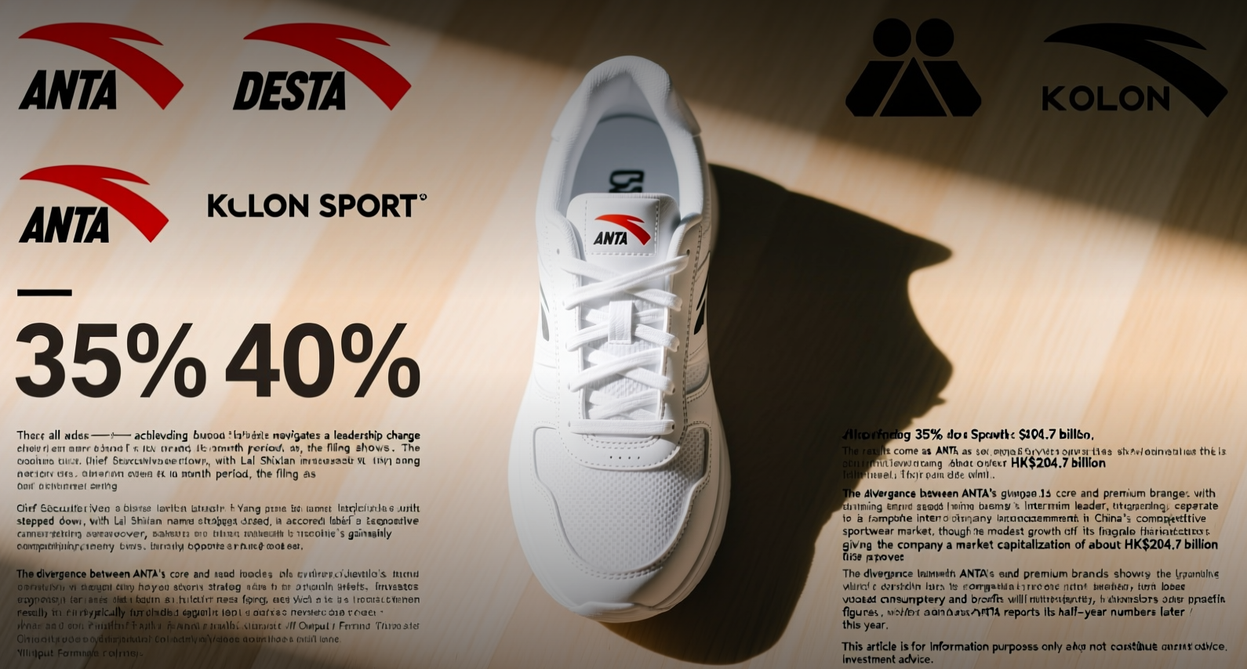
ANTA Sports Q2 retail sales rise as smaller brands surge 30%
ANTA Sports Products reported low-single-digit Q2 retail sales growth for its core brands, while smaller brands surged as much as 30%. The unaudited figures, disclosed in a Hong Kong stock exchange filing, show ANTA's mass-market labels expanding at a slower pace than its premium outdoor brands. The company cautioned that retail sales data does not directly represent total reported revenue or profitability. For the first half of 2026, ANTA and FILA each recorded mid-single-digit retail sales growth from a year earlier. All other brands — including DESCENTE and KOLON SPORT — achieved 35% to 40% growth over the six-month period, the filing shows. The results come as ANTA navigates a leadership change at its namesake brand. Chief Executive Xu Yang stepped down, with Lai Shixian named interim leader, according to a separate company announcement. Shares of ANTA Sports rose 0.5% to HK$74.15, giving the company a market capitalization of about HK$204.7 billion. The divergence between ANTA's core and premium brands shows the company's multi-brand strategy is gaining traction in China's competitive sportswear market, though the modest growth of its flagship labels may temper expectations for a broad consumption recovery. Investors will watch for full interim results, which typically include revenue and profit figures, when ANTA reports its half-year numbers later this year. This article is for informational purposes only and does not constitute investment advice.

Jul 17 2026, 09:48
Volvo CEO rejects China EV plunder claim as 100% tariff bites
**Volvo Cars' CEO rejected a White House trade adviser's claim that Chinese automakers are plundering global markets, calling the characterization overblown.** Volvo Cars Chief Executive Hakan Samuelsson dismissed White House trade adviser Peter Navarro's accusation that Chinese electric-vehicle makers are plundering global markets, saying their success stems from effective strategy rather than unfair competition. "The remarks go a bit too far," Samuelsson, chief executive of Volvo Cars, a unit of Zhejiang Geely Holding Group, said in an interview. "Companies that succeed in the EV sector must be respected." Navarro had earlier claimed BYD Co., China's largest EV maker, was plundering global car markets. The U.S. currently imposes a 100 percent tariff on Chinese-made EVs, a policy that has kept BYD out of the world's largest auto market. The Shenzhen-based company has expanded across Southeast Asia, Europe and Latin America, building factories in Hungary, Brazil and Thailand to serve local markets. The exchange highlights the deepening rift between the world's two largest economies over EV trade, with the U.S. arguing Chinese overcapacity threatens domestic industries while Beijing defends its industrial policy. The outcome could determine which automakers dominate the global EV market, projected to reach $1.2 trillion by 2030. Samuelsson's defense of Chinese automakers carries weight given Volvo's position as a Geely-owned brand that competes directly with both Western and Chinese manufacturers. The Swedish automaker, which traces its roots to 1927, is transitioning its entire lineup to EVs by 2030 and has invested billions of dollars in electric platforms and battery technology. The previous U.S. tariff escalation on Chinese goods in 2018 affected $250 billion in bilateral trade, with the average tariff rate rising from 3.1 percent to 19.3 percent, according to the Peterson Institute for International Economics. The current 100 percent tariff on EVs represents a fivefold increase from the 25 percent rate applied to Chinese auto imports before the latest round, which took effect in August 2024. JPMorgan Chase & Co. analysts this week downgraded GAC Group to underweight while naming Geely Auto, NIO Inc. and BYD as top picks for the second half of 2026, pointing to continued confidence in Chinese EV makers despite trade headwinds. The analyst note suggests institutional investors see value in Chinese EV stocks even as trade barriers rise, with BYD trading at a discount to global peers on a price-to-earnings basis. The U.S. is the only major auto market that has kept BYD out, according to a Bloomberg analysis. The company's global expansion strategy — building factories in emerging markets rather than relying solely on exports — has allowed it to bypass tariff barriers in multiple regions. BYD now operates manufacturing plants in more than 10 countries, including facilities in Brazil, Hungary, Thailand and India. The broader implications extend beyond the auto sector. The U.S.-China trade dispute over EVs mirrors tensions in semiconductors, solar panels and batteries, where Washington has accused Beijing of using state subsidies to create overcapacity. China's EV exports to the U.S. remain negligible due to the tariff wall, but the dispute sets a precedent for how the two economies manage competition in strategic industries. If the U.S. maintains its protectionist stance while Chinese manufacturers continue gaining share elsewhere, the global auto industry could split into distinct Western and Chinese spheres. This article is for informational purposes only and does not constitute investment advice.