Edgen AI operates independently of, and is not controlled by Aspen Digital Financial Limited.
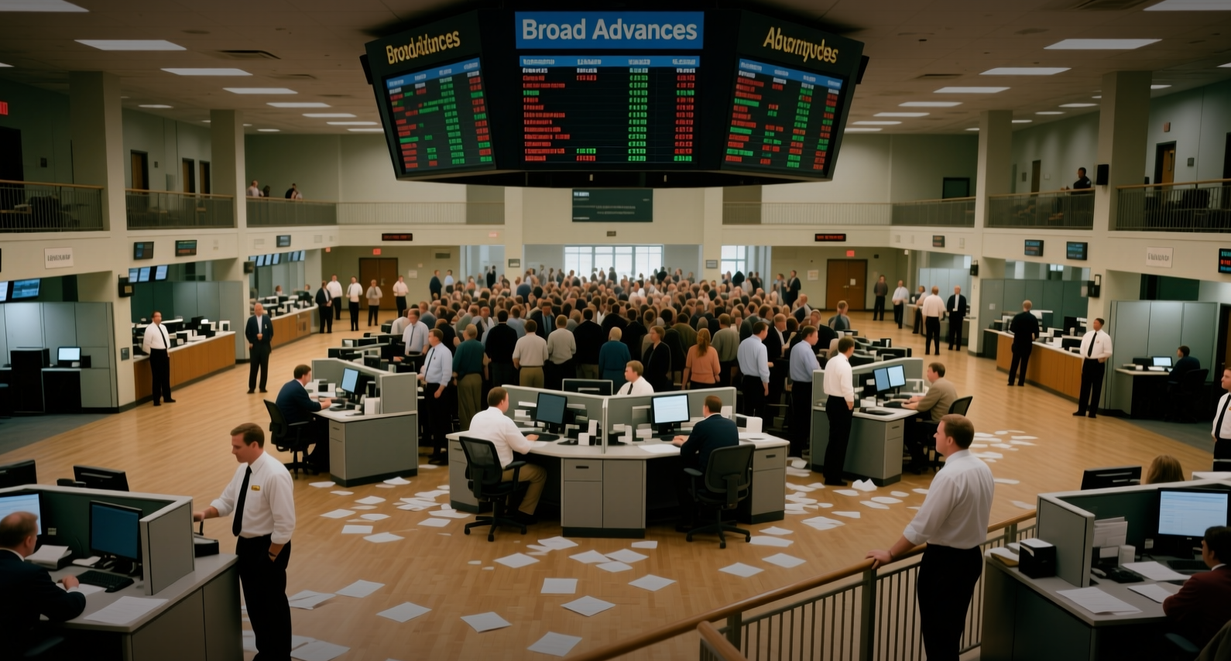
S&P 500 climbs 1.5% as 1999-style breadth warning flashes
 Edgen Stock·Sep 21 2026, 22:00
Share to
Share to
Copy link
[1] Stocks had a great day on the surface. But something alarming occurred not seen since 1999 (https://www.cnbc.com/2026/09/21/stocks-had-a- ...)[2] How major US stock indexes fared Monday 9/21/2026 (https://apnews.com/article/wall-street-stocks ...)[3] The Stock Market's Best Quarter of the Year Is About to Start. The S&P 500 Has Risen in 34 of the Last 41. (https://www.fool.com/investing/2026/09/20/the ...)[4] S&P 500 Annual Returns by Year: Historical Data Since 1928 (https://www.fool.com/research/sp-500-annual-r ...)[5] Wall Street rallies within 0.4% of its record after oil prices and bond yields ease - reflector.com (http://www.reflector.com/news/national/wall-s ...)
Related News

Sep 21 2026, 22:19
Google funds 96 MW nuclear uprate in $900 million Georgia Power deal
Georgia Power will squeeze 96 megawatts of additional output from two existing nuclear plants using money from Google, a contract that converts hyperscaler power demand into ratepayer savings rather than a new reactor order book. The agreement, filed Monday with the Georgia Public Service Commission under Docket 44280 and Docket 56002, covers uprates on Georgia Power's owned share of units at Plant Vogtle near Waynesboro and Plant Hatch near Baxley. Google subscribes to a new Nuclear Uprate tariff, designated NU-1, and receives the Zero-Emission Credits tied to the incremental generation. Georgia Power puts the projected customer benefit at roughly $900 million over the life of the units. "Many of our large customers have specific clean energy goals, and we continue to work with the Georgia PSC to create programs that not only help them meet their goals, but align with our Customer Protection Pledge," Aaron Mitchell, senior vice president of strategic growth at Georgia Power, said. The mechanics matter more than the headline capacity. An extended power uprate, or EPU, raises a reactor's licensed thermal power level through targeted changes to turbines, pumps, motors and cooling systems, letting the unit produce more steam and more electricity without new fuel design or new plant footprint. The Georgia PSC already approved an EPU for Vogtle Units 1 and 2 in the 2025 Integrated Resource Plan. Monday's filing adds a request to approve a fresh EPU for Hatch Units 1 and 2. For scale, 96 MW is roughly 0.6% of the 1,100 MW nameplate capacity of each Vogtle AP1000 unit, and it arrives at a fraction of the cost and timeline of new-build generation. Georgia Power's four nuclear units — two at Vogtle, two at Hatch — anchor a fleet that supplied more than 25% of the state's electricity last year, according to the company. ## Why the tariff structure is the real product The NU-1 design is the part other utilities are likely to copy. Google's subscription covers the incremental cost of the uprate work, and the tariff is structured so that non-participating customers are shielded from those costs — the same architecture Georgia Power has used for years on its renewable energy programs, where large buyers underwrite new capacity in exchange for the environmental attributes. That structure answers the sharpest political objection to data-center growth: that hyperscaler load raises bills for everyone else. Georgia Power's framing is explicit — large-load growth should benefit all electric customers, not just the buyer signing the contract. "Google data centers are long-term investments in the communities we call home," Lucia Tian, director of advanced energy technologies at Google, said. "This collaboration with Georgia Power ensures that digital infrastructure growth goes hand-in-hand with positive local impact." The deal also gives Google something it cannot buy on the open market at scale: firm, carbon-free, round-the-clock power with a documented emissions attribute. Solar and wind contracts deliver intermittency; nuclear uprates deliver baseload. For a company running AI training clusters that draw power continuously, the distinction is the entire point. ## What it signals for the wider nuclear fleet The template is portable. Every U.S. nuclear operator with un-uprated capacity now has a worked example of how to monetize it without a rate case fight — sell the increment to a creditworthy corporate buyer, pass the savings to the general rate base, and let the regulator bless the structure. Constellation Energy, Vistra and Duke Energy all operate fleets where similar uprates have been studied or pursued, and all face the same question of who pays for the incremental capital. The constraint is physical, not financial. Uprates are bounded by licensing limits and equipment tolerances, so the aggregate megawatts available across the U.S. fleet are measured in single-digit gigawatts, not the tens of gigawatts that AI data-center forecasts imply. That ceiling is precisely why hyperscalers have also signed long-term contracts tied to new-build and restart projects elsewhere. Southern Company shares closed at $85.46, down 0.07%, on a day when Alphabet rose 1.55% to $354.97, according to MarketScreener data. The muted utility reaction reflects the deal's size: $900 million of lifetime customer benefit spread across a 2.8-million-customer base is real but not transformative to earnings, and the capacity is contingent on PSC approval. The next checkpoint is the Georgia PSC's review of the NU-1 tariff and the Hatch EPU request. Approval would make Georgia the first state with a standing nuclear uprate tariff on its books — and give every other utility commission in the country a filing to point at. This article is for informational purposes only and does not constitute investment advice.

Sep 21 2026, 21:55
Congress moves to slow US-China investment after deal surge
A bipartisan group of lawmakers is drafting legislation that would force U.S. investors to clear Chinese equity stakes with the Treasury Department before closing, extending Washington's screening reach from inbound deals to the roughly $1.2 trillion of American capital already committed to Chinese assets. "The bill is designed to close the gap between what we screen on the way in and what we let walk out the door," said a senior Senate aide involved in drafting the measure, who asked not to be named because the text is not yet public. The legislation would require U.S. persons to notify Treasury before acquiring equity in Chinese companies working in semiconductors, artificial intelligence, quantum computing, hypersonics and advanced aerospace, with a 45-day review window and civil penalties of up to $1 million or twice the transaction value for failures to file. Treasury's outbound screening program, in force since January 2025, already covers those five sectors, but the bill would convert its notification regime into a mandatory filing requirement with a statutory deadline. The House Financial Services Committee has scheduled a markup for the week of Oct. 6, and the Senate Banking Committee is drafting a companion text. The measure lands on a bilateral investment relationship that has been rebuilding since 2023. U.S. direct investment in China stood at $126.9 billion at the end of 2024, according to Bureau of Economic Analysis data, while U.S. holdings of Chinese portfolio assets — equities and debt — totaled about $1.1 trillion, the Treasury's latest international capital survey shows. Chinese direct investment in the U.S. was $28.4 billion over the same period. The flow has been one-directional and concentrated: venture and growth capital into Chinese AI and semiconductor startups accounted for the largest share of the increase, according to PitchBook data, with U.S. funds participating in a majority of the largest China-based rounds above $100 million. The transmission into public markets is already visible. The Nasdaq Golden Dragon China Index has fallen 6.8% since the start of September, underperforming the S&P 500 by roughly 9 percentage points, and the iShares MSCI China ETF has recorded three consecutive weeks of net outflows, according to fund flow data compiled by Bloomberg. Shares of U.S. asset managers with the largest China-dedicated vehicles have moved with the headlines rather than with earnings. The last time Congress advanced comparable outbound restrictions, in the summer of 2024, the Golden Dragon index fell 11% over the six weeks that followed before recovering half the decline once the final text narrowed the covered sectors. Beijing has signaled it will respond in kind. China's Ministry of Commerce said in a Sept. 18 statement that it "reserves the right to take necessary countermeasures" against measures it deems discriminatory, without specifying targets. The 2023 Chinese restrictions on gallium and germanium exports, imposed after U.S. chip controls, cut global supply of the two metals by 12% within two quarters and pushed gallium prices up 43%, according to Fastmarkets data — a template for how quickly a tit-for-tat response can move physical markets. The stakes are largest for the venture and private equity firms that built China-focused franchises over the past decade. A mandatory filing regime adds legal cost and delay to every deal, and a 45-day review window can kill a competitive auction outright. For limited partners, the risk is not a ban but a slow bleed: funds that cannot deploy committed capital face extension requests and discounted secondary sales, and China-dedicated vehicles are already trading at 15% to 25% discounts to net asset value on the secondary market, according to advisory firm data. The next hard date is the House Financial Services markup in the week of Oct. 6. If the bill clears committee with the five-sector scope intact, expect the compliance burden to fall first on funds with more than $1 billion in China exposure, with the filing requirement taking effect for transactions closing after Jan. 1, 2027. If the covered sectors narrow to semiconductors and AI alone, the near-term hit to deal flow is smaller but the precedent — that Washington will legislate the outbound side of the relationship — stands regardless. This article is for informational purposes only and does not constitute investment advice.

Sep 21 2026, 21:33
Silver vaults shed 7.2 million ounces as COMEX deliveries spike
Silver held in COMEX depositories dropped by 223 tonnes last week, a 2.1% cut to exchange stock, while delivery notices on September futures ran to 6,168 contracts. The withdrawal was concentrated in eligible metal, which fell 8.6 million ounces to 232.8 million ounces, according to CME vault data. Registered silver — the only category that can settle a futures contract — rose 1.4 million ounces to 97.3 million ounces over the same period. "Registered stocks are still sufficient to meet delivery obligations," said Mike Maharrey, analyst at Money Metals Exchange. "The squeeze case depends on whether this pace of withdrawal persists and starts pulling metal out of the registered category." The distinction matters for anyone pricing front-month risk. A drain that hits eligible metal signals holders moving bullion out of the futures settlement system; a drain that hits registered metal directly reduces the pool available to deliver against open short positions. Last week's data show the first, not the second. ## 30.84 million ounces converted from paper CME recorded 6,168 September silver delivery notices through Sept. 18, representing 30.84 million ounces of metal moving from futures positions into physical hands. That is the mechanical link between the vault numbers and the delivery surge: each notice converts a paper claim into a demand for bullion. The weekly drawdown was roughly 25% larger than the outflow recorded during the October 2025 squeeze, when front-month spreads blew out and lease rates spiked. The difference this time is that deliverable supply expanded rather than contracted, which is why spot silver has not broken into backwardation. Spot silver traded at $65.93 an ounce at 16:50 UTC on Sept. 21, down 0.46% on the session, according to XAGUSD quotes. The iShares Silver Trust (SLV) closed at $59.63, down 0.50%, with $32.81 billion in assets. Sprott Physical Silver Trust (PSLV) traded at $21.56, down 0.69%, and the Aberdeen Physical Silver Shares ETF (SIVR) at $62.74, down 0.43%. ## What 97.3 million ounces buys Registered inventory of 97.3 million ounces covers roughly three times the 30.84 million ounces of September deliveries recorded so far, leaving a buffer that would take several weeks of comparable withdrawals to exhaust. That is the arithmetic standing between the current drain and a repeat of October 2025. The forward signal is the next weekly CME vault report, due Sept. 24. A second consecutive drawdown of similar size — particularly one that pulls from registered rather than eligible stock — would narrow the deliverable cushion and give short holders reason to source metal ahead of the December contract roll. Gold offers the peer anchor. COMEX gold vaults have held broadly steady through September, with the metal trading near record levels on central bank buying rather than exchange-level tightness. Silver's move is a physical-market story specific to the white metal, not a broad precious-metals vault drain. This article is for informational purposes only and does not constitute investment advice.