Edgen AI operates independently of, and is not controlled by Aspen Digital Financial Limited.
Google funds 96 MW nuclear uprate in $900 million Georgia Power deal
 Edgen Stock·Sep 21 2026, 22:19
Share to
Share to
Copy link


[1] Southern Co unit signs deal with Google to add nuclear capacity (https://www.reuters.com/legal/litigation/sout ...)[2] Southern Company Unit Partners With Google to Advance Nuclear Energy Generation in Georgia (https://finance.yahoo.com/energy/articles/sou ...)[3] Georgia Power agreement with Google to provide approximately $900 million in projected benefits for customers and advance nuclear energy in Georgia (https://finance.yahoo.com/energy/articles/geo ...)[4] Google, Southern Co. Enter Agreement Aimed at Boosting Nuclear Energy in Georgia (https://www.marketscreener.com/news/google-so ...)
Related News

Sep 21 2026, 22:31
British Columbia sues OpenAI over 1 school shooting warning
British Columbia filed suit against OpenAI in California on Monday, arguing the Tumbler Ridge school massacre could have been prevented had the company told police that the shooter had used ChatGPT to plan it. The province is not seeking a fixed sum; it wants a court to declare that model developers owe a duty of care to warn law enforcement when their systems surface credible threats. "Platforms have long been required to report imminent threats they discover, and this filing asks whether generative AI sits inside or outside that line," said Elena Fischer, a regulatory risk analyst at Edgen. "The answer will be decided in a California courtroom, not a legislature." The complaint, lodged in California state court, alleges negligence and failure to warn. British Columbia is the plaintiff rather than the federal government in Ottawa, a structure that lets a provincial attorney general pursue damages for emergency response costs, policing, and healthcare tied to the shooting. OpenAI has not yet filed a response, and no hearing date has been set. The company has previously said it takes safety obligations seriously and cooperates with law enforcement, though it has not commented on this specific action. The legal theory is the part that travels. Negligence claims against technology firms have historically foundered on Section 230 of the Communications Decency Act, which shields platforms from liability for third-party content, and on the First Amendment, which protects the distribution of lawful code and speech. A failure-to-warn claim is built to sidestep both: it targets what the company allegedly knew and did not say, not what a user did with the product. That framing is why the case matters beyond OpenAI. If a court accepts it, every developer of a general-purpose model inherits a monitoring and reporting obligation whose boundaries are undefined — how much certainty, how fast, and to which jurisdiction's police. The precedent risk is already being priced into the sector's legal discount rather than its earnings. Microsoft, OpenAI's largest investor and cloud partner, carries the most direct read-through, since a duty-of-care finding would attach to the deployment relationship as well as the model. Alphabet, Meta, and Anthropic face the same architecture of exposure. None of these companies breaks out litigation reserves at a level that would capture a systemic duty-of-care standard, which is precisely the problem: the liability is unquantifiable, and unquantifiable risk compresses multiples faster than a known fine. The regulatory response is likely to arrive before the verdict. Legislatures in Canada, the European Union, and several U.S. states have been drafting incident-reporting requirements for frontier models, and a live lawsuit gives those efforts a factual record to cite. The EU AI Act's transparency obligations for general-purpose models already require documentation of capabilities and known risks, though they do not mandate threat reporting to police. Expect proposals to close that gap, and expect OpenAI and its peers to argue that mandatory reporting would turn model providers into an arm of law enforcement with no clear liability cap. The financial stakes are asymmetric. A settlement in the tens of millions of dollars would be immaterial to a company valued in the hundreds of billions. A judicial finding that developers owe an affirmative duty to warn would be material to the entire sector, because it converts an open-ended safety commitment into an enforceable legal standard with damages attached. That is the number that matters here, and it will not be disclosed on any balance sheet until a court writes it. The next markers are procedural: OpenAI's response to the complaint, any motion to dismiss on Section 230 or First Amendment grounds, and whether other jurisdictions file parallel claims. A successful motion to dismiss would deflate the precedent thesis quickly. A denial would push the question toward discovery, where internal safety escalations become evidence. This article is for informational purposes only and does not constitute investment advice.
Sep 21 2026, 22:00
S&P 500 climbs 1.5% as 1999-style breadth warning flashes
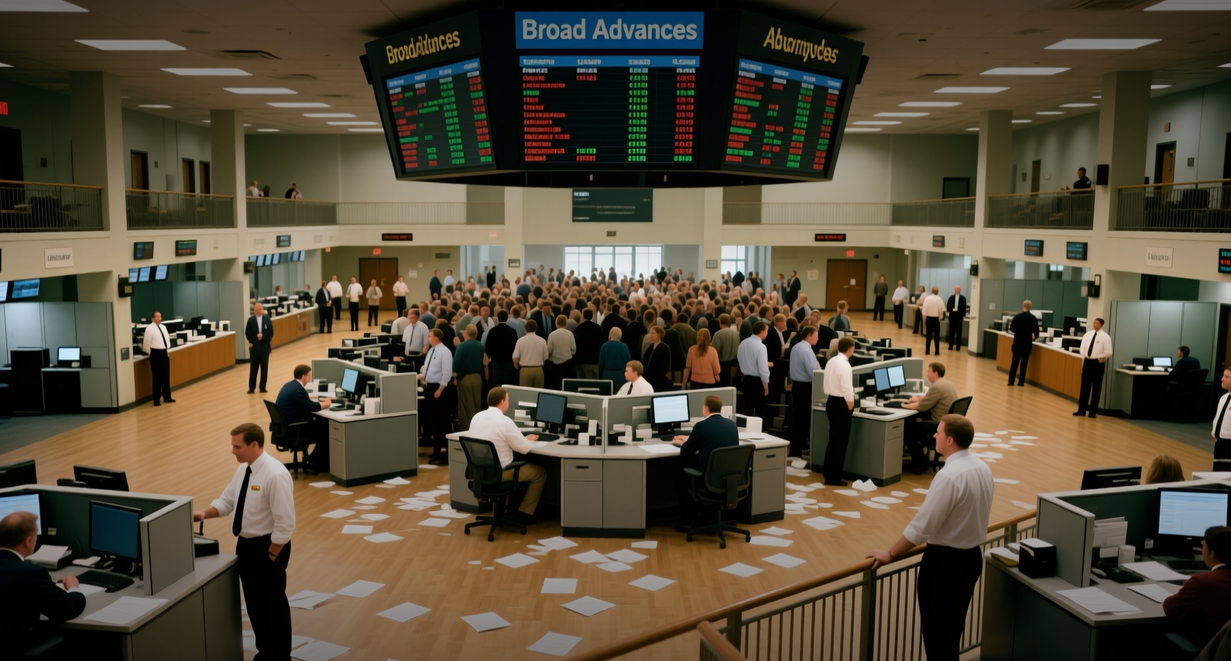
The S&P 500 jumped 1.5% to 7,764.70 on Monday, pulling within 0.4% of its record close, even as more index members touched new 52-week lows than new 52-week highs — the first such breadth inversion since 1999. "An index at an all-time high with negative net new highs is a leadership problem, not a valuation problem," said Priya Mehta, equity market structure analyst at Edgen. "The cap-weighted number is telling you what five or six companies did. The median stock is telling you what the economy did." The divergence is stark. The S&P 500 added 114.20 points, and the Nasdaq composite climbed 2.3% to 27,122.09, its own record, as chip and artificial-intelligence names led. Advanced Micro Devices rallied 9.9% and crossed $1 trillion in market value; Nvidia added 2.3%. The Dow Jones Industrial Average, an equal-weighted price index, rose just 0.7% to 52,048.83. The Russell 2000 gained 0.5% to 2,875.36 — roughly a third of the S&P's advance. That gap between the headline and the median is the whole story. When a handful of trillion-dollar companies carry the index, the index can print a record while the typical constituent is being sold. Monday's session was the first time since 1999 that new lows outnumbered new highs on a day the S&P rose more than 1%. ## The 1999 comparison is not a forecast, but it is a warning The last time this happened, the S&P 500 was in the final stretch of the dot-com run. The index peaked in March 2000 and then fell about 49% over the following 30 months. Breadth deterioration did not cause that decline — it described the market's internal condition before it happened. The mechanics are straightforward. Cap-weighted indices give the largest companies the largest influence, so a $1 move in a $4 trillion company moves the index far more than a $1 move in a $40 billion one. When gains concentrate, the index's advance overstates how the average stock is doing. Equal-weight and small-cap segments then lag, which is exactly what Monday's numbers showed: the Dow's 0.7% and the Russell 2000's 0.5% against the S&P's 1.5%. The cross-asset backdrop explains the rally itself. Brent crude fell 3.4% to $100.34 a barrel, down from nearly $110 last week, and the 10-year Treasury yield eased to 4.95% from 5.01% late Friday after crossing above 5% for the first time since 2023. Lower oil and lower yields relieve the two pressures that had been squeezing equity multiples. Indexes rose 0.9% in France, 1.2% in Hong Kong and 1.6% in South Korea on the same relief. Morgan Stanley's Michael Wilson said another leg higher in oil, gasoline and refined product prices is the main near-term risk that could keep the market from reaching his year-end target. The national average for regular gasoline has already climbed to nearly $4.48 a gallon, according to AAA, from less than $4.32 a week earlier and $3.18 a year ago. ## What the median stock is saying Breadth is a measure of participation, and participation is what makes an advance durable. A rally carried by a narrow group is more sensitive to any single leader's disappointment: if the AI trade stumbles, there is no broad base of advancing stocks to absorb the shock. That is the risk the 52-week lows are flagging. The counterargument is that narrow leadership has persisted for long stretches without immediate consequence. The S&P 500 is up 13.4% year to date, the Nasdaq 16.7%, and the Russell 2000 15.9% — small caps are not being abandoned outright, they are simply not keeping pace with the largest names. Bitcoin's move back above $86,000 lifted crypto-linked equities, with Coinbase Global up 3.5% and Robinhood Markets up 2.9%, another sign that risk appetite is intact rather than retreating. What matters next is whether the breadth reading persists. A single session of more new lows than highs can be noise; a cluster of them while the index sits at a record is a pattern. Traders will watch the 10-year yield's hold below 5%, Brent's path around $100, and whether the equal-weighted S&P 500 can close the gap with its cap-weighted sibling. The next test comes with the September employment report and the Federal Reserve's October meeting, both of which will reset the rate expectations that have been driving the largest stocks. For now, the index and its members are telling different stories. The index says record. The median stock says caution. This article is for informational purposes only and does not constitute investment advice.

Sep 21 2026, 21:55
Congress moves to slow US-China investment after deal surge
A bipartisan group of lawmakers is drafting legislation that would force U.S. investors to clear Chinese equity stakes with the Treasury Department before closing, extending Washington's screening reach from inbound deals to the roughly $1.2 trillion of American capital already committed to Chinese assets. "The bill is designed to close the gap between what we screen on the way in and what we let walk out the door," said a senior Senate aide involved in drafting the measure, who asked not to be named because the text is not yet public. The legislation would require U.S. persons to notify Treasury before acquiring equity in Chinese companies working in semiconductors, artificial intelligence, quantum computing, hypersonics and advanced aerospace, with a 45-day review window and civil penalties of up to $1 million or twice the transaction value for failures to file. Treasury's outbound screening program, in force since January 2025, already covers those five sectors, but the bill would convert its notification regime into a mandatory filing requirement with a statutory deadline. The House Financial Services Committee has scheduled a markup for the week of Oct. 6, and the Senate Banking Committee is drafting a companion text. The measure lands on a bilateral investment relationship that has been rebuilding since 2023. U.S. direct investment in China stood at $126.9 billion at the end of 2024, according to Bureau of Economic Analysis data, while U.S. holdings of Chinese portfolio assets — equities and debt — totaled about $1.1 trillion, the Treasury's latest international capital survey shows. Chinese direct investment in the U.S. was $28.4 billion over the same period. The flow has been one-directional and concentrated: venture and growth capital into Chinese AI and semiconductor startups accounted for the largest share of the increase, according to PitchBook data, with U.S. funds participating in a majority of the largest China-based rounds above $100 million. The transmission into public markets is already visible. The Nasdaq Golden Dragon China Index has fallen 6.8% since the start of September, underperforming the S&P 500 by roughly 9 percentage points, and the iShares MSCI China ETF has recorded three consecutive weeks of net outflows, according to fund flow data compiled by Bloomberg. Shares of U.S. asset managers with the largest China-dedicated vehicles have moved with the headlines rather than with earnings. The last time Congress advanced comparable outbound restrictions, in the summer of 2024, the Golden Dragon index fell 11% over the six weeks that followed before recovering half the decline once the final text narrowed the covered sectors. Beijing has signaled it will respond in kind. China's Ministry of Commerce said in a Sept. 18 statement that it "reserves the right to take necessary countermeasures" against measures it deems discriminatory, without specifying targets. The 2023 Chinese restrictions on gallium and germanium exports, imposed after U.S. chip controls, cut global supply of the two metals by 12% within two quarters and pushed gallium prices up 43%, according to Fastmarkets data — a template for how quickly a tit-for-tat response can move physical markets. The stakes are largest for the venture and private equity firms that built China-focused franchises over the past decade. A mandatory filing regime adds legal cost and delay to every deal, and a 45-day review window can kill a competitive auction outright. For limited partners, the risk is not a ban but a slow bleed: funds that cannot deploy committed capital face extension requests and discounted secondary sales, and China-dedicated vehicles are already trading at 15% to 25% discounts to net asset value on the secondary market, according to advisory firm data. The next hard date is the House Financial Services markup in the week of Oct. 6. If the bill clears committee with the five-sector scope intact, expect the compliance burden to fall first on funds with more than $1 billion in China exposure, with the filing requirement taking effect for transactions closing after Jan. 1, 2027. If the covered sectors narrow to semiconductors and AI alone, the near-term hit to deal flow is smaller but the precedent — that Washington will legislate the outbound side of the relationship — stands regardless. This article is for informational purposes only and does not constitute investment advice.