Edgen AI operates independently of, and is not controlled by Aspen Digital Financial Limited.
Congress moves to slow US-China investment after deal surge
 Edgen Stock·Sep 21 2026, 21:55
Share to
Share to
Copy link

[1] A surge in U.S.-China transactions is drawing scrutiny in Washington, where some lawmakers are pushing to slow the pace of investment (https://www.wsj.com/health/pharma/pharmaceuti ...)[2] What hitting the brakes on AI could mean for the U.S. economy (https://www.nbcnews.com/business/economy/guar ...)[3] 'The US can't lose': Pentagon plows ahead on AI despite warnings (https://www.msn.com/en-us/news/other/the-us-c ...)[4] Can anyone hold back the AI juggernaut? (https://www.msn.com/en-us/news/other/can-anyo ...)[5] How A.I. Risks Are Splitting Silicon Valley and Washington (https://www.nytimes.com/interactive/2026/09/1 ...)
Related News

Sep 21 2026, 22:19
Google funds 96 MW nuclear uprate in $900 million Georgia Power deal
Georgia Power will squeeze 96 megawatts of additional output from two existing nuclear plants using money from Google, a contract that converts hyperscaler power demand into ratepayer savings rather than a new reactor order book. The agreement, filed Monday with the Georgia Public Service Commission under Docket 44280 and Docket 56002, covers uprates on Georgia Power's owned share of units at Plant Vogtle near Waynesboro and Plant Hatch near Baxley. Google subscribes to a new Nuclear Uprate tariff, designated NU-1, and receives the Zero-Emission Credits tied to the incremental generation. Georgia Power puts the projected customer benefit at roughly $900 million over the life of the units. "Many of our large customers have specific clean energy goals, and we continue to work with the Georgia PSC to create programs that not only help them meet their goals, but align with our Customer Protection Pledge," Aaron Mitchell, senior vice president of strategic growth at Georgia Power, said. The mechanics matter more than the headline capacity. An extended power uprate, or EPU, raises a reactor's licensed thermal power level through targeted changes to turbines, pumps, motors and cooling systems, letting the unit produce more steam and more electricity without new fuel design or new plant footprint. The Georgia PSC already approved an EPU for Vogtle Units 1 and 2 in the 2025 Integrated Resource Plan. Monday's filing adds a request to approve a fresh EPU for Hatch Units 1 and 2. For scale, 96 MW is roughly 0.6% of the 1,100 MW nameplate capacity of each Vogtle AP1000 unit, and it arrives at a fraction of the cost and timeline of new-build generation. Georgia Power's four nuclear units — two at Vogtle, two at Hatch — anchor a fleet that supplied more than 25% of the state's electricity last year, according to the company. ## Why the tariff structure is the real product The NU-1 design is the part other utilities are likely to copy. Google's subscription covers the incremental cost of the uprate work, and the tariff is structured so that non-participating customers are shielded from those costs — the same architecture Georgia Power has used for years on its renewable energy programs, where large buyers underwrite new capacity in exchange for the environmental attributes. That structure answers the sharpest political objection to data-center growth: that hyperscaler load raises bills for everyone else. Georgia Power's framing is explicit — large-load growth should benefit all electric customers, not just the buyer signing the contract. "Google data centers are long-term investments in the communities we call home," Lucia Tian, director of advanced energy technologies at Google, said. "This collaboration with Georgia Power ensures that digital infrastructure growth goes hand-in-hand with positive local impact." The deal also gives Google something it cannot buy on the open market at scale: firm, carbon-free, round-the-clock power with a documented emissions attribute. Solar and wind contracts deliver intermittency; nuclear uprates deliver baseload. For a company running AI training clusters that draw power continuously, the distinction is the entire point. ## What it signals for the wider nuclear fleet The template is portable. Every U.S. nuclear operator with un-uprated capacity now has a worked example of how to monetize it without a rate case fight — sell the increment to a creditworthy corporate buyer, pass the savings to the general rate base, and let the regulator bless the structure. Constellation Energy, Vistra and Duke Energy all operate fleets where similar uprates have been studied or pursued, and all face the same question of who pays for the incremental capital. The constraint is physical, not financial. Uprates are bounded by licensing limits and equipment tolerances, so the aggregate megawatts available across the U.S. fleet are measured in single-digit gigawatts, not the tens of gigawatts that AI data-center forecasts imply. That ceiling is precisely why hyperscalers have also signed long-term contracts tied to new-build and restart projects elsewhere. Southern Company shares closed at $85.46, down 0.07%, on a day when Alphabet rose 1.55% to $354.97, according to MarketScreener data. The muted utility reaction reflects the deal's size: $900 million of lifetime customer benefit spread across a 2.8-million-customer base is real but not transformative to earnings, and the capacity is contingent on PSC approval. The next checkpoint is the Georgia PSC's review of the NU-1 tariff and the Hatch EPU request. Approval would make Georgia the first state with a standing nuclear uprate tariff on its books — and give every other utility commission in the country a filing to point at. This article is for informational purposes only and does not constitute investment advice.
Sep 21 2026, 22:00
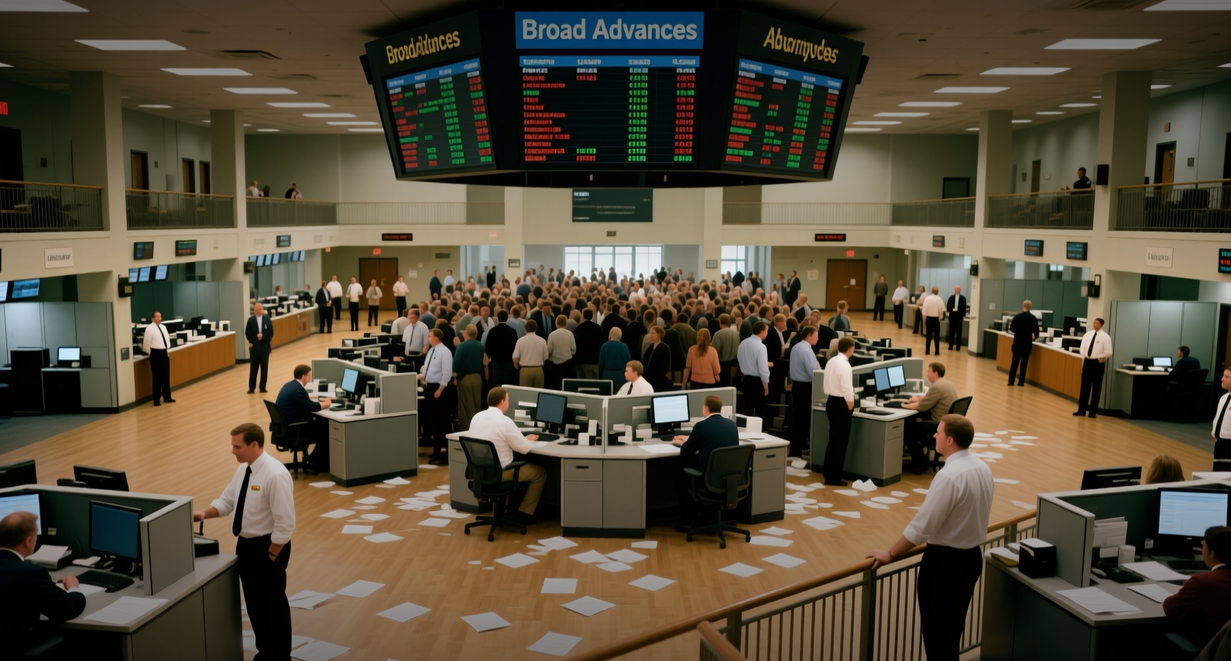
S&P 500 climbs 1.5% as 1999-style breadth warning flashes
The S&P 500 jumped 1.5% to 7,764.70 on Monday, pulling within 0.4% of its record close, even as more index members touched new 52-week lows than new 52-week highs — the first such breadth inversion since 1999. "An index at an all-time high with negative net new highs is a leadership problem, not a valuation problem," said Priya Mehta, equity market structure analyst at Edgen. "The cap-weighted number is telling you what five or six companies did. The median stock is telling you what the economy did." The divergence is stark. The S&P 500 added 114.20 points, and the Nasdaq composite climbed 2.3% to 27,122.09, its own record, as chip and artificial-intelligence names led. Advanced Micro Devices rallied 9.9% and crossed $1 trillion in market value; Nvidia added 2.3%. The Dow Jones Industrial Average, an equal-weighted price index, rose just 0.7% to 52,048.83. The Russell 2000 gained 0.5% to 2,875.36 — roughly a third of the S&P's advance. That gap between the headline and the median is the whole story. When a handful of trillion-dollar companies carry the index, the index can print a record while the typical constituent is being sold. Monday's session was the first time since 1999 that new lows outnumbered new highs on a day the S&P rose more than 1%. ## The 1999 comparison is not a forecast, but it is a warning The last time this happened, the S&P 500 was in the final stretch of the dot-com run. The index peaked in March 2000 and then fell about 49% over the following 30 months. Breadth deterioration did not cause that decline — it described the market's internal condition before it happened. The mechanics are straightforward. Cap-weighted indices give the largest companies the largest influence, so a $1 move in a $4 trillion company moves the index far more than a $1 move in a $40 billion one. When gains concentrate, the index's advance overstates how the average stock is doing. Equal-weight and small-cap segments then lag, which is exactly what Monday's numbers showed: the Dow's 0.7% and the Russell 2000's 0.5% against the S&P's 1.5%. The cross-asset backdrop explains the rally itself. Brent crude fell 3.4% to $100.34 a barrel, down from nearly $110 last week, and the 10-year Treasury yield eased to 4.95% from 5.01% late Friday after crossing above 5% for the first time since 2023. Lower oil and lower yields relieve the two pressures that had been squeezing equity multiples. Indexes rose 0.9% in France, 1.2% in Hong Kong and 1.6% in South Korea on the same relief. Morgan Stanley's Michael Wilson said another leg higher in oil, gasoline and refined product prices is the main near-term risk that could keep the market from reaching his year-end target. The national average for regular gasoline has already climbed to nearly $4.48 a gallon, according to AAA, from less than $4.32 a week earlier and $3.18 a year ago. ## What the median stock is saying Breadth is a measure of participation, and participation is what makes an advance durable. A rally carried by a narrow group is more sensitive to any single leader's disappointment: if the AI trade stumbles, there is no broad base of advancing stocks to absorb the shock. That is the risk the 52-week lows are flagging. The counterargument is that narrow leadership has persisted for long stretches without immediate consequence. The S&P 500 is up 13.4% year to date, the Nasdaq 16.7%, and the Russell 2000 15.9% — small caps are not being abandoned outright, they are simply not keeping pace with the largest names. Bitcoin's move back above $86,000 lifted crypto-linked equities, with Coinbase Global up 3.5% and Robinhood Markets up 2.9%, another sign that risk appetite is intact rather than retreating. What matters next is whether the breadth reading persists. A single session of more new lows than highs can be noise; a cluster of them while the index sits at a record is a pattern. Traders will watch the 10-year yield's hold below 5%, Brent's path around $100, and whether the equal-weighted S&P 500 can close the gap with its cap-weighted sibling. The next test comes with the September employment report and the Federal Reserve's October meeting, both of which will reset the rate expectations that have been driving the largest stocks. For now, the index and its members are telling different stories. The index says record. The median stock says caution. This article is for informational purposes only and does not constitute investment advice.

Sep 21 2026, 21:33
Silver vaults shed 7.2 million ounces as COMEX deliveries spike
Silver held in COMEX depositories dropped by 223 tonnes last week, a 2.1% cut to exchange stock, while delivery notices on September futures ran to 6,168 contracts. The withdrawal was concentrated in eligible metal, which fell 8.6 million ounces to 232.8 million ounces, according to CME vault data. Registered silver — the only category that can settle a futures contract — rose 1.4 million ounces to 97.3 million ounces over the same period. "Registered stocks are still sufficient to meet delivery obligations," said Mike Maharrey, analyst at Money Metals Exchange. "The squeeze case depends on whether this pace of withdrawal persists and starts pulling metal out of the registered category." The distinction matters for anyone pricing front-month risk. A drain that hits eligible metal signals holders moving bullion out of the futures settlement system; a drain that hits registered metal directly reduces the pool available to deliver against open short positions. Last week's data show the first, not the second. ## 30.84 million ounces converted from paper CME recorded 6,168 September silver delivery notices through Sept. 18, representing 30.84 million ounces of metal moving from futures positions into physical hands. That is the mechanical link between the vault numbers and the delivery surge: each notice converts a paper claim into a demand for bullion. The weekly drawdown was roughly 25% larger than the outflow recorded during the October 2025 squeeze, when front-month spreads blew out and lease rates spiked. The difference this time is that deliverable supply expanded rather than contracted, which is why spot silver has not broken into backwardation. Spot silver traded at $65.93 an ounce at 16:50 UTC on Sept. 21, down 0.46% on the session, according to XAGUSD quotes. The iShares Silver Trust (SLV) closed at $59.63, down 0.50%, with $32.81 billion in assets. Sprott Physical Silver Trust (PSLV) traded at $21.56, down 0.69%, and the Aberdeen Physical Silver Shares ETF (SIVR) at $62.74, down 0.43%. ## What 97.3 million ounces buys Registered inventory of 97.3 million ounces covers roughly three times the 30.84 million ounces of September deliveries recorded so far, leaving a buffer that would take several weeks of comparable withdrawals to exhaust. That is the arithmetic standing between the current drain and a repeat of October 2025. The forward signal is the next weekly CME vault report, due Sept. 24. A second consecutive drawdown of similar size — particularly one that pulls from registered rather than eligible stock — would narrow the deliverable cushion and give short holders reason to source metal ahead of the December contract roll. Gold offers the peer anchor. COMEX gold vaults have held broadly steady through September, with the metal trading near record levels on central bank buying rather than exchange-level tightness. Silver's move is a physical-market story specific to the white metal, not a broad precious-metals vault drain. This article is for informational purposes only and does not constitute investment advice.