Edgen AI operates independently of, and is not controlled by Aspen Digital Financial Limited.
Gauzy faces Nasdaq delisting after failing $1 bid price test
 Edgen Stock·Sep 21 2026, 21:03
Share to
Share to
Copy link


[1] Gauzy Announces Receipt of Delisting Notice from Nasdaq; Intends to Appeal (https://www.globenewswire.com/news-release/20 ...)
Related News
Sep 21 2026, 21:33
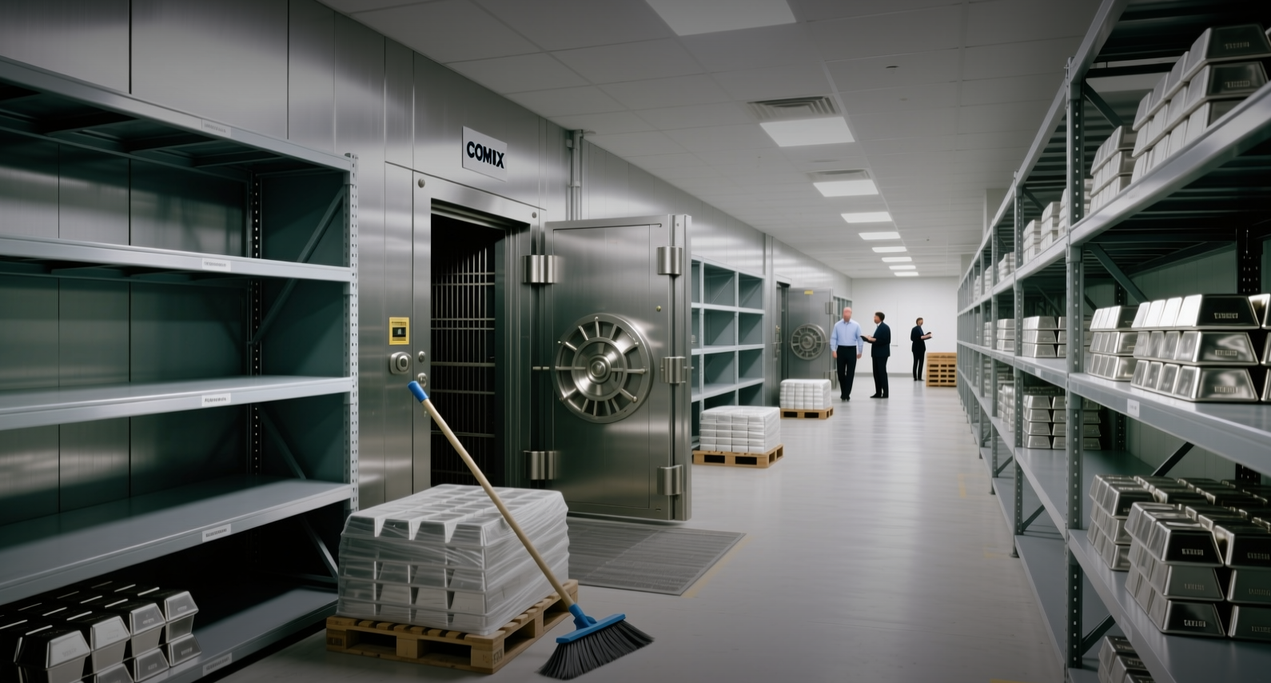
Silver vaults shed 7.2 million ounces as COMEX deliveries spike
Silver held in COMEX depositories dropped by 223 tonnes last week, a 2.1% cut to exchange stock, while delivery notices on September futures ran to 6,168 contracts. The withdrawal was concentrated in eligible metal, which fell 8.6 million ounces to 232.8 million ounces, according to CME vault data. Registered silver — the only category that can settle a futures contract — rose 1.4 million ounces to 97.3 million ounces over the same period. "Registered stocks are still sufficient to meet delivery obligations," said Mike Maharrey, analyst at Money Metals Exchange. "The squeeze case depends on whether this pace of withdrawal persists and starts pulling metal out of the registered category." The distinction matters for anyone pricing front-month risk. A drain that hits eligible metal signals holders moving bullion out of the futures settlement system; a drain that hits registered metal directly reduces the pool available to deliver against open short positions. Last week's data show the first, not the second. ## 30.84 million ounces converted from paper CME recorded 6,168 September silver delivery notices through Sept. 18, representing 30.84 million ounces of metal moving from futures positions into physical hands. That is the mechanical link between the vault numbers and the delivery surge: each notice converts a paper claim into a demand for bullion. The weekly drawdown was roughly 25% larger than the outflow recorded during the October 2025 squeeze, when front-month spreads blew out and lease rates spiked. The difference this time is that deliverable supply expanded rather than contracted, which is why spot silver has not broken into backwardation. Spot silver traded at $65.93 an ounce at 16:50 UTC on Sept. 21, down 0.46% on the session, according to XAGUSD quotes. The iShares Silver Trust (SLV) closed at $59.63, down 0.50%, with $32.81 billion in assets. Sprott Physical Silver Trust (PSLV) traded at $21.56, down 0.69%, and the Aberdeen Physical Silver Shares ETF (SIVR) at $62.74, down 0.43%. ## What 97.3 million ounces buys Registered inventory of 97.3 million ounces covers roughly three times the 30.84 million ounces of September deliveries recorded so far, leaving a buffer that would take several weeks of comparable withdrawals to exhaust. That is the arithmetic standing between the current drain and a repeat of October 2025. The forward signal is the next weekly CME vault report, due Sept. 24. A second consecutive drawdown of similar size — particularly one that pulls from registered rather than eligible stock — would narrow the deliverable cushion and give short holders reason to source metal ahead of the December contract roll. Gold offers the peer anchor. COMEX gold vaults have held broadly steady through September, with the metal trading near record levels on central bank buying rather than exchange-level tightness. Silver's move is a physical-market story specific to the white metal, not a broad precious-metals vault drain. This article is for informational purposes only and does not constitute investment advice.
Sep 21 2026, 21:28
Apple opens $250M Siri settlement claims worth up to $95
Apple began accepting claims on Sept. 21 in the $250 million settlement of *Landsheft v. Apple Inc.*, a class action alleging the company marketed Siri Apple Intelligence features that buyers of its newest iPhones did not receive. Eligible U.S. purchasers can file for a presumptive $25 per device, a figure that can rise as high as $95 or fall below $25 depending on how many valid claims arrive before the Dec. 21, 2026 deadline. "These settlements are designed to close the book on a marketing dispute, not to compensate anyone for the full value of a missing feature," said Ryan J. Clarkson, interim co-lead counsel for the class, in the case's court filings. Apple has denied all allegations and said the agreement is not an admission of wrongdoing. The class covers original purchasers of an iPhone 15 Pro, iPhone 15 Pro Max, or any iPhone 16 model — the 16, 16e, 16 Plus, 16 Pro, and 16 Pro Max — bought in the United States between June 10, 2024, and March 29, 2025, for personal or business use rather than resale. Each qualifying device supports its own claim, so a household with two covered phones can file twice. Claimants submit a device serial number, or an Apple Account email paired with the phone number, through the administrator's portal run by Verita Global LLC, and can elect payment by check, PayPal, Venmo, or ACH. The $250 million goes into a non-reversionary qualified settlement fund, meaning no money returns to Apple. Notice and administration costs are capped at $5,444,056, class counsel will seek service awards of up to $2,000 per named plaintiff, and the parties reached no agreement on attorneys' fees, which will be deducted before distribution. Judge Noel Wise of the U.S. District Court for the Northern District of California granted preliminary approval on July 17, 2026, finding the settlement fair and the product of arms-length negotiation, and barred any payment above the $95 cap without a report to the court. Payments are to be transmitted within 60 calendar days of the settlement's effective date, and checks void after 120 days. ## From a March 2025 lawsuit to a $95 ceiling Peter Landsheft filed the original complaint on March 19, 2025, and seven related cases were consolidated under his name two months later. The consolidated amended complaint asserted claims under California's Unfair Competition Law, False Advertising Law, Consumers Legal Remedies Act, and Song-Beverly Consumer Warranty Act, plus consumer protection statutes in other states and common-law theories including fraud, negligent misrepresentation, breach of contract, and unjust enrichment. Apple moved to dismiss on Sept. 25, 2025. The parties mediated before retired Judge Layn R. Phillips across three sessions — Oct. 24, 2025, Dec. 8, 2025, and March 23, 2026 — and executed the settlement agreement as of May 5, 2026, the same day plaintiffs moved for preliminary approval. A May 19, 2026 opposition from five named plaintiffs represented by Pomerantz LLP sought subclass divisions; Judge Wise rejected it, finding the underlying value of the Enhanced Siri features identical across all eligible devices. The math on the payout is straightforward and unfavorable to anyone assuming the top end. The $95 figure is a cap, not a forecast. Judge Wise noted at the July 8, 2026 hearing that exceeding it was a low probability given the anticipated reach of the notice program, which spans email waves, postcards, an online campaign across Google and Meta, publication notice, and a toll-free line in English and Spanish. The $25 presumptive payment is the more useful planning number. A claimant who files and then waits will not see funds before 2027: the final approval hearing is set for Feb. 24, 2027, in San Jose, reset from an original Sept. 29, 2027 date by an Aug. 13, 2026 order. ## What the settlement does not resolve The underlying dispute was never about a missing feature in the abstract. Apple introduced Apple Intelligence at its Worldwide Developers Conference in June 2024 and promoted a more personalized Siri able to understand a user's personal context, read information on screen, and act across apps. The company acknowledged in March 2025 that some of those capabilities would take longer to deliver. Plaintiffs alleged the advertising led buyers to pay a premium for phones on the strength of features that had not shipped. That gap has since narrowed. Apple unveiled a rebuilt assistant, Siri AI, at its Worldwide Developers Conference in June 2026, built on Google's Gemini models. It arrived with iOS 27, released the week before the claims window opened, and runs in beta on iPhone 15 Pro models and newer, according to MacRumors. The settlement agreement's recitals state that Apple has delivered more than 20 Apple Intelligence features and anticipates delivering additional Siri Apple Intelligence features in future software updates at no additional cost. For Apple, the financial weight is negligible against a balance sheet of its size, and the stock showed no discernible reaction to the claims opening. The durable cost sits in the precedent: a court-supervised record establishing that promotional claims about AI assistants can be priced into hardware purchases and litigated when delivery slips. That record now exists as Apple positions Siri AI as the centerpiece of its AI strategy and competes with Google, whose Gemini models power the rebuilt assistant, and with OpenAI and Samsung on device-level AI features. Class members who do not file a claim remain bound by the settlement and its releases unless they opt out by Dec. 21, 2026, the same deadline for claims and objections. Only class members who file a timely written objection may appear at the February hearing. This article is for informational purposes only and does not constitute investment advice.
Sep 21 2026, 21:06
British Columbia sues OpenAI over ChatGPT link to school shooting
A provincial government in Canada is testing whether an AI developer can be held liable for how its model is used after it ships. British Columbia's lawsuit against OpenAI, filed Sept. 21, claims ChatGPT played a role in a mass school shooting and that the company stayed silent when its systems flagged the danger — a claim no court has yet resolved for a large language model. "This case tests whether a model provider owes a duty of care to the public when its system is used to plan violence," said Emily Cartwright, a product-liability litigator at Bennett Jones in Vancouver, who is not involved in the matter. "No court has answered that question for a large language model." The suit, filed in British Columbia Supreme Court, names two distinct failures. The first is a product-safety claim: that ChatGPT's safeguards did not prevent the model from assisting in the planning of an attack. The second is a disclosure claim: that OpenAI detected the usage and did not notify police, which the province frames as a monitoring and reporting gap rather than a design defect. The province did not disclose a specific damages figure, and OpenAI has not yet filed a response. Neither the number of plaintiffs nor the shooting's casualty count was confirmed in the filing summary. The notification prong is the harder of the two for OpenAI to defend, because it turns on what the company knew and when — a question that lives in internal logs rather than in model architecture. OpenAI's usage policies state that it may report credible threats of violence to authorities, and its safety systems flag categories including self-harm and violent intent. Whether a flagged conversation triggers a human review, and how quickly, is not publicly documented. That opacity is precisely what the province is targeting. The financial stakes extend well beyond one jurisdiction. OpenAI was last valued at $500 billion in a secondary share sale, and its largest backer, Microsoft, has committed more than $13 billion to the partnership and books a share of OpenAI's losses. Microsoft shares have traded near $500 after a year in which its Azure AI business became the company's primary growth engine. Any ruling that establishes a duty to monitor and report model outputs would apply to every consumer-facing AI product, including Google's Gemini, Anthropic's Claude, Meta's Llama, and xAI's Grok — all of which operate under similar usage policies with similar disclosure gaps. The precedent question is what makes the case structurally different from earlier AI litigation. Copyright suits filed by authors and news publishers, including the New York Times against OpenAI and Microsoft, test how models are trained. This suit tests what a model does after deployment and what its maker owes the public when it does harm. A finding for British Columbia would create a post-deployment duty of care; a dismissal would leave the sector without a liability standard, which is arguably worse for planning purposes because it keeps the risk unquantifiable. For investors, the near-term earnings impact is negligible and the near-term risk premium is not. Insurance carriers that underwrite technology errors-and-omissions policies have begun asking about model-monitoring practices in renewal questionnaires, according to two brokers who declined to be named discussing client matters. If carriers start excluding AI-related harm from standard policies, the cost of operating a consumer AI product rises for every company in the sector, not just OpenAI. That is the channel through which a single provincial lawsuit becomes a sector-wide expense line. The next milestone is OpenAI's response to the complaint, which under British Columbia civil procedure is typically due within 21 to 30 days of service. Other provinces and at least one U.S. state attorney general's office are watching the filing, according to a person familiar with the matter, though no additional suits have been filed. The case is British Columbia v. OpenAI, filed in the Supreme Court of British Columbia. This article is for informational purposes only and does not constitute investment advice.