Edgen AI operates independently of, and is not controlled by Aspen Digital Financial Limited.
British Columbia sues OpenAI over ChatGPT link to school shooting
 Edgen Stock·Sep 21 2026, 21:06
Share to
Share to
Copy link
[1] British Columbia Sues OpenAI, Alleging ChatGPT Aided Mass School Shooting (https://www.wsj.com/tech/ai/british-columbia- ...)
Related News
Sep 21 2026, 21:33
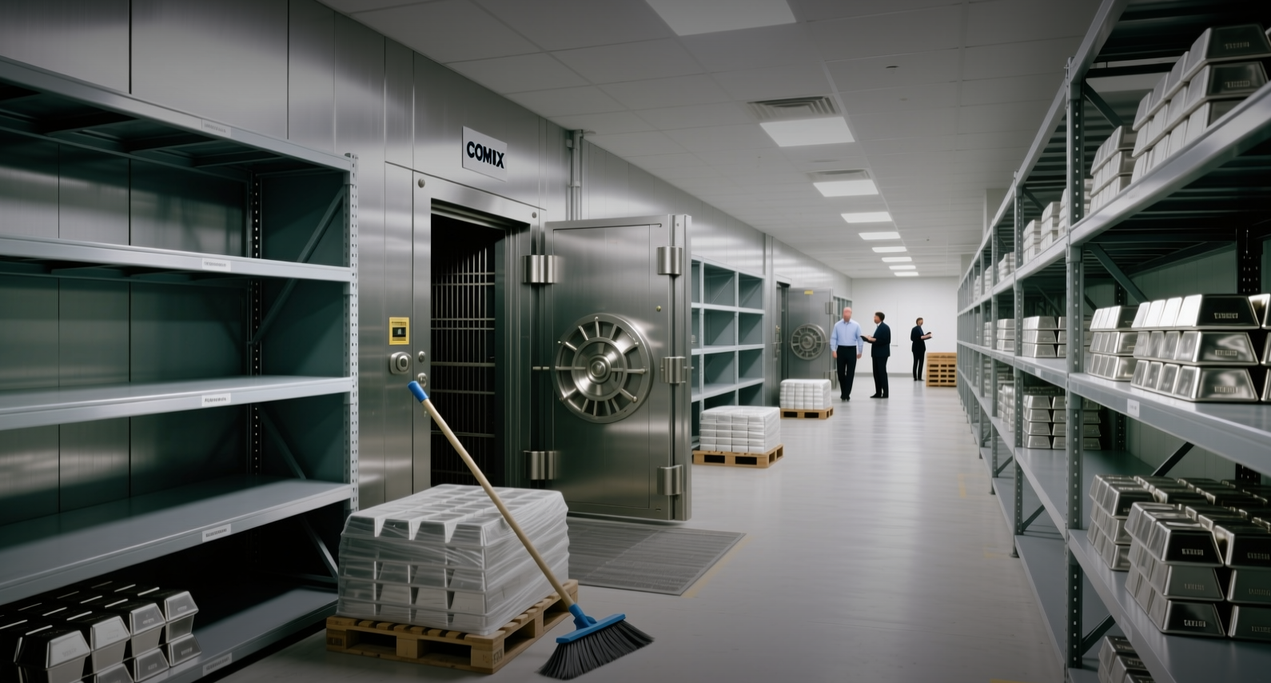
Silver vaults shed 7.2 million ounces as COMEX deliveries spike
Silver held in COMEX depositories dropped by 223 tonnes last week, a 2.1% cut to exchange stock, while delivery notices on September futures ran to 6,168 contracts. The withdrawal was concentrated in eligible metal, which fell 8.6 million ounces to 232.8 million ounces, according to CME vault data. Registered silver — the only category that can settle a futures contract — rose 1.4 million ounces to 97.3 million ounces over the same period. "Registered stocks are still sufficient to meet delivery obligations," said Mike Maharrey, analyst at Money Metals Exchange. "The squeeze case depends on whether this pace of withdrawal persists and starts pulling metal out of the registered category." The distinction matters for anyone pricing front-month risk. A drain that hits eligible metal signals holders moving bullion out of the futures settlement system; a drain that hits registered metal directly reduces the pool available to deliver against open short positions. Last week's data show the first, not the second. ## 30.84 million ounces converted from paper CME recorded 6,168 September silver delivery notices through Sept. 18, representing 30.84 million ounces of metal moving from futures positions into physical hands. That is the mechanical link between the vault numbers and the delivery surge: each notice converts a paper claim into a demand for bullion. The weekly drawdown was roughly 25% larger than the outflow recorded during the October 2025 squeeze, when front-month spreads blew out and lease rates spiked. The difference this time is that deliverable supply expanded rather than contracted, which is why spot silver has not broken into backwardation. Spot silver traded at $65.93 an ounce at 16:50 UTC on Sept. 21, down 0.46% on the session, according to XAGUSD quotes. The iShares Silver Trust (SLV) closed at $59.63, down 0.50%, with $32.81 billion in assets. Sprott Physical Silver Trust (PSLV) traded at $21.56, down 0.69%, and the Aberdeen Physical Silver Shares ETF (SIVR) at $62.74, down 0.43%. ## What 97.3 million ounces buys Registered inventory of 97.3 million ounces covers roughly three times the 30.84 million ounces of September deliveries recorded so far, leaving a buffer that would take several weeks of comparable withdrawals to exhaust. That is the arithmetic standing between the current drain and a repeat of October 2025. The forward signal is the next weekly CME vault report, due Sept. 24. A second consecutive drawdown of similar size — particularly one that pulls from registered rather than eligible stock — would narrow the deliverable cushion and give short holders reason to source metal ahead of the December contract roll. Gold offers the peer anchor. COMEX gold vaults have held broadly steady through September, with the metal trading near record levels on central bank buying rather than exchange-level tightness. Silver's move is a physical-market story specific to the white metal, not a broad precious-metals vault drain. This article is for informational purposes only and does not constitute investment advice.
Sep 21 2026, 21:28
Apple opens $250M Siri settlement claims worth up to $95
Apple began accepting claims on Sept. 21 in the $250 million settlement of *Landsheft v. Apple Inc.*, a class action alleging the company marketed Siri Apple Intelligence features that buyers of its newest iPhones did not receive. Eligible U.S. purchasers can file for a presumptive $25 per device, a figure that can rise as high as $95 or fall below $25 depending on how many valid claims arrive before the Dec. 21, 2026 deadline. "These settlements are designed to close the book on a marketing dispute, not to compensate anyone for the full value of a missing feature," said Ryan J. Clarkson, interim co-lead counsel for the class, in the case's court filings. Apple has denied all allegations and said the agreement is not an admission of wrongdoing. The class covers original purchasers of an iPhone 15 Pro, iPhone 15 Pro Max, or any iPhone 16 model — the 16, 16e, 16 Plus, 16 Pro, and 16 Pro Max — bought in the United States between June 10, 2024, and March 29, 2025, for personal or business use rather than resale. Each qualifying device supports its own claim, so a household with two covered phones can file twice. Claimants submit a device serial number, or an Apple Account email paired with the phone number, through the administrator's portal run by Verita Global LLC, and can elect payment by check, PayPal, Venmo, or ACH. The $250 million goes into a non-reversionary qualified settlement fund, meaning no money returns to Apple. Notice and administration costs are capped at $5,444,056, class counsel will seek service awards of up to $2,000 per named plaintiff, and the parties reached no agreement on attorneys' fees, which will be deducted before distribution. Judge Noel Wise of the U.S. District Court for the Northern District of California granted preliminary approval on July 17, 2026, finding the settlement fair and the product of arms-length negotiation, and barred any payment above the $95 cap without a report to the court. Payments are to be transmitted within 60 calendar days of the settlement's effective date, and checks void after 120 days. ## From a March 2025 lawsuit to a $95 ceiling Peter Landsheft filed the original complaint on March 19, 2025, and seven related cases were consolidated under his name two months later. The consolidated amended complaint asserted claims under California's Unfair Competition Law, False Advertising Law, Consumers Legal Remedies Act, and Song-Beverly Consumer Warranty Act, plus consumer protection statutes in other states and common-law theories including fraud, negligent misrepresentation, breach of contract, and unjust enrichment. Apple moved to dismiss on Sept. 25, 2025. The parties mediated before retired Judge Layn R. Phillips across three sessions — Oct. 24, 2025, Dec. 8, 2025, and March 23, 2026 — and executed the settlement agreement as of May 5, 2026, the same day plaintiffs moved for preliminary approval. A May 19, 2026 opposition from five named plaintiffs represented by Pomerantz LLP sought subclass divisions; Judge Wise rejected it, finding the underlying value of the Enhanced Siri features identical across all eligible devices. The math on the payout is straightforward and unfavorable to anyone assuming the top end. The $95 figure is a cap, not a forecast. Judge Wise noted at the July 8, 2026 hearing that exceeding it was a low probability given the anticipated reach of the notice program, which spans email waves, postcards, an online campaign across Google and Meta, publication notice, and a toll-free line in English and Spanish. The $25 presumptive payment is the more useful planning number. A claimant who files and then waits will not see funds before 2027: the final approval hearing is set for Feb. 24, 2027, in San Jose, reset from an original Sept. 29, 2027 date by an Aug. 13, 2026 order. ## What the settlement does not resolve The underlying dispute was never about a missing feature in the abstract. Apple introduced Apple Intelligence at its Worldwide Developers Conference in June 2024 and promoted a more personalized Siri able to understand a user's personal context, read information on screen, and act across apps. The company acknowledged in March 2025 that some of those capabilities would take longer to deliver. Plaintiffs alleged the advertising led buyers to pay a premium for phones on the strength of features that had not shipped. That gap has since narrowed. Apple unveiled a rebuilt assistant, Siri AI, at its Worldwide Developers Conference in June 2026, built on Google's Gemini models. It arrived with iOS 27, released the week before the claims window opened, and runs in beta on iPhone 15 Pro models and newer, according to MacRumors. The settlement agreement's recitals state that Apple has delivered more than 20 Apple Intelligence features and anticipates delivering additional Siri Apple Intelligence features in future software updates at no additional cost. For Apple, the financial weight is negligible against a balance sheet of its size, and the stock showed no discernible reaction to the claims opening. The durable cost sits in the precedent: a court-supervised record establishing that promotional claims about AI assistants can be priced into hardware purchases and litigated when delivery slips. That record now exists as Apple positions Siri AI as the centerpiece of its AI strategy and competes with Google, whose Gemini models power the rebuilt assistant, and with OpenAI and Samsung on device-level AI features. Class members who do not file a claim remain bound by the settlement and its releases unless they opt out by Dec. 21, 2026, the same deadline for claims and objections. Only class members who file a timely written objection may appear at the February hearing. This article is for informational purposes only and does not constitute investment advice.

Sep 21 2026, 21:03
Gauzy faces Nasdaq delisting after failing $1 bid price test
Gauzy Ltd. is contesting an exchange ruling that would end its U.S. listing, after the Israeli light-control maker spent 180 days without lifting its share price back above the $1 floor Nasdaq requires. Gauzy will ask a Hearings Panel to review the staff determination, a step it must take by Sept. 22, 2026 under Listing Rule 5815. Filing the request suspends any suspension or delisting action, leaving the securities fully tradeable while the review proceeds. Nasdaq's determination rests on two separate failures. The first is Listing Rule 5450(a)(1): Gauzy disclosed on March 17, 2026 that its bid price had closed below $1 for 30 consecutive business days, giving it until Sept. 14, 2026 — 180 calendar days under Rule 5810(c)(3)(A) — to regain compliance. It did not. The second is Listing Rule 5250(c)(1): on May 19, 2026, Nasdaq staff notified Gauzy that it had not filed its Form 20-F for the year ended Dec. 31, 2025. Because the bid-price deficiency went uncured, Nasdaq told the company it is no longer eligible to have a compliance plan reviewed for the delinquent filing under Rule 5810(c)(2)(A), making the missing annual report an additional basis for delisting. "The Company believes that its currently improved financial position will support the continued listing of its securities," Gauzy said in the statement, adding that "there can be no assurance that upon the Appeal hearing, the Panel will determine to allow the continued listing of the Company's securities on the Nasdaq Global Market." The appeal buys time but not certainty. A Nasdaq Hearings Panel can grant continued listing, impose a cure period with conditions, or affirm the delisting. Gauzy's own disclosure flags the outcome as unresolved, and the company did not disclose a hearing date or the size of any equity infusion tied to the "improved financial position" it cites. The stakes for holders are mechanical. A delisting would move Gauzy's shares to the over-the-counter market, where spreads widen, institutional mandates that restrict unlisted holdings force sales, and index providers remove the stock from their benchmarks. Gauzy is not currently a member of the major U.S. large-cap indices, so the removal risk is concentrated in small-cap and micro-cap benchmarks that screen on exchange listing. Peer small-cap vision and display suppliers that have migrated to OTC — including several Israeli-domiciled technology issuers that lost Nasdaq compliance on bid price in 2024 and 2025 — have typically traded at wider spreads and lower revenue multiples than exchange-listed comparables. The delisting notice lands alongside separate stress in Gauzy's operations. The company's forward-looking disclosure references a proposed debt settlement in Israel and court-supervised reorganization proceedings in France, known as redressement judiciaire, including a call for public tenders. Those processes, not the Nasdaq notice, are the larger claim on the company's balance sheet, and the timing of any resolution is not yet disclosed. Gauzy describes itself as a fully integrated light and vision control company serving aeronautics, automotive and architecture customers in more than 60 countries, with subsidiaries in Germany, France, the United States, Canada, China, Singapore and the United Arab Emirates. Its shares trade under the ticker GAUZ. For holders, the near-term signal is binary. A successful appeal preserves Nasdaq trading and keeps the stock eligible for institutional mandates and index inclusion; a failed appeal pushes GAUZ to OTC, where liquidity and valuation multiples compress. The next hard date is the Sept. 22, 2026 appeal filing deadline, after which the Panel's scheduling order will set the hearing timeline. Investors should also watch for the overdue Form 20-F for fiscal 2025, whose filing would remove one of the two delisting bases. This article is for informational purposes only and does not constitute investment advice.