Edgen AI operates independently of, and is not controlled by Aspen Digital Financial Limited.
Rosen probes Anavex over disclosures tied to CEO's for-cause exit
 Edgen Stock·Sep 23 2026, 19:27
Share to
Share to
Copy link


[1] ROSEN, SKILLED INVESTOR COUNSEL, Encourages Anavex Life Sciences Corp. Investors to Inquire About Securities Class Action Investigation - AVXL (https://www.newsfilecorp.com/release/315725/R ...)[2] Rosen Law Firm Encourages Anavex Life Sciences Corp. Investors to Inquire About Securities Class Action Investigation - AVXL (https://www.prnewswire.com/news-releases/rose ...)[3] Investigation launched into Anavex Life Science... | Pluang (https://pluang.com/en/news-feed/rosen-law-fir ...)[4] Rosen Law Firm Encourages Anavex Life Sciences Corp. Investors to Inquire About Securities Class Action Investigation (https://www.morningstar.com/news/business-wir ...)
Related News

Sep 23 2026, 20:02
Gold slips below $4,300 as TD Securities sees $5,000 next leg
Spot gold fell through its $4,300 an ounce support level on Wednesday, extending a pullback that has erased most of last week's post-Fed rebound, even as TD Securities said the decline is unlikely to run far and forecast a renewed advance above $5,000. The metal traded near $4,334/oz in late Asian hours, down about 0.6% on the session, according to Kitco data. The Bloomberg Dollar Spot Index rose for a fourth consecutive session, making bullion more expensive for buyers outside the US. TD Securities said the macro backdrop remains supportive of a resumption of the bull market, with downside limited and the next leg carrying gold above $5,000/oz. The call puts the bank well above Goldman Sachs, which cut its year-end target to $4,650 while saying stronger-than-expected central bank purchases continue to offset part of the drag from higher rates. **The $4,300 line is now the whole trade** The first support sits at $4,300/oz. A daily close below it exposes roughly $4,230/oz, followed by $4,160/oz. Gold briefly tested $4,240/oz earlier this week — within $1 of the 61.8% Fibonacci retracement of the July-to-August swing at $4,241/oz — before buyers stepped in. To the upside, bullion must reclaim $4,380/oz before confronting the $4,400-$4,405/oz zone, where recent highs and the 38.2% retracement converge. A sustained break above that area would bring $4,500/oz back into view, with the 200-day moving average at about $4,541/oz the sterner test beyond it. Gold has held above its 100-day exponential moving average near $4,367/oz on some sessions and slipped below it on others, leaving the daily RSI near 49 — neither side in control. MACD remains below zero. **China's 1,000 tonnes is the floor under the tape** The counterweight to the Fed is coming from Asia. China imported more than 1,000 tonnes of gold through August, already exceeding its total purchases for all of 2025, according to customs and trade data. Chinese gold ETFs added roughly 44 tonnes over the same period, while the People's Bank of China bought 20.2 tonnes in August — its largest monthly addition since October 2023 — extending official purchases to 22 consecutive months. Globally, gold-backed ETFs drew $18 billion in August, lifting total holdings to a record 4,189 tonnes, the World Gold Council reported. That is the longest run of inflows since October 2025. The Fed remains the immediate obstacle. Boston Fed President Susan Collins backed last week's quarter-point increase to a 3.75%-4% policy range and warned the risk of inflation staying materially above 2% has grown. Richmond Fed President Thomas Barkin said recent inflation shocks could prove persistent. The 10-year Treasury yield has eased toward 4.97% after briefly breaking above 5%, and Brent crude has fallen more than 10% from last Tuesday's close as US-Iran diplomacy progresses — both of which reduce the odds of another energy-driven tightening scare. For scale, gold at $4,334/oz sits roughly 7.8% below the near-$4,700/oz peak reached in August and about 13% above the $3,885/oz level that technical analysts have flagged as the next major downside objective if $4,300/oz fails decisively. Silver and platinum have tracked the same range-bound pattern, indicating the move is dollar- and rates-driven rather than metal-specific. The next signal comes from US Flash PMIs and the Trump-Xi meeting, with positioning stretched enough that a modest downside data surprise could cut rate-hike expectations and hand gold the squeeze it needs to retake $4,400/oz. This article is for informational purposes only and does not constitute investment advice.

Sep 23 2026, 19:59
Centinela unions vote on strike as 2 unions reject Antofagasta offer
Workers at Antofagasta Minerals' Centinela copper complex began casting ballots on Sept. 26, and a rejection would set in motion a legal sequence that could halt output at one of Chile's largest mines within roughly two weeks. Trabajadores de Minera Esperanza and Trabajadores Distrito Centinela, which bargained jointly, said the company's latest proposal "does not even resolve the discrimination, as long-standing disparities remain." The unions said they are financially prepared for a stoppage "lasting many days." Antofagasta Minerals declined to comment on the negotiations, according to a Reuters report from Santiago. Voting runs through Sept. 28. Under Chilean labor law, a rejected offer does not authorize an immediate walkout: the parties must first enter a mandatory five-day government mediation, extendable by the same period if both sides agree. Only after that window closes can the unions legally stop work. Centinela is one of Antofagasta PLC's (LSE: ANTO) two flagship Chilean assets alongside Los Pelambres, and the company has been ramping the Centinela Concentrates expansion — a project designed to add roughly 170,000 tonnes of copper equivalent per year at full rates. Antofagasta's 2026 production guidance and its unit-cost outlook both lean on that ramp. A stoppage of even a week would land on a concentrate market that has been running tight, with spot treatment and refining charges for Chinese smelters sitting near multi-year lows as miners and traders compete for limited feedstock. **Key Takeaways:** - Two Centinela unions opened a strike ballot on Sept. 26 after talks with Antofagasta Minerals hit a dead end, with voting closing Sept. 28. - Chilean law requires a mandatory five-day government mediation before any walkout, so the earliest legal stoppage is roughly two weeks away. - Centinela anchors Antofagasta PLC's growth plan and sits inside a concentrate market already short of feedstock. The ballot is the first formal step in a dispute that has been building through the second half of 2026. The two unions joined forces for this round of bargaining, a structure that raises the stakes for the company because a single rejection now covers both the Esperanza and Centinela district workforces rather than one bargaining unit. Chilean copper output has been the swing factor in global balances for several years, and the country's labor calendar has repeatedly moved prices. The 2024 Los Pelambres and 2023 Centinela negotiations each produced last-minute settlements after government mediation, a pattern that has trained traders to treat Chilean strike votes as headline risk rather than certain supply loss. The difference this time is the state of the concentrate market: with treatment charges compressed, smelters have little buffer to absorb a disruption, and any lost tonnes transmit into spot pricing faster than they did in prior cycles. **What a stoppage would remove from the market** Centinela's output is measured in the hundreds of thousands of tonnes annually, and the expansion currently being commissioned is the single largest growth lever in Antofagasta's portfolio. For scale, the company's total copper production sits in the 600,000-700,000 tonne range across its Chilean operations, which makes Centinela a materially larger contributor than most single-asset producers in the region. Peer diversified miners with Chilean exposure — BHP, which operates Escondida, and Freeport-McMoRan — face the same labor and permitting environment, though neither is currently in a comparable bargaining window. Copper on the London Metal Exchange has traded in a broad range through 2026, supported by grid investment, data-center buildout and EV demand, and capped by soft Chinese property construction. A Chilean supply scare would test the upper end of that range. Antofagasta PLC shares, which trade in London and are a common proxy for pure-play Chilean copper exposure, are the most direct equity expression of the outcome. The next hard date is Sept. 28, when the vote count lands. A rejection sends both sides into mediation; a narrow rejection would give the company room to improve its offer before the five-day clock expires. A clear rejection with no movement from either side puts a work stoppage in play by early October. This article is for informational purposes only and does not constitute investment advice.
Sep 23 2026, 19:35
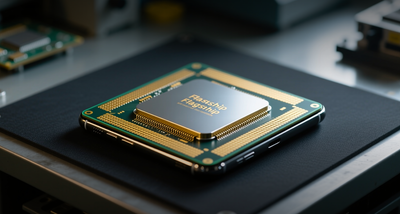
Qualcomm pairs 2nm AI chips with PickNik to escape phone cycle
Two chips unveiled in Lahaina, Hawaii, on Sept. 22 push a smartphone CPU past 5 GHz for the first time and put a 30-billion-parameter AI model on a handset — and Qualcomm built both around a cache design whose only purpose is to make autonomous AI agents run cheaply. Add the PickNik Robotics acquisition, and the company is claiming ground in digital and physical edge computing at once, a combination the market still values as a handset cyclical. "This closes the inference cost gap between the phone and the server," Qualcomm CEO Cristiano Amon said at the Snapdragon Summit. Amon framed the shift more broadly at Computex 2026, arguing the smartphone's role as the center of a user's digital life is ending, replaced by an AI agent that follows the user across glasses, earbuds, laptops and vehicles. Both chips use TSMC's N2 process, which entered high-volume manufacturing in the fourth quarter of 2025 and moves the foundry from FinFET to gate-all-around nanosheet transistors — a gate that wraps all four sides of the channel instead of three. TSMC's own characterization puts the gain at up to 15% more performance or 30% lower power at equivalent clocks, with 15% higher transistor density versus its prior 3nm N3E node. Qualcomm spent that density on memory architecture rather than clock speed alone: a shared L2 pool called FlexCache that all eight Oryon cores draw from dynamically, replacing the fixed per-core partitions every prior Snapdragon used. The eight-core CPU runs two Prime cores at 5.00 GHz and six Performance cores at 4.00 GHz. The Extreme Gen 6 adds 18 MB of Adreno high-performance on-chip GPU memory, LPDDR6 support, a Hexagon NPU with 35% more performance and 50% larger shared memory, 8K video at 60 frames per second, and hardware decode for the H.266 codec that Qualcomm says extends video playback battery life by up to 55% versus software decoding. The standard Gen 6 delivers a 14% NPU gain over the prior generation and 8K at 30 fps. Both carry the Snapdragon X105 modem, the first certified against 3GPP Release 19 with peak downlink of 14.8 Gbps, and FastConnect 8800 with Wi-Fi 8 readiness and Bluetooth 6.0. ## Why a cache change matters more than a clock record Agentic AI breaks the assumption fixed cache partitions were built on. An agent executing a multi-step task — reading context, calling a tool, updating a plan, acting — shifts its working set at every step, and each shift forces the active core to evict and reload from slower L3 or DRAM. FlexCache lets a Prime core orchestrating a planning step reach nearly the entire pool, then re-allocate as work hands off to a Performance core. The 5 GHz clock makes each step fast; the shared pool makes the transitions between steps cheap. The Oryon v3 in the Gen 5 was also a 5 GHz-class part, but its L2 was partitioned — which is why the generational jump is a memory-architecture story, not a speed story. The 30-billion-parameter claim rests on Mixture-of-Experts routing, which activates roughly 3 billion parameters per token while the rest sit dormant on UFS 5.0 flash, readable at more than 4.2 GB/s. A conventional 30-billion-parameter model would need 15 to 30 gigabytes of high-bandwidth memory, far beyond any phone. Hexagon's new Element Accelerator adds dedicated paths for transformer attention, the irregular memory-access pattern that matrix-only NPUs handle poorly. Qualcomm's own reference-device numbers — 82% single-core improvement over Gen 5 in Geekbench 6 and 65% in AnTuTu — come with a caveat the company volunteered: retail configurations, thermal management and software stacks will determine how much survives into shipping hardware. Qualcomm did not disclose the test conditions behind the comparisons. Independent testing of retail units is pending. ## Apple, MediaTek and Nvidia all face the same question The competitive read-through is direct. Apple's A20 Pro remains the benchmark Qualcomm's reference Geekbench 7 scores are described as competitive with, and Apple controls its own silicon-to-software stack in a way Qualcomm cannot. MediaTek competes for the same Android flagship sockets at the Ultra tier. Nvidia's edge offerings and its CUDA software moat are the reference point Qualcomm is explicitly chasing: the company also announced the acquisition of Modular, whose Mojo language and MAX inference engine will be open-sourced, an attempt to build a hardware-agnostic deployment path analogous to CUDA. PickNik Robotics is the physical half of the pairing. The acquisition extends Qualcomm's control from the inference layer into robot motion planning and manipulation software — the layer that turns edge compute into actuation. That is a different buyer, a different sales cycle and a different margin structure than a flagship phone socket, and it is the piece that makes the "edge computing platform" framing more than marketing. Customer commitments are real but concentrated. Xiaomi's 18 Pro and 18 Pro Max are scheduled as the first devices on both tiers, with a Beijing launch on Sept. 23. Motorola's Signature 27 carries the Extreme Gen 6 with a seven-year OS upgrade commitment. Qualcomm named Honor, iQOO, Nubia, OnePlus, Oppo, Redmi, RedMagic, Vivo and ZTE as partners; the Samsung Galaxy S27, historically Samsung's first phone on the newest Snapdragon platform, is expected in the first quarter of 2027 with no confirmed configuration. ## The valuation gap is the whole trade Qualcomm's problem is that none of this shows up cleanly in a handset-cycle model. The company's revenue still tracks Android flagship launch cadence, and the market prices it accordingly — which is precisely the disconnect the bull case rests on. Richard Windsor of Radio Free Mobile, writing during the summit, called the silicon story compelling but cautioned that widespread AI agent adoption is "just a theory," and that the investment case rests more solidly on diversification away from pure smartphone silicon than on any agent-driven upgrade cycle. That is the honest version of the thesis: the hardware is shipping, the consumer behavior is not yet proven. Two things would move the multiple. First, disclosure — if Qualcomm begins breaking out robotics and edge-software revenue separately from handset QCT, the market gets a line item to value on a platform basis rather than a cycle basis. Second, the High Bandwidth Compute co-processor Amon previewed, developed in Qualcomm's data-center business and now being miniaturized for phones, laptops, glasses and vehicles, with a formal announcement set for Mobile World Congress. That addresses the real constraint on sustained on-device agents: not peak inference throughput but throughput under thermal pressure over hours. The risk cuts both ways. DRAM supply constraints are already shaping the product line — the dual-flagship split exists partly to give OEMs a cheaper path to 2nm without absorbing the Extreme tier's cost. If 2nm wafer pricing or yields disappoint, or if PickNik's robotics software fails to convert into named industrial customers, the platform narrative loses its second leg and Qualcomm reverts to being what the market already thinks it is. This article is for informational purposes only and does not constitute investment advice.