Edgen AI operates independently of, and is not controlled by Aspen Digital Financial Limited.
Oil risk premium deflates as Trump says 3-hour Iran talks were fruitful
 Edgen Stock·Sep 22 2026, 18:10
Share to
Share to
Copy link

[1] Trump: Will Hold Talks with Iran in the Near Future (https://wallstreetcn.com/livenews/3169093 ...)[2] Trump and Iran Exchange Threats as Leaders Converge for Key U.N. Gathering. Can the Meeting Cool Rising Tensions? (https://time.com/article/2026/09/21/trump-ira ...)[3] What to know about Trump's UN visit and meetings with world leaders (https://abcnews.com/Politics/trump-address-ge ...)[4] United States (https://www.aljazeera.com/where/united-states ...)[5] Live Updates: War returns to Iran with Israel, US strikes - Dawn (https://www.dawn.com/live/iran-israel-war ...)
Related News
Sep 22 2026, 18:33
Acadia Healthcare doubles in 2026 as guidance raise lifts cash flow
Acadia Healthcare shares have doubled in 2026, a rebound built on a raised 2026 profit outlook, a $65 million upgrade to operating cash flow guidance and 240 new licensed beds added in the second quarter. "The combination of stronger expected cash generation and lower spending provided additional support, particularly given Acadia's elevated leverage," Zacks Investment Research wrote in a Sept. 22 note on the behavioral-health operator. The Franklin, Tenn.-based company, which trades on the Nasdaq under the ticker ACHC, has climbed 100% year to date, against an 11.1% gain for its industry group and 13.2% for the S&P 500 over the same period, according to Zacks. The move reverses a 2025 slump driven by rising patient-related litigation costs and broader legal and liability concerns that had compressed the stock's valuation. The re-rating rests on three revisions management made across the first half. After both first- and second-quarter results, Acadia raised its 2026 adjusted EBITDA and earnings outlook. Following the second quarter, it lifted operating cash flow guidance to $350 million to $400 million from $285 million to $325 million, and cut expected capital expenditures to $235 million to $255 million from $255 million to $280 million. The midpoint of the cash-flow range now sits $70 million above the prior midpoint, while the capex midpoint falls $22.5 million. For a company carrying elevated leverage, that spread matters more than the headline earnings number. Every dollar of incremental operating cash flow and every dollar of avoided capex is a dollar available to service debt or fund the bed additions that underpin the growth story, rather than a dollar that has to be borrowed. **Capacity additions carry the structural leg** Acadia added 240 licensed beds in the second quarter through two newly opened joint-venture facilities: a 144-bed hospital with Orlando Health in Florida and a 96-bed facility with Methodist Jennie Edmundson Hospital in Iowa. It also opened two Comprehensive Treatment Center locations in the quarter. The joint-venture structure spreads the capital burden with a health-system partner while giving Acadia the operating role, which keeps the bed count rising without a matching increase in wholly owned capex. The consensus view has moved with the guidance. The Zacks Consensus Estimate for 2026 earnings stands at $1.55 per share, with four upward revisions and no cuts over the past 60 days. The 2027 consensus implies a further 14.4% year-over-year increase. Acadia has beaten earnings estimates in each of the past four quarters, with an average surprise of 47%. Consensus revenue is pegged at $3.42 billion for 2026 and $3.61 billion for 2027, signaling 3.4% and 5.4% increases respectively. Leadership has also changed. Early this year Acadia brought back former CEO Debra Osteen, replacing Chris Hunter, while reaffirming its 2025 guidance. Investors appeared to welcome Osteen's return as a potential source of greater operational discipline and stability. The stock carries a Zacks Rank #3 (Hold), a signal that the estimate revisions have already been absorbed into the price. That is the tension in the setup: a doubled share price means the raised outlook is now the baseline, not the surprise. The next test is whether the third quarter delivers the cash flow the new guidance promises, and whether the bed additions convert into revenue at the pace the 2027 consensus assumes. Peers in the medical sector carrying a Zacks Rank #2 (Buy) include Tenet Healthcare, UnitedHealth Group and The Ensign Group. This article is for informational purposes only and does not constitute investment advice.
Sep 22 2026, 18:30
Cognex buys RealSense for $500M to enter robotic perception
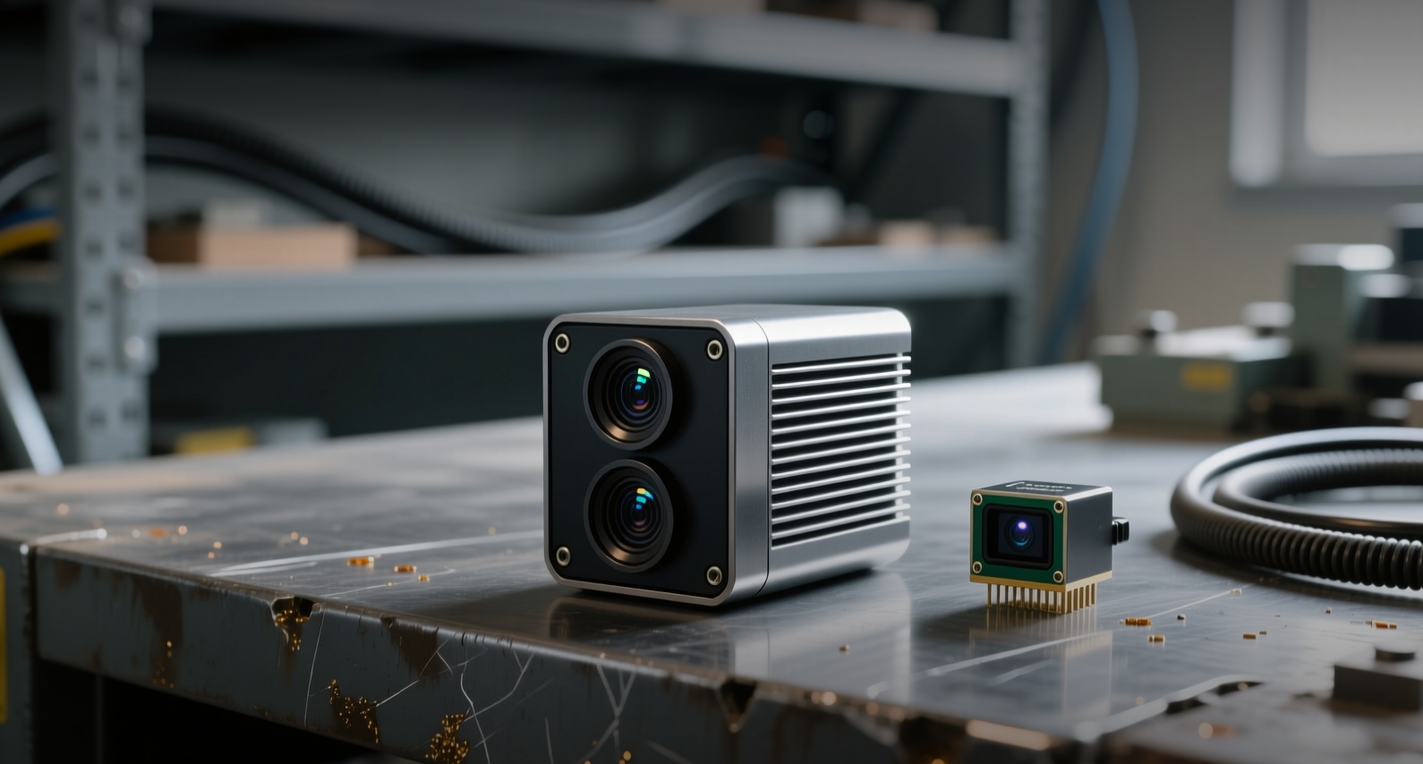
Cognex will pay $500 million in cash for RealSense, a depth-sensing camera maker spun out of Intel in 2025, in a deal that moves the industrial machine-vision leader into robotic perception and the software layer of Physical AI. The purchase price is funded entirely from Cognex's existing cash and investments, which stood at $755 million at the end of the second quarter, and the company expects the transaction to close in the fourth quarter of 2026. "RealSense represents a compelling strategic expansion for Cognex into robotic perception, one of the most attractive adjacent markets in machine vision," Matt Moschner, president and chief executive officer of Cognex, said in a statement announcing the agreement. "Combined with Cognex's machine vision expertise and global reach, RealSense positions us to offer a full-stack visual intelligence platform." The target is small in revenue terms and expensive on a multiple basis. RealSense is expected to generate $80 million to $90 million of revenue in 2026, growth of more than 50% over the prior year, which implies roughly 5.6x to 6.3x forward sales. Cognex trades at about 4.7x its own 2026 revenue guidance of $1.13 billion to $1.15 billion, according to the company's August guidance. RealSense carries a gross margin in the low 50% range, below Cognex's own profile, with management pointing to a path toward the mid-50s and eventually the high 50s as volume scales. The strategic case rests on a market that is small today and forecast to grow quickly. Cognex estimates robotic perception is worth about $600 million now and will expand at more than 25% annually to roughly $1.6 billion by 2030. RealSense has shipped more than 1 million units, holds more than 70 patents and patent applications, employs about 160 people, and runs a software development kit downloaded more than 1.2 million times, with roughly 20,000 active developers. Its recently launched D585 system combines depth sensing, onboard AI and edge computing to calculate depth on the device up to 30 times per second. The two product lines are complementary rather than overlapping. Cognex systems are built for precision measurement and guidance of fixed-arm robots in controlled factory settings, while RealSense hardware is designed for higher-frame-rate depth sensing that supports real-time motion, localization and collision avoidance. Fixed-arm and autonomous mobile robot deployments carry the near-term revenue, concentrated in automotive, logistics, semiconductor manufacturing, warehouse automation and e-commerce. Quadrupeds and humanoids are treated as longer-term optionality rather than a requirement of the investment case. ## Retention costs push the real outlay past $600 million The headline price understates the total commitment. Cognex expects to fund a three-year cash retention program for RealSense employees with a target value of about $56.5 million, subject to performance modifiers, and to grant restricted stock units valued at roughly $50 million that vest over three years. Both are incremental to the purchase price, taking the total package to about $606.5 million before any transaction fees. Evercore advised Cognex on the deal; no advisor to RealSense was disclosed. Cognex said the acquisition will not materially affect its 2026 results because of the expected closing timing and financial-period alignment, which means the first full contribution lands in 2027. Over the longer term, management expects RealSense to reach Cognex's through-cycle framework of 25% to 31% adjusted EBITDA margins and free-cash-flow conversion above 100%, supported by scale and by selling through Cognex's existing commercial infrastructure. Dennis Fehr, Cognex's chief financial officer, described the transaction as "highly aligned with our disciplined M&A strategy" and said RealSense is expected to be "strongly accretive to Cognex's growth profile." The deal is the clearest signal yet that machine-vision vendors are repositioning around robotics rather than factory inspection alone. Cognex competes with Keyence, Basler and Teledyne FLIR in industrial vision, and with Intel's own RealSense successor products, Nvidia's Isaac robotics platform and Chinese depth-camera suppliers in perception. Nvidia has pushed its Jetson and Isaac stack as the default compute and simulation layer for humanoid and mobile robots, and depth sensing is the input that stack requires. Owning a camera platform gives Cognex a position in that supply chain that its inspection business alone does not provide. RealSense will spin out its Facial Authentication product line into an independent company before closing, retaining the functions needed to pursue its biometrics strategy separately. That carve-out removes a business with different customers and compliance requirements from the deal perimeter. Cognex shares fell 4.19% to $59.39 in Cboe BZX trading on the announcement, against a 52-week gain of 65.33%, while the consensus target price among 20 analysts sits at $80.05, implying 29.14% upside from the last close. The stock reaction suggests investors are weighing the cash outlay and integration work against a revenue contribution that will not show up in reported numbers until 2027. This article is for informational purposes only and does not constitute investment advice.

Sep 22 2026, 18:29
Cleveland-Cliffs jumps 5% as steel rebound outruns peers
Cleveland-Cliffs climbed 5% to $12.69 on Tuesday afternoon, the sharpest move in the U.S. steel group and the latest leg of a rally that has now run for roughly a month. The advance came with no verified company-specific news and no fresh sector headline, leaving traders to attribute the move to continued rebound buying in a stock that has been climbing for weeks. Cleveland-Cliffs is up 11.98% over the past month, so Tuesday's gain extends an established trend rather than marking a single-session pop. "This is a catch-up trade, not a new thesis," said Priya Mehta, an equity market structure analyst who tracks fund flows and positioning. "When one name in a group is down on the year while its two closest comparables are up 38% and 51%, valuation-driven money and momentum money end up on the same side of the boat." The separation from peers is the session's defining feature. Nucor traded at $244.20, up 0.74%, and Steel Dynamics at $232.30, up 1%. Both moved higher, but neither matched Cleveland-Cliffs' pace, and the gap between the three is what distinguishes Tuesday's action from a broad sector bid. The wider metals complex did carry a bid. The SPDR S&P Metals & Mining ETF traded at $111.11, up 1.94%, while the SPDR S&P 500 ETF Trust sat at $773.20 and was essentially unchanged. The metals corner of the market attracted buying while the broad index did not, a split that argues for sector-specific flows rather than a macro risk-appetite shift. ## The year-to-date gap that is pulling in buyers Cleveland-Cliffs remains down 4.97% year to date even after Tuesday's advance. Nucor is up 50.59% and Steel Dynamics is up 37.81% over the same period. That spread is the mechanism behind the buying: a portfolio manager wanting steel exposure at a lower entry price has one obvious place to go, and it is not the two names that have already run. The positioning consequence is that Cleveland-Cliffs now carries the group's highest beta to any steel thesis, in both directions. Buyers stepping in are expressing the same end-market view — automotive-linked orders, tariff-supported domestic pricing — at a materially different starting price than Nucor and Steel Dynamics currently offer. The bull case rests on mean reversion in a beaten-down cyclical, a trade that can run for weeks once it starts. The risk is that a move of this size on no confirmed catalyst is momentum without a floor under it. ## What to watch The first test is whether Cleveland-Cliffs holds $12.50 once the rebound trade cools. The stock's month-long climb has done real work on the year-to-date deficit, and the next question is whether follow-through buying appears without a company catalyst behind it. The second test is peer confirmation. Cleveland-Cliffs has moved best when the wider metals fund is bid, so a session in which XME rolls over while the single name holds would suggest the trade has narrowed to a positioning story rather than a sector one. Traders watching the group will also weigh the recent pattern in which Nucor and Steel Dynamics sold off on soft quarterly guidance despite firm steel pricing — a reminder that the sector's earnings signals and its share prices have not been moving together. For readers sizing exposure, Cleveland-Cliffs remains a high-beta cyclical after a fast move on no confirmed catalyst. This article is for informational purposes only and does not constitute investment advice.