Edgen AI operates independently of, and is not controlled by Aspen Digital Financial Limited.
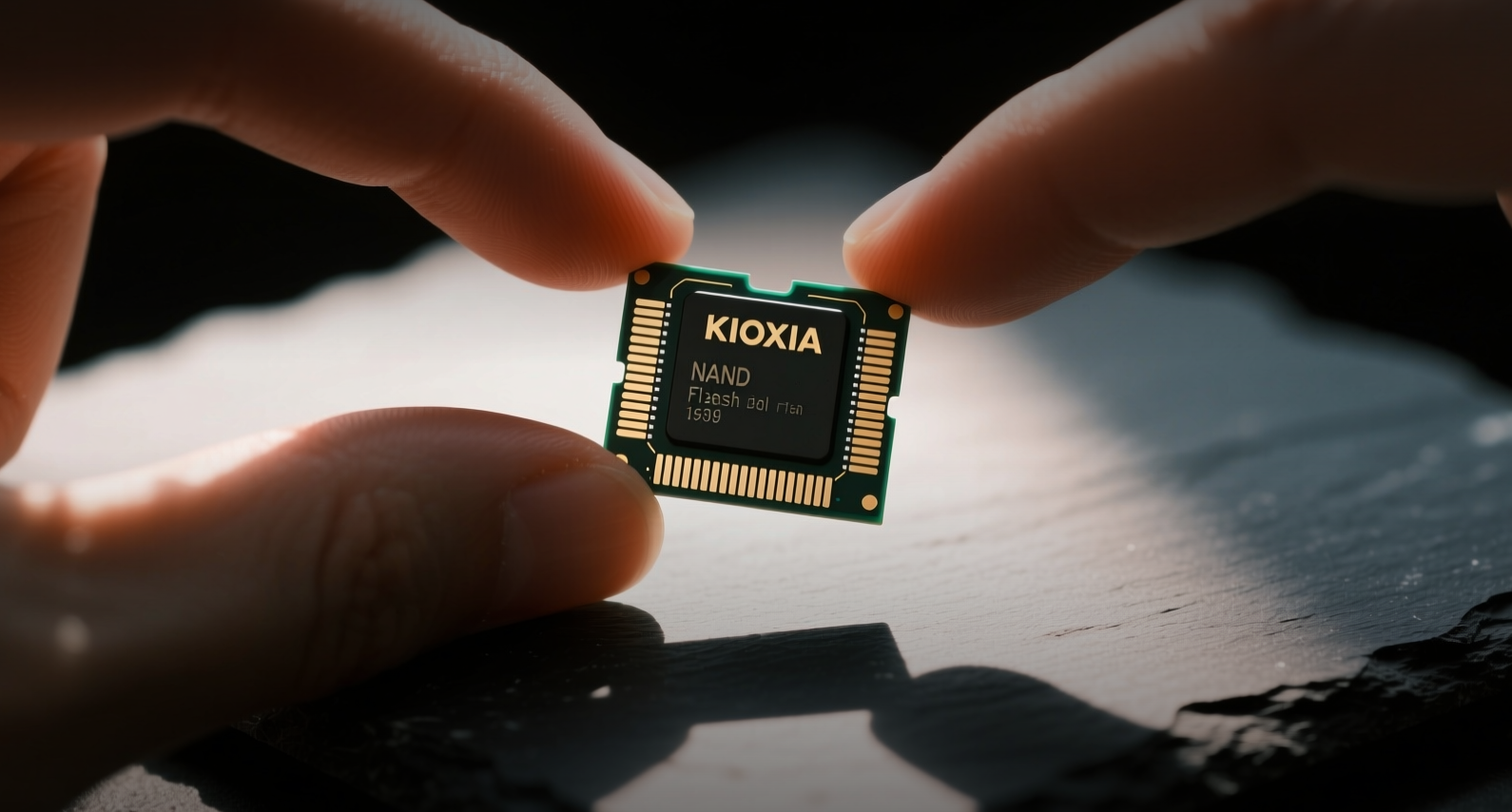
Kioxia launches ¥800B buyback as NAND profits surge 28-fold
 Edgen Stock·Aug 01 2026, 04:17
Share to
Share to
Copy link
[1] Kioxia Kicks Off "Massive Buyback" Era, Is a Storage Giant "Buyback Bull Market" Coming? (https://wallstreetcn.com/articles/3778486 ...)[2] Kioxia Forecasts $11.8 Billion Operating Profit as AI Data Center Boom Fuels Memory Demand — BigGo Finance (https://finance.biggo.com/news/4640271d-c457- ...)[3] Kioxia reported Q1 operating profit of JPY 1.27 trillion ... (https://news.futunn.com/en/post/76917093/kiox ...)[4] Can South Korean equities reclaim lost ground? Nomura: From deleveraging to buyback-driven market support (https://news.futunn.com/en/post/76746452/can- ...)[5] How can Korean stocks "regain lost ground"? From "Leverage-Driven Bull Market" to "Buyback-Driven Bull Market" | Bitget News (https://www.bitget.com/asia/amp/news/detail/1 ...)
Related News
Aug 01 2026, 04:23
Micron up 222% vs Nvidia 11% as chip crash tests investors
**The semiconductor crash has split the sector into two camps — memory makers that soared 222% this year and AI chip leaders that gained just 11%.** The semiconductor crash has split the sector into two camps, with Micron up 222% this year versus Nvidia's 11% gain, as a 33% KOSPI collapse forces investors to reassess which chip trade holds up. "Memory stocks exhibit high convexity: small demand shifts cause outsized earnings and valuation swings due to their fixed cost structure and lack of inventory buffers," Dustin Quasney, a Seeking Alpha contributor, wrote. The KOSPI index fell 10.84% on July 30, triggering its eighth circuit breaker this year, and is now down more than 33% from its highs in less than a month. The index's decline reflects its heavy concentration in memory giants like SK hynix and Samsung, making it a leveraged proxy for global memory demand. Micron has risen nearly 222% this year to around $933.86, while Nvidia has gained about 11% to roughly $210.28. The divergence matters because memory and AI compute face different demand drivers. Nvidia and Broadcom recently signed billion-dollar AI memory deals at a South Korea summit, and Bernstein reiterated buy ratings on Micron, Samsung, and SK hynix. But Michael Burry has doubled down on bearish bets against both Micron and Nvidia, adding short positions in the iShares Semiconductor ETF (SOXX) using both short stock and put options. The crash's root cause is shifting investor perceptions of hyperscaler capex sustainability, not just China's CXMT IPO or domestic lithography advances, according to the Seeking Alpha analysis. Memory stocks are particularly vulnerable because their fixed cost structure means small demand shifts produce outsized earnings swings. The KOSPI's decline, which has accelerated through July, has been amplified by retail leverage in South Korea, where individual investors have piled into memory names through margin accounts. ## Micron's 222% run faces a memory cycle test Micron has been the biggest beneficiary of the AI memory boom, with HBM (high-bandwidth memory) demand from Nvidia and other AI chipmakers driving prices higher. HBM is a specialized type of memory stacked vertically to deliver higher bandwidth for AI accelerators, and it has become one of the tightest segments in the semiconductor supply chain. But the stock's 222% gain this year has made it a target for bears. Burry sold short additional shares of Micron at $933.86, betting the rally has stretched too far. Bernstein disagrees, reiterating buy ratings on Micron, Samsung, and SK hynix after Nvidia and Broadcom signed billion-dollar AI memory deals at a South Korea summit. The firm sees continued HBM demand growth as AI training and inference workloads expand. The deals suggest hyperscalers remain committed to memory procurement even as broader semiconductor sentiment sours. ## Nvidia's modest 11% gain offers a different risk profile Nvidia, up just 11% this year, has been a relative laggard in the semiconductor rally. The stock's more modest appreciation reflects concerns about hyperscaler capex sustainability and competition from custom AI chips developed by cloud providers. Burry added to his Nvidia short at $210.28, while maintaining a large bearish position in SOXX. The iShares Semiconductor ETF, which tracks the broader semiconductor sector, has been caught in the crossfire. SOXX traded at $504.89 on July 31, recovering from earlier losses as AMD and Micron surged and Lam Research climbed 17% in a sharp rebound. The volatility has been extreme, with AMD, Intel, and Micron extending losses one day before reversing sharply the next. For investors weighing Micron versus Nvidia, the choice comes down to risk tolerance and time horizon. Micron offers higher upside if memory prices hold, but its convexity cuts both ways — a demand slowdown could produce outsized losses. Nvidia's more modest valuation and diversified AI platform position may offer relative stability, though its growth is increasingly tied to the same hyperscaler capex cycle driving the current volatility. The next test comes with Palantir's earnings on August 3, which could set the tone for AI sentiment broadly. If AI demand shows signs of slowing, both Micron and Nvidia face further downside. If it holds, the current crash may represent a buying opportunity for the memory trade. This article is for informational purposes only and does not constitute investment advice.

Aug 01 2026, 04:18
TELUS cuts dividend 55% as Q2 miss, impairment hit profit
TELUS Corp. cut its quarterly dividend 55% to $0.1875 after Q2 earnings missed estimates, sending shares down 12.63% to a 52-week low. "The macro environment has shifted and we are responding with clarity and discipline," Victor Dodig, president and chief executive officer, said. Adjusted EPS of $0.16 fell 27% from a year earlier, while adjusted net income dropped 26% to $254 million. Consolidated operating revenue slipped 2% to $4.92 billion. A $2.1 billion non-cash impairment of the TELUS Digital unit drove a net loss of $1.83 billion. The reset lowers the annual payout to $0.75 per share from $1.6736, generating about $2.7 billion in cumulative cash savings through 2028 to cut net debt to Adjusted EBITDA to 3.0 times or lower by year-end 2028, a year later than planned. The dividend, payable Oct. 1 to holders of record Sept. 10, was cut after adjusted EPS of $0.16 missed the $0.17 consensus by nearly 30 percent, and revenue of $3.561 billion fell short of the $3.760 billion estimate. TELUS also removed the discount on its dividend reinvestment plan effective Oct. 1, reducing shareholder dilution. Consolidated service revenue declined 1 percent to $4.4 billion, and adjusted EBITDA fell 2 percent to $1.8 billion. Mobile network revenue rose 1 percent to $1.7 billion on subscriber growth, but average revenue per user slipped 0.4 percent to $56.36 and churn edged up to 1.08 percent from 1.06 percent on promotional price competition. TTech subscriber connections grew 6 percent to 17.9 million. TELUS Health revenue rose 4 percent, with healthcare lives covered reaching 158.9 million, up 1.8 million over 12 months. TELUS Digital revenue dropped 10 percent on client ramp-downs in trust and safety and AI data solutions, triggering the impairment as the recoverable amount of the cash-generating unit fell below its carrying value. The company is running a strategic portfolio review, including monetizing non-core TELUS Health assets and real estate. Full-year guidance was cut sharply. Consolidated service revenue growth is now seen flat to down 2 percent, from 2 to 4 percent, and adjusted EBITDA is expected to contract 2 to 4 percent, from growth of 2 to 4 percent. Capital expenditures were raised to about $2.6 billion from $2.3 billion on inflation and supply chain costs, while free cash flow guidance was pulled to about $1.8 billion from $2.45 billion. The dividend cut and lowered outlook signal weaker near-term cash generation, pressuring income-focused holders as the company prioritizes deleveraging over shareholder yield. Investors will watch the third-quarter results in November for details on the capital returns framework and the outcome of the portfolio review. This article is for informational purposes only and does not constitute investment advice.
Aug 01 2026, 03:58
Amazon completes $50B OpenAI investment as AI cloud race intensifies
Amazon completed its $50 billion investment in OpenAI, taking roughly a 5 percent stake and securing access to the AI lab's cloud and chip workloads as the infrastructure arms race intensifies. "AWS is booming, growing 36.7 percent year-over-year in Q2 — our fastest growth in 18 quarters — and our AI and Chips businesses each eclipsed run rates of more than $25 billion," Andy Jassy, President and CEO of Amazon, said. The investment was structured in two tranches. Amazon paid $15 billion in February as part of a broader commercial agreement, then delivered the remaining $35 billion this week after OpenAI and Microsoft renegotiated their cloud contract in April, clearing the way for AWS to serve OpenAI's compute needs. The final payment arrived even though neither of the original milestone triggers — a public listing or a major AI breakthrough — was met. Amazon also committed up to $33 billion to Anthropic, OpenAI's chief rival, with $18 billion already deployed. The dual investments strengthen Amazon's position across the AI value chain: Trainium chips now have multi-year, multi-gigawatt commitments from both Anthropic and OpenAI, and AWS can offer both labs' models through Bedrock. The move pressures Microsoft's Azure, which previously held near-exclusive cloud rights to OpenAI, and challenges Nvidia's GPU dominance in AI training workloads. **AWS AI run rate tops $25B as Trainium adoption spreads** AWS reported Q2 revenue of $42.2 billion, up 37 percent year-over-year, with operating income of $16.6 billion — a 64 percent jump from $10.2 billion a year earlier. Amazon's overall Q2 revenue reached $200.6 billion, up 20 percent, while operating income rose 43 percent to $27.5 billion. Net income surged to $62.6 billion, or $5.75 per diluted share, boosted by $53.4 billion in non-operating income from mark-to-market gains on Anthropic investments. Advertising revenue added $19.8 billion, up 26 percent. Amazon raised its 2026 capital expenditure guidance to $220 billion to support AI infrastructure demand. The company's Trainium chip line has gained traction beyond the two leading AI labs, with startups including NEURA Robotics, Odyssey, TwelveLabs, Decart, and Poolside adopting the silicon, alongside larger enterprises like Uber and Pinterest. Amazon also released Graviton5 into general availability, delivering up to 25 percent better compute performance than Graviton4. **Microsoft's cloud exclusivity erodes** The April renegotiation of the Microsoft-OpenAI cloud contract marked a structural shift. Microsoft had previously held near-exclusive rights to host OpenAI's workloads and had internally discussed legal action over Amazon's partnership with the AI lab, according to the Financial Times. The new agreement opened the door for AWS to provide cloud compute to OpenAI, weakening Azure's AI revenue narrative and strengthening AWS's position in the cloud infrastructure market. Amazon Bedrock now hosts OpenAI's GPT-5.6, Anthropic's Claude Opus 5, Google DeepMind's Gemma 4, and SpaceXAI's Grok 4.3, giving AWS customers access to leading frontier models from a single platform. Hundreds of thousands of customers now use Bedrock, with more added in the last six months than in the first two years after launch. Amazon shares jumped 14.53 percent to $269.73 following Q2 earnings, reflecting investor enthusiasm for AI-driven growth across AWS, advertising, and retail. The OpenAI investment positions Amazon to capture a share of the AI training and inference market, while Microsoft faces the more immediate risk: losing exclusive access to OpenAI's workloads could slow Azure's AI revenue growth. Nvidia, meanwhile, faces a longer-term threat from Trainium adoption at scale, though its CUDA ecosystem and data center GPU dominance remain formidable barriers. This article is for informational purposes only and does not constitute investment advice.