Edgen AI operates independently of, and is not controlled by Aspen Digital Financial Limited.
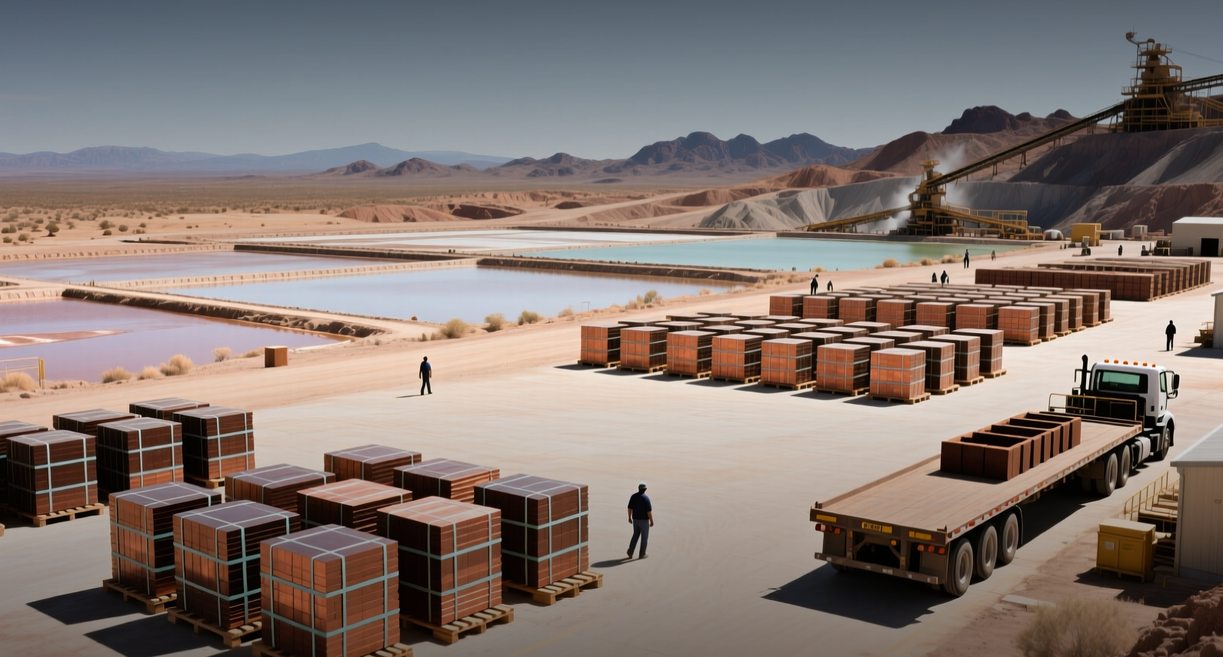
Gunnison Copper hits commercial production after 1.3 million lb August
 Edgen Stock·Sep 22 2026, 12:55
Share to
Share to
Copy link
[1] Gunnison Copper Achieves Commercial Production at Johnson Camp Mine (https://www.newsfilecorp.com/release/315350/G ...)
Related News

Sep 22 2026, 13:46
Two-year Treasury yields fall 18bps as oil truce reshapes Fed bets
Traders are paying up for the shortest maturities on the U.S. curve, driving two-year yields down 18 basis points to 3.62% after the U.S.-Iran truce drained the crude-supply risk premium that had been feeding straight into inflation expectations. Deutsche Bank global macro vice chair Ozan Tarman told CNBC's "Squawk Box" on Sept. 22 that the move reflects a mechanical repricing rather than a change in the growth outlook. "The short end of rates is loving every minute of the oil truce," Tarman said. "When you take a war premium out of crude, you take it out of breakevens, and the front end is where that gets expressed fastest." Brent crude has fallen to $68.40 a barrel from a wartime peak of $94.10, a 27% decline, while WTI sits at $64.85. Two-year inflation breakevens have compressed to 2.18% from 2.61% over the same stretch, and the 10-year yield has eased 11 basis points to 4.05% — a 43-basis-point gap between the two maturities that is close to the flattest the curve has been since the Fed began cutting. Fed funds futures now assign a 74% probability to a quarter-point reduction at the October meeting, up from 51% a month ago, according to CME FedWatch data. The transmission is straightforward. Crude is the single largest volatile input into headline inflation, and a 27% drop in Brent feeds through to gasoline and freight costs within roughly six weeks. That gives the Federal Reserve room to look through the energy-driven inflation prints that had kept the committee cautious through the summer. The fed funds rate has sat at 3.75-4.00% since the 25-basis-point cut in July, and officials have declined to pre-commit to a path. The last time front-end yields fell this fast on an energy shock was in the fourth quarter of 2023, when Brent slid from $95 to $78 after the Israel-Hamas conflict failed to widen into a regional supply disruption. Two-year yields dropped 62 basis points over the following ten weeks, and the S&P 500 gained 9.4% in that window. The current move is roughly a third of that magnitude, which suggests positioning has room to extend if the truce holds. That "if" is doing a lot of work. The truce is a political arrangement, not a supply agreement, and the Strait of Hormuz still carries about 21% of global seaborne oil. A breakdown would restore the risk premium within days and reverse the front-end bid just as quickly. Options markets are already pricing that possibility: one-month implied volatility on Brent futures sits at 38%, above its 12-month average of 31%. The second variable is the Fed itself. Chair Kevin Warsh has said he prefers to avoid detailed forward guidance, which means each data release carries more weight than it did under his predecessor. Attention now turns to speeches from several policymakers this week and to the September employment report, which will be the first clean read on the labor market since the truce took effect. If payrolls come in below the roughly 90,000 monthly breakeven pace estimated by the Atlanta Fed, the front end extends its rally. If they beat, the 18-basis-point move unwinds fast. The third thread is trade. Chinese President Xi Jinping is expected to visit the U.S. and meet with President Donald Trump on Thursday, with semiconductor export restrictions and the AI development race on the agenda. Technology accounts for about 38% of the S&P 500 and has gained more than 20% in 2026, though it has lost ground since early June. A constructive summit would add to the risk-on tone that lower front-end yields have already encouraged; a breakdown would put the entire rates move back in question. Positioning data shows the market has already leaned in. Asset managers have added to two-year note futures for four consecutive weeks, and the front end now carries the largest net long positioning of any point on the curve. That is a crowded trade, and crowded trades need the truce to hold and the Fed to deliver. The October meeting is the next hard test, with the employment report and the Trump-Xi summit arriving first. This article is for informational purposes only and does not constitute investment advice.
Sep 22 2026, 13:42
DoorDash pays $131.5 million to settle NYC pay probe
DoorDash agreed to pay $131.5 million to New York City after the Department of Consumer and Worker Protection found the company underpaid delivery workers or paid them late, a penalty that fixes the price of non-compliance with the city's minimum-pay floor for app-based couriers. "Simply put, we screwed up," DoorDash said in a statement. "Our mistakes meant some Dashers were underpaid or paid late. While these mistakes weren't intentional, that doesn't make them okay." The settlement, announced Tuesday by Mayor Zohran Mamdani at City Hall, splits into three parts. A $16.7 million fine goes to the city. More than $83 million resolves a dispute over how to calculate pay for time a Dasher is logged into the app and on call but not actively delivering. Another $12.3 million covers payments that were missed or arrived days or weeks late. DoorDash said it set aside the full amount in prior quarters, so the charge does not hit current-period earnings. Roughly 264,000 workers are covered. About $6.6 million never reached Dashers at all, while $5.7 million arrived late. The average missing payment was $7.70, and 65 percent of affected workers were short by $1 or less. Every impacted Dasher receives a minimum of $10, with a median payout near $48 — a distribution that makes the headline number look far larger than the per-worker harm. DoorDash blamed the errors on technical bugs and complicated delivery scenarios: orders crossing city boundaries, jobs with multiple pickup or drop-off points, and deliveries only partially completed or canceled. Some failures traced to incomplete or inaccurate banking information. The company said it has fixed the software and strengthened internal compliance processes. ## The $22.13 floor is the real number The settlement matters less as a one-time charge than as a marker of where the city's pay floor now sits. New York's DCWP has raised the minimum rate for delivery workers to $22.13 per active hour as of April 2026, with plans to extend the requirement to all delivery apps by early 2027. That figure is the binding constraint on unit economics for every platform dispatching couriers inside the five boroughs. The enforcement action arrived nearly eight months after the city agency accused DoorDash and Uber Eats of engineering what it called "design tricks" to deprive workers of more than $550 million in tips. That earlier allegation was roughly four times the size of Tuesday's settlement, and it named Uber Eats alongside DoorDash. Uber did not immediately respond to requests for comment. Grubhub, the third major player in the market, has also faced repeated friction with the city over tipping rules and whether platforms must share customer data with restaurants. For DoorDash, the arithmetic is modest against scale. The company has not yet disclosed the settlement's line-item effect on its income statement, but the $131.5 million is fully reserved and spread across prior quarters. The more consequential exposure is structural: a pay floor set per active hour forces platforms to absorb idle-time compensation, the exact category that produced the $83 million dispute. DoorDash calculated on-call time differently than the city required and chose to pay rather than contest the matter — a decision that effectively concedes the city's methodology. That concession is the precedent. Any platform using a comparable on-call calculation now has a template for what the city will demand, and a reference price for what refusing costs. The read-through extends beyond New York. Municipalities that have adopted or are weighing minimum-pay rules for delivery workers — including Seattle, Chicago and several California cities — now have a settled enforcement outcome to cite. The $22.13 active-hour floor and the early-2027 extension to all apps give regulators elsewhere a concrete benchmark, and give platforms a cost baseline to model. DoorDash said all affected workers will be contacted and paid in the coming weeks. The company's next quarterly filing will show whether the reserve was sized correctly, and whether compliance costs are showing up in delivery margins rather than in one-time charges. For Uber Eats and Grubhub, the question is whether they face parallel proceedings on the same on-call methodology — a scenario the city has not ruled out. This article is for informational purposes only and does not constitute investment advice.
Sep 22 2026, 13:40
Celldex's barzolvolimab hits Phase 3 goals but stock drops 20%
Celldex Therapeutics said its experimental antibody barzolvolimab met the primary endpoint and every key secondary goal in two Phase 3 trials in chronic spontaneous urticaria, then watched its shares fall more than 20% in premarket trading on Tuesday. "We believe that barzolvolimab can be a transformational therapy for people living with CSU," Diane Young, Senior Vice President and Chief Medical Officer at Celldex, said in the company's statement. Chief Executive Anthony Marucci called the efficacy "best-in-disease in CSU" and said the company is moving to build a commercial-stage organization. The EMBARQ-CSU1 and EMBARQ-CSU2 studies randomized 1,939 patients — 963 and 976 respectively — to barzolvolimab 150 mg every four weeks, 300 mg every eight weeks, or placebo. Both dose groups beat placebo on the primary measure, mean change from baseline in the weekly urticaria activity score (UAS7) at Week 12. In EMBARQ-CSU1, the 150 mg arm improved 20.2 points versus 10.7 for placebo; in EMBARQ-CSU2, the 300 mg arm improved 19.7 points versus 11.4. Every comparison carried a p-value below .00001, meaning the odds the results were random are under one in 100,000. Complete response — the total absence of itch and hives, or UAS7=0 — reached 42.1% to 45.7% across the two doses and two studies at Week 12, against 9.3% to 12.6% for placebo. By Week 24 the active arms held 45.1% to 54.0% complete response rates versus 15.4% to 17.6% on placebo, showing the benefit deepened rather than faded after the 12-week readout. The differentiation sits in the hardest-to-treat groups. Among patients refractory to omalizumab — the standard advanced therapy sold by Novartis and Roche as Xolair — complete response at Week 12 ranged from 41.7% to 55.3% on barzolvolimab versus 9.3% to 15.1% on placebo. In patients who entered with angioedema, complete resolution of swelling reached 62.7% to 74.3% on the drug against roughly 34% on placebo. Barzolvolimab is a humanized monoclonal antibody that binds a unique region of the KIT receptor, blocking the signaling mast cells need to survive. Mast cell activation drives the itch and hives of CSU, a condition that affects an estimated 1% of the global population and leaves a meaningful share of patients uncontrolled on H1-antihistamines. The safety profile through the 24-week placebo-controlled period matched prior Phase 2 experience, the company said, with no new signals disclosed. Celldex plans to present the full EMBARQ-CSU dataset at an upcoming medical meeting and to file a Biologics License Application with the FDA in 2027. Treatment continues in both trials through 52 weeks, and a Phase 3b long-term extension study is enrolling. The program also spans Phase 3 work in cold urticaria and symptomatic dermographism and a Phase 2 study in atopic dermatitis, where it would compete with Dupixent from Sanofi and Regeneron. The premarket decline puts the readout in the same category as several 2026 biotech catalysts where strong efficacy failed to clear a bar set by elevated expectations. Investors will watch two things from here: whether the 52-week data and the medical-meeting presentation resolve questions about durability and dosing convenience, and whether the 2027 BLA filing stays on schedule. The company has not yet disclosed a peak sales estimate for barzolvolimab. This article is for informational purposes only and does not constitute investment advice.