Edgen AI operates independently of, and is not controlled by Aspen Digital Financial Limited.

 Portfolio
Investment Ideas
Personal
Agentic Execution
Aura Leaderboard
Rebate
 Edgen Stock·Jul 09 2026, 10:03

The dollar extended its advance Thursday as traders raised the odds of another Federal Reserve rate increase this year, pressuring EUR/USD a week after the central bank delivered its first hike since 2023 and signaled more to come. "The market is repricing the terminal rate, not the direction," said David Lefkowitz, head of US equities at UBS Global Wealth Management. "The debate is how much the Fed has to hike, and that debate is being settled in the dollar's favor right now." Fed funds futures imply the benchmark rate peaks near 4.8% in a little over a year, for total tightening of just over 100 basis points, according to LSEG data. That is a fraction of the 525 basis points delivered in the 2022-2023 cycle, but it is enough to widen the rate gap that has anchored the euro's range all year. The Fed raised rates by a quarter point last week, its first increase since 2023, and signaled another move by year-end. The euro's slide is the cleanest expression of that repricing. Europe's central bank has offered no matching hawkish turn: ECB policymaker Martin Kocher said Thursday the Governing Council will decide on rates "meeting to meeting," language that leaves the deposit rate where it is while the Fed's path steepens. Rate differentials, not growth expectations, are doing the work. ## A summit that cuts both ways Layered on top is the two-day state visit by Chinese President Xi Jinping, who arrived Wednesday evening at Joint Base Andrews outside Washington and meets President Donald Trump at the White House on Thursday. The agenda covers trade irritants, artificial intelligence safeguards and the war in Iran, with the two sides agreeing Wednesday to extend a one-year trade truce due to expire Nov. 10 by two months. For currency desks, the summit is a two-sided headline rather than a directional bet. Escalation would feed risk-off flows and add to dollar demand; a conciliatory outcome, particularly any softening on the $14 billion US arms package for Taiwan that Trump has called a "very good negotiating chip," would unwind part of the hike-driven bid. Peak baseline US tariffs reached 145% during last year's trade battle, matched by Chinese levies of 125%, before falling to roughly 47% after the leaders met in South Korea. The dollar's strength carries costs beyond the currency pair. A firmer greenback tightens global financial conditions, weighing on US exporters, emerging-market assets and dollar-denominated commodities. Gold traded muted Thursday as Fed tightening prospects and a decline in oil prices removed two of its supports, while crude eased off highs as trade and peace talks progressed. ## What the next FOMC meeting decides The near-term path hinges on whether the Fed validates the futures curve. Investors are factoring in further increases in 2027, and the current cycle is expected to be short and shallow relative to history: since 1983 the average hiking cycle has run just under two years with rates rising 320 basis points, according to Jefferies equity strategist Jane Gibbons. History offers a caution. The S&P 500 has fallen a median 2.6% in the three months after the first hike of a cycle, based on six cycles since 1994 compiled by LPL Financial, with drawdowns of 8% to 14% in five of them. The 2022 exception was far worse — a 25% peak-to-trough decline — because the pace of tightening, not the first move, broke the market. For EUR/USD, the arithmetic is narrower. The pair stays hostage to the spread between US and euro-area policy expectations until either the Fed's December meeting or a summit deliverable changes the calculus. A truce extension alone removes tail risk without reversing the hike premium; a breakdown in talks would compound it. This article is for informational purposes only and does not constitute investment advice.
Benchmark Dutch TTF front-month contracts traded near EUR 68.36 per megawatt-hour on Sept. 24, holding gains of as much as 5 percent, as traders confronted a storage buffer that has not been this thin entering a heating season since the 2022 crisis. "Storage is the only number that matters between now and December," said Omar Tariq, commodities analyst covering European gas markets. "At 61.6 percent full, the system has roughly 12 percentage points less cushion than it did a year ago, and that gap has to be closed by imports or by mild weather — there is no third option." Gas Infrastructure Europe data put EU storage at 61.6 percent of capacity, against 74 percent at the same point in 2025 — a shortfall of 12.4 percentage points. The move extends a rally that has kept TTF elevated through a summer in which injections typically depress spot values. The arithmetic behind the risk premium is straightforward. Europe entered the 2025-26 winter with storage near 95 percent full and exited it with inventories well above the five-year average. This year's injection season has run behind schedule, leaving the market dependent on sustained LNG arrivals through October and November to reach a comfortable pre-winter level. Every week of below-normal injections now translates into a larger call on cargoes during the coldest months. ## Spain's 2027 exit adds a second pull on Atlantic cargoes Spain plans to stop importing Russian LNG from Jan. 1, 2027, aligning Madrid with European Union restrictions on Russian gas. Foreign Minister José Manuel Albares said the government intends to comply with the EU framework, while acknowledging that long-term supply agreements held by Spanish companies complicate an immediate break. The timing matters less than the direction. Spain operates one of Europe's largest LNG storage and regasification networks, giving it unusual flexibility to receive cargoes from the United States, Qatar and West Africa and to redistribute them onward to landlocked European buyers. Albares said that infrastructure could support other European countries as the region secures alternative supply. Hungary's Minister of Economy and Energy, Istvan Kapitany, has said Budapest expects to meet its gas requirements without Russian supply by October 2027, a later deadline that reflects the country's heavier dependence on pipeline flows. For the chemicals sector, the transmission is direct. Higher gas costs raise production expenses for ammonia, methanol and hydrogen, all of which use natural gas as both feedstock and fuel. European ammonia producers have repeatedly curtailed output when TTF has spiked, and a sustained move above EUR 70 per megawatt-hour would reopen that calculation for the third consecutive winter. ## What closes the gap The bear case rests on LNG supply. Additional volumes from the United States and other exporters could cap upside, and a mild start to the heating season would slow the drawdown. The last time European storage entered October more than 10 percentage points below the prior year, in 2021, TTF went on to multiply several times over before peaking in August 2022 — a precedent that still shapes how traders price tail risk. The bull case is simpler: storage is the buffer, and the buffer is smaller. A cold snap in Northwest Europe in late November, combined with any disruption to Norwegian pipeline flows or a delayed US export terminal, would force the market to bid for cargoes against Asian buyers at the same time. The next hard data points are the weekly GIE storage update and the November injection figures, which will show whether Europe can still reach the 90 percent target that EU rules set for Nov. 1. Missing that threshold would leave the market carrying winter risk into December with no ability to rebuild inventories. This article is for informational purposes only and does not constitute investment advice.

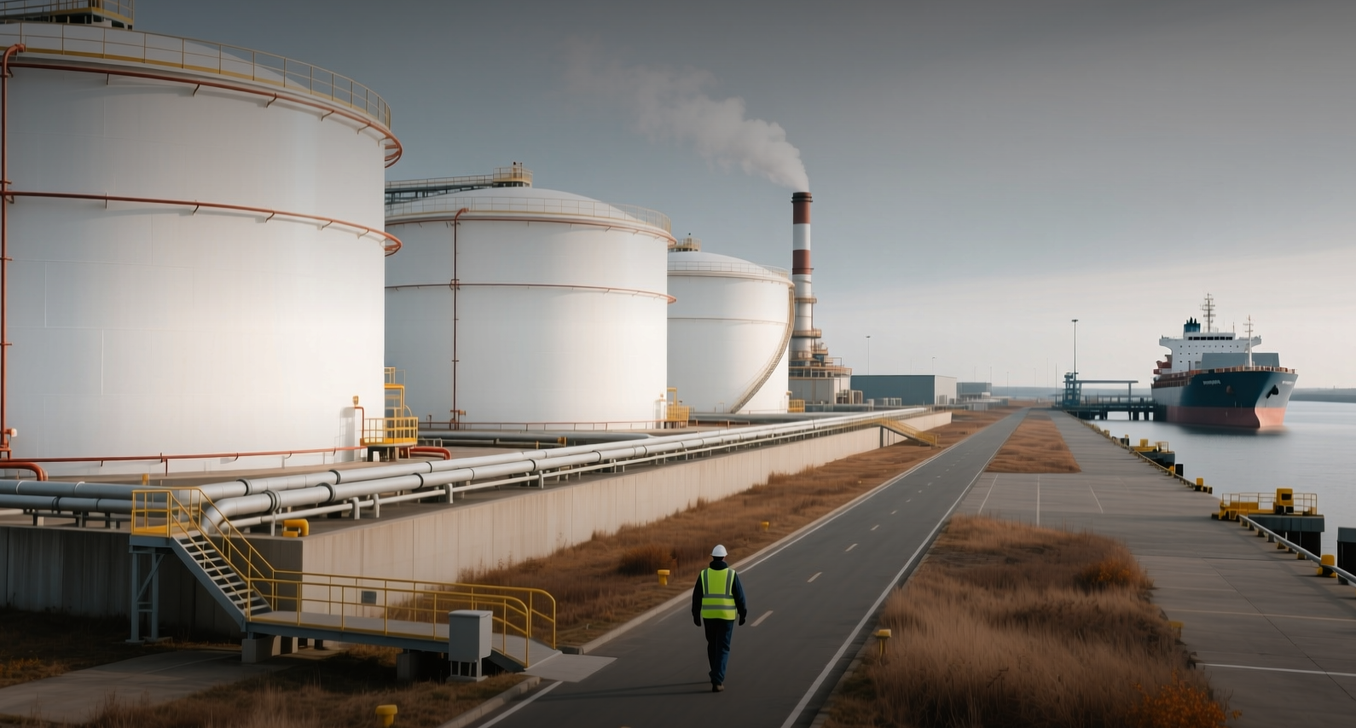
Serbia's only oil refinery has six days of legal operating room left. NIS, the country's dominant fuel supplier and 56.16% owned by Russia's Gazprom Neft and Gazprom, said Thursday it has filed for a fresh US sanctions waiver to keep running after the current one lapses on September 30. "The regular functioning of the ... oil refinery, and a stable market supply are of crucial importance for maintaining energy stability" in Serbia, NIS said in a statement announcing the application. The numbers behind that statement are unusually concentrated. NIS supplies up to 80% of the Serbian market and operates the Pancevo refinery in northern Serbia, with annual crude processing capacity of 4.8 million tons. The US Office of Foreign Assets Control sanctioned NIS last October over its Russian ownership, part of a broader campaign against Moscow's energy revenue, and Washington has since granted a series of short-term waivers while pushing for divestment of the Russian stake. Serbia holds 29.9% of NIS; the remainder sits with small shareholders and employees. The timing is what makes the filing consequential. Serbia's energy ministry said the same day it will release roughly 5,000 metric tons of Eurodiesel from state reserves to ease a supply squeeze, with October consumption projected at about 205,000 tons. Companies have stopped importing diesel because of high prices, and logistics costs remain elevated after low water levels on the Danube cut August fuel imports by barge to just 25% to 30% of planned volumes. In August the ministry ordered NIS to lift crude processing from 9,500 tons to 13,000 tons per day and released 23,000 tons of operational reserves to other distributors to offset the import shortfall. A waiver denial would remove the marginal barrel Serbia has been leaning on to plug that gap. ## The sale that has to close before the waiver stops mattering The mechanism Washington has chosen is divestment, not permanent exemption. Hungary's MOL is the named buyer for the Russian stake, and the waivers exist to keep Pancevo running until that transaction completes. That sequencing creates a narrow window: NIS needs crude imports to continue through the sale process, and OFAC needs the sale to be credible enough to justify each extension. Neither side has disclosed a closing date, and the deal's regulatory approvals across multiple jurisdictions remain not yet disclosed. For European refiners, the read-through is about regional product balances rather than Serbian equity risk. NIS shares trade on the Belgrade exchange, a market too small to transmit a meaningful signal to the wider energy complex. The transmission runs through diesel instead. Serbia sits on the southern leg of the Adriatic pipeline system and its Pancevo barrels feed Balkan and broader Danube-basin demand; losing 4.8 million tons of annual refining capacity from an already tight European diesel market would push marginal buyers toward Mediterranean and Italian cargoes. The precedent is instructive. The last time Washington tightened the waiver cycle on a Russian-owned European refiner, the affected operator's crude runs fell before a buyer was found, and regional diesel cracks widened in the interim. Serbia's own August data already shows the pattern in miniature: when imports failed, the state raided reserves and ordered the refinery to run harder. That works once. It does not work if the refinery itself is the constraint. ## What a denial prices in The asymmetry favors a renewal. OFAC has extended repeatedly, and a denial would hand Belgrade a fuel crisis in the middle of a diesel shortage it is already managing with strategic stock. The counterargument is political: each extension weakens the incentive for Gazprom Neft to accept a discounted exit, and the US House passed the Lindsey O. Graham Sanctioning Russia and Iran Act of 2026 on September 16, adding a legislative channel for tighter enforcement. The EU, meanwhile, failed to roll over its own Russia asset-freeze regulation on September 14 and settled for a one-week extension, a reminder that allied sanctions discipline is itself under strain. For traders, the position to watch is not NIS equity but the Mediterranean diesel crack and the pace of MOL's filing progress. A renewal on or before September 30 keeps the risk premium contained and leaves the divestment timeline as the only live variable. A denial, or a lapse into a technical gap while paperwork is processed, would force Serbia to source product on the spot market at record prices and would test whether the Balkan supply chain can absorb the loss of its only refinery. Either way, the decision lands within days, and it lands on a market with no spare diesel. This article is for informational purposes only and does not constitute investment advice.
