Edgen AI operates independently of, and is not controlled by Aspen Digital Financial Limited.
EIA slashes Brent forecasts by $13 as US output climbs
 Edgen Stock·Jul 07 2026, 16:17
Share to
Share to
Copy link


[1] Trump administration lowers Brent oil price forecasts by over $10 for this year and next, raises US oil production forecast for this year (https://wallstreetcn.com/livenews/3130093 ...)[2] 3 Energy ETFs Surging Past 50% as Hormuz Crisis Reshapes Oil Markets in 2026 (https://finance.yahoo.com/energy/articles/3-e ...)[3] Oil Prices On July 7: Brent Crude Holds Above $72 As Tanker Strike Puts Strait Of Hormuz Risks In Focus (https://www.ndtvprofit.com/markets/oil-prices ...)[4] Oil steadies as tanker hit in Strait of Hormuz highlights risks (https://www.cnbctv18.com/market/oil-steadies- ...)[5] Oil climbs as fresh tanker strike highlights risks around Hormuz (https://www.businesstimes.com.sg/companies-ma ...)
Related News

Jul 17 2026, 04:58
NDRC AI plan targets $177B industry as China accelerates development
China's top economic planner just published a national blueprint for artificial intelligence cooperation, putting policy muscle behind a sector already worth 1.2 trillion yuan. China's National Development and Reform Commission released the "AI Cooperation Development Action Plan," a government policy document outlining strategic priorities for artificial intelligence development and cooperation. The plan arrives as China's core AI industry has already surpassed 1.2 trillion yuan ($177 billion) in value, with more than 6,200 AI enterprises operating across the country, according to the Ministry of Industry and Information Technology. "The action plan enables different stakeholders to coordinate around common objectives," Xiao Qian, vice-dean of the Institute for AI International Governance at Tsinghua University, said. "This top-level vision allows governments, universities, research institutes and enterprises to align their efforts." The NDRC's plan follows a series of policy moves that have accelerated since 2025. In April of that year, President Xi Jinping told a group study session of the Political Bureau that AI introduces both unprecedented opportunities and risks, calling for accelerated work on laws, regulations, application standards and ethical guidelines. The new action plan operationalizes that directive, providing a framework for cooperation across sectors. The policy comes at a moment of rapid industrial expansion. By the end of 2025, more than 30 percent of manufacturing enterprises above designated size had adopted AI technologies, while Chinese companies had released more than 300 humanoid robot products. The government has also moved to establish governance mechanisms for autonomous software: in May 2026, Beijing published its first national policy framework for AI agents, mandating traceability, version control and kill-switch capabilities for agents operating in sensitive sectors. **What the Plan Means for Investors** For investors, the NDRC action plan provides a policy backstop for continued capital deployment into AI infrastructure, research and application companies. China's sustained commitment — from the 2017 New Generation AI Development Plan through Xi's repeated emphasis on AI as a strategic technology — has created a regulatory environment where government and industry move in the same direction. The plan is expected to boost sentiment toward AI-related equities, particularly Chinese tech companies with exposure to AI model development, cloud infrastructure and enterprise AI adoption. Positive spillover effects could extend to global AI markets as China's large language models and AI applications — many of which are open-source and relatively affordable — gain traction in developing economies through Belt and Road initiatives. **Competitive Landscape and Global Context** China's AI push directly challenges US dominance in the sector. The US has no equivalent national policy centered specifically on AI agents, relying instead on sector-specific regulation and voluntary frameworks such as NIST's AI Risk Management Framework. Washington released its own National Policy Framework in March 2026, but it remains nonbinding and asks Congress to preempt state laws rather than creating a new federal AI agency. The contrast is sharpest in governance. China's May 2026 AI agent framework introduced the concept of "recall" for problematic autonomous software — a mechanism that assumes traceability, version control and the ability to shut down a deployed agent. Most US companies deploying AI agents today cannot identify which version acted, what systems it touched or who can stop it in an emergency, according to analysis by Forbes contributor Robert J. Szczerba. Robert Lawrence Kuhn, chairman of The Kuhn Foundation, described China and the US as undisputed global leaders in AI. China's strengths include strong capabilities in computer science and mathematics, leading research centers, large pools of talent and data, and a highly competitive market for private AI companies, he said. The NDRC action plan is expected to accelerate capital flows into AI infrastructure, research and application companies. Chinese AI stocks have already caught a lift as Beijing warms to the technology sector, with investors betting that government backing will translate into faster commercialization and wider adoption. The 2026 World AI Conference in Shanghai, where Xi is scheduled to deliver a keynote address, will provide the next major catalyst for the sector. This article is for informational purposes only and does not constitute investment advice.
Jul 17 2026, 04:57
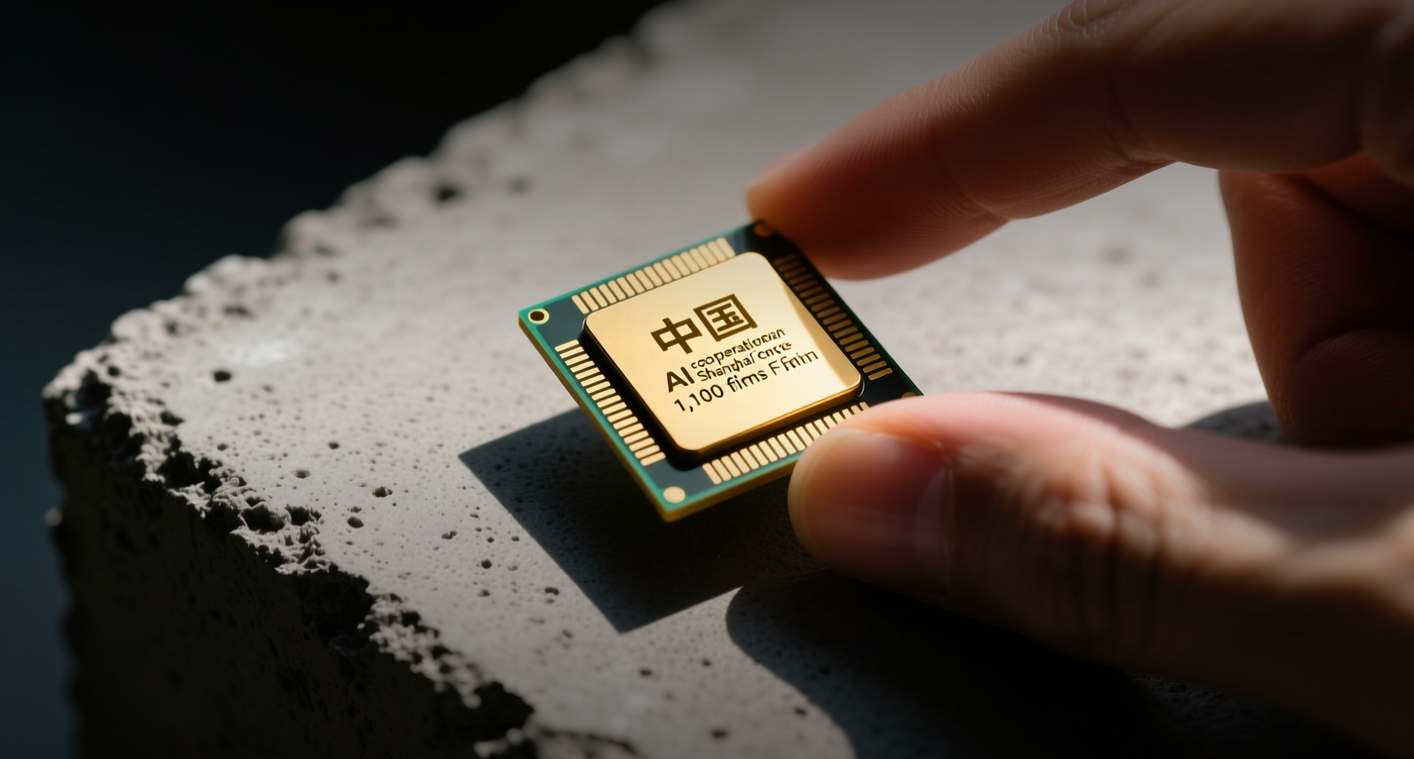
China unveils AI cooperation plan at Shanghai conference with 1,100 firms
**China's top economic planner released two AI policy documents at the 2026 WAIC as Beijing pushes to shape global AI governance.** China's National Development and Reform Commission on Friday released an AI Cooperation Development Action Plan and a case collection at the 2026 World Artificial Intelligence Conference, as Beijing accelerates efforts to set global AI governance standards. "China is committed to promoting AI access and ensuring the benefits of artificial intelligence are shared by all countries," President Xi Jinping said in a speech at the Shanghai conference, according to state media reports. The action plan outlines Beijing's framework for international collaboration on AI research, standards and ethics. The companion "China Smart · Benefits the World (2026)" case collection highlights more than 50 Chinese AI projects deployed across healthcare, education and smart-city systems globally. The four-day event, running through July 20, features over 1,100 domestic and international companies unveiling more than 300 products making their global debut. The policy push comes as China and the US compete for dominance in a global AI market projected to exceed $2 trillion by 2030. Beijing's ability to set governance norms could determine which technologies and standards prevail in emerging markets across Southeast Asia, Africa and Latin America — regions where Chinese tech giants including Huawei, Alibaba Group Holding Ltd. and Baidu Inc. already have deep commercial ties. ## A Contrast to US-Led Export Controls The action plan represents China's most detailed public framework for AI cooperation since Xi's Global AI Governance Initiative proposed in 2023. Unlike the European Union's AI Act, which emphasizes risk-based regulation, Beijing's approach focuses on development access and technology sharing among developing nations — a deliberate counterpoint to US-led export controls that restrict Chinese access to advanced semiconductors from Nvidia Corp. and Advanced Micro Devices Inc. For Chinese AI companies, the policy provides continued central government backing at a time when US sanctions have limited access to Nvidia's H100 and B200 graphics processing units. Domestic chip makers including Huawei Technologies Co.'s Ascend division and Shanghai-based Enflame Technology Co. stand to benefit from the push for self-reliance, while Alibaba's Tongyi Qianwen and Baidu's Ernie Bot large-language models compete for market share in China's rapidly expanding AI sector. The policy clarity could boost sentiment for Chinese AI and tech stocks listed in Hong Kong and Shanghai. The Hang Seng Tech Index has gained 18% year-to-date through Thursday, partly on expectations of government AI support. Alibaba trades at 11 times forward earnings, a discount to US peers, while Baidu's AI cloud revenue grew 12% in the most recent quarter. Investors will watch for implementation details and specific funding commitments in the months ahead. This article is for informational purposes only and does not constitute investment advice.

Jul 17 2026, 04:31
Taylor Farms lettuce linked to 4,300+ cyclosporiasis cases at Taco Bell
Investigators linked shredded iceberg lettuce from Taylor Farms supplied to Taco Bell to a cyclosporiasis outbreak that has sickened more than 4,300 people in Michigan. "The signal we have gotten is that there is a very high percentage of people who got sick at Taco Bell, and when investigators asked what their menu items were in common, lettuce came up frequently," one person familiar with the investigation told the Washington Post. Michigan health officials reported 4,312 cases Thursday, with Ohio and New York also logging large numbers of infections. The CDC has confirmed 1,645 cases across 34 states and is investigating roughly 5,100 additional possible cases. At least 141 people have been hospitalized; no deaths have been reported. The outbreak, which began May 1, has been concentrated in the Great Lakes region. The FDA is expected to advise consumers to avoid shredded lettuce at Taco Bell restaurants in Michigan, Ohio, West Virginia, Kentucky and Indiana. Taco Bell earlier this week removed lettuce, cilantro, onion, pico de gallo and guacamole from some Detroit-area restaurants as a precaution. The CDC this week identified a likely link among cases in Michigan, Ohio, West Virginia and Kentucky, suggesting many infections may stem from a common source, according to the Washington Post report. Yum! Brands (YUM.N), Taco Bell's parent company, and Taylor Farms did not respond to requests for comment. White House press secretary Karoline Leavitt said Thursday the Trump administration "has a handle on the situation," though she acknowledged an "unusually high number of cases" and reiterated CDC guidance to wash and cook raw produce. The outbreak has drawn scrutiny to changes in federal disease tracking. The Trump administration scaled down a federal program that previously required 10 states to monitor cyclospora, the parasite that causes cyclosporiasis. Health experts have warned the reduced requirements could make it harder to identify and track foodborne illnesses. Cyclosporiasis is contracted by consuming food or water contaminated with feces and causes diarrhea, nausea and other gastrointestinal symptoms. The identification of Taylor Farms lettuce as the likely source gives investigators a clear target for containment, though the six-week reporting lag means case counts will continue rising. Investors will watch for any broader menu changes or supply chain disruptions at Yum! Brands as the investigation progresses. This article is for informational purposes only and does not constitute investment advice.