Edgen AI operates independently of, and is not controlled by Aspen Digital Financial Limited.
Dollar Tree lifts 2026 EPS outlook as $210M refund reinvestment weighs
 Edgen Stock·Sep 22 2026, 17:31
Share to
Share to
Copy link


[1] DLTR Lifts 2026 Earnings Outlook as Tariff Refunds Fund Reinvestment (https://www.zacks.com/stock/news/2993898/dltr ...)[2] Is DLTR a Buy as Earnings Improve but Margin and Tariff Risks Remain? (https://finance.yahoo.com/markets/stocks/arti ...)[3] DLTR Falls 17.9% in the Past Month as Margin Risks Test Its Rebound (https://finance.yahoo.com/markets/stocks/arti ...)
Related News

Sep 22 2026, 18:10
Oil risk premium deflates as Trump says 3-hour Iran talks were fruitful
President Donald Trump said US officials met an Iranian delegation for three hours on the sidelines of the United Nations General Assembly, describing the encounter as "very good" and confirming a further round of talks has already been arranged — the first direct contact between the two governments since a June memorandum of understanding collapsed. "It was a meeting that lasted for three hours; it ended an hour ago," Trump told reporters in New York on Tuesday. "It was a very good meeting. I can't imagine why they wouldn't want to do it; it's greatness or obliteration." He added that "a settlement is going to be reached" and that "the relationship is developing." The headline cut against seven months of escalation. Trump told the same gathering that Iran had refused to end its nuclear program and called on all nations to join Washington's economic pressure campaign, while Iran's Revolutionary Guard spokesman Hossein Mohebbi said Tehran had "toughened our conditions" after the June deal broke down. Iranian Foreign Minister Abbas Araghchi met Qatari Prime Minister Sheikh Mohammed bin Abdulrahman Al-Thani in New York to discuss "efforts being made to de-escalate," according to Doha's foreign ministry. The market transmission runs through the Strait of Hormuz, which handles roughly a fifth of global seaborne crude. Brent's geopolitical risk premium had been inflated by Houthi attacks on Saudi Arabia, the capture of Perim Island in the Bab el-Mandeb, and Iraqi airports being ordered to stop accepting Iranian aircraft as of midnight to comply with US sanctions. Any credible path to sanctions relief reopens the Iran supply channel — the single largest dormant barrel source outside OPEC's spare capacity — and that is what oil, gold and the dollar are now pricing. The safe-haven leg is the most reversible. Gold and the dollar index had both carried a Middle East escalation bid through the summer; a scheduled follow-up meeting at the presidential level removes the immediate tail risk without removing the sanctions architecture that keeps Iranian barrels off the market. That distinction matters: sentiment can reprice in a session, but supply cannot restart without Treasury licenses and shipping insurance that no one has yet agreed to issue. ## What has to change for Iranian barrels to actually return Trump has leverage he has not yet spent. Ali Vaez, deputy program director for the Middle East and North Africa at the International Crisis Group, said the president could offer "removing naval blockades on Iranian ports, rolling back sanctions against Tehran, or returning access to certain frozen assets." Vaez added: "The most important thing for Iranians is economic reprieve and that's precisely where President Trump has tremendous leverage." The Gulf states are the likely brokers. Trump met leaders from Saudi Arabia, the UAE, Qatar, Bahrain, Kuwait and Oman on Tuesday, with US Ambassador to the UN Mike Waltz saying the president "truly values hearing from them and hearing their concerns" directly. Vaez said Qatar could lead mediation with backing from Saudi Arabia, Oman, Turkey, Pakistan and Egypt. Pakistan, Turkiye, Saudi Arabia and Egypt issued a joint statement stressing that "dialogue and diplomacy remain the only path towards sustainable resolution." The historical template is cautionary. The June memorandum of understanding produced a brief moderation in regional tension — Saudi crude exports rose 3.3 percent in July to 4.125 million barrels per day, the highest since March, on data from the Joint Organisations Data Initiative — before the deal broke down and exports from Red Sea terminals weakened again on renewed Houthi activity. UBS analyst Giovanni Staunovo attributed the July increase to "regional tensions moderated," a phrase that has since been overtaken. ## The binary that sets the next move in crude Trump framed the choice in explicitly binary terms at the assembly: "Will a deal be made with Iran that lets them rebuild and create a far greater country than it ever was before … or do I annihilate the Islamic republic, and do it quickly?" He also said he believes a deal comes "after the election," which pushes any durable resolution past the near-term window and leaves the risk premium oscillating on headlines rather than fundamentals. Vaez put the odds of a breakthrough this week low. "There are very serious differences, and there's deep mistrust," he said. "And so that's why I'm not very optimistic." Sanam Valki, director of the Middle East and North Africa Programme at Chatham House, said a direct exchange between the delegations would be "a big deal" because it would mean Iran's president is willing to risk his standing at home "in order to stave off a serious military attack and build a direct lifeline to the Trump team." For positioning, the asymmetry is now skewed. If the scheduled follow-up round produces sanctions relief or asset unfreezing, crude gives back more of the war premium and the dollar's safe-haven bid fades further. If it stalls — or if Washington proceeds with what Valki described as "another round of serious and severe strikes against the Islamic Republic" — the premium re-inflates quickly, with European jet fuel already running a daily shortfall of 510,000 barrels and reserves at a seven-year low, according to former Iranian roads minister Mehrdad Bazrpash. This article is for informational purposes only and does not constitute investment advice.

Sep 22 2026, 18:04
Grok Bot hits 418,000 users as SPCX seeks AI revenue
SpaceXAI's Grok Bot reached 418,000 users as of Sept. 14, a 24% weekly gain roughly a month after the autonomous agent launched, according to a company presentation shown at a London event and people in the room who spoke on condition of anonymity. The figure, reported by Bloomberg News, covers weekly users of a product SpaceXAI is counting on to establish itself in enterprise AI agents against Anthropic PBC and OpenAI. "This is a real product with real early traction, but 418,000 weekly users is a rounding error against the enterprise seat counts that justify agent valuations," said Alex Nguyen, an analyst covering enterprise AI adoption at Edgen. "The number that matters is not users. It is revenue per user, and SpaceXAI has not disclosed it." The milestone is the first hard adoption data point since Grok Bot's mid-August debut. SpaceXAI has positioned the agent as an enterprise tool bundled into tiers of its AI subscription plans, and also sells it as a standalone app. It is designed to work like an always-on employee rather than a chatbot: answering email, updating sales databases, processing invoices and filing software bugs. The company did not respond to requests for comment, and the current weekly user number could not be learned. The comparison that matters is Meta Platforms Inc.'s Muse, a consumer-facing free app that topped Apple Inc.'s App Store free rankings this week and has been downloaded four times more than Grok Bot, according to Bloomberg Intelligence. Muse's early traction drew analyst comparisons to ChatGPT's late-2022 breakout. The two products are not directly comparable — Muse is free and consumer-oriented, Grok Bot is priced and enterprise-oriented — but the download gap sets the reference frame investors will use. ## The revenue math behind 418,000 users SpaceXAI has spent the past three months buying its way into position. The company completed a $60 billion acquisition of AI coding startup Cursor, released Grok 4.5 in July as a cheaper option for coding, finance and legal tasks, and introduced Grok 4.7 this week with longer-horizon task handling. None of those announcements came with disclosed agent revenue. That gap matters because of the parent. Grok Bot operates under Space Exploration Technologies Corp. (NASDAQ: SPCX), which carries a $2.06 trillion market cap and a forward price-to-earnings ratio of 1,052.69, according to Seeking Alpha data, on revenue growth of 33.24% year over year. At that multiple, the equity is priced for a business that does not yet exist in reported financials. SPCX traded at $153.57, up 1.13%, on Sept. 22. The competitive field is not waiting. OpenAI and Anthropic PBC both sell enterprise agents with disclosed seat-based pricing, and Microsoft Corp. bundles agent capability into existing enterprise agreements — a distribution advantage SpaceXAI cannot match through a standalone app. Grok Bot's 24% week-over-week growth is strong at this stage, but it is growth off a small base, and the agent market's enterprise buyers evaluate on integration depth and compliance, not download counts. ## What would change the story Two disclosures would convert this from a sentiment event into an earnings event. First, paid conversion: how many of the 418,000 weekly users sit inside a paid subscription tier rather than a free trial. Second, revenue per seat, which would let investors compare Grok Bot against Anthropic's and OpenAI's enterprise contracts on a like-for-like basis. SpaceXAI has disclosed neither, and the presentation shared in London contained no pricing detail. Until then, the milestone functions as narrative support for SPCX rather than a valuation input. The stock's 1,052x forward multiple leaves no room for an agent business that stalls at hundreds of thousands of users instead of millions of paid seats. The next scheduled test is SpaceXAI's next model or agent release cadence — Grok 4.7 arrived this week — and any quarterly disclosure that separates AI segment revenue from the launch and Starlink businesses. For investors in AI-agent peers, the read-through is narrower than the headline suggests. A 418,000-user milestone with no attached revenue does not confirm enterprise agent demand at scale; it confirms that SpaceXAI can ship a product and get people to try it. The companies that have disclosed agent revenue — and the enterprise software vendors bundling agents into existing contracts — remain the cleaner way to own the theme until SpaceXAI publishes numbers. This article is for informational purposes only and does not constitute investment advice.
Sep 22 2026, 17:55
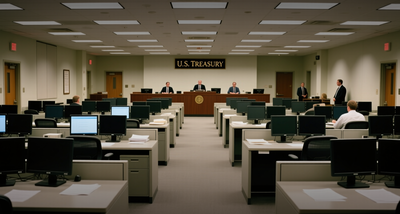
Two-year Treasury auction clears at 4.757% as Fed hike bets build
Investors demanded the highest yield at a two-year U.S. Treasury auction since 2024, a print that confirms the front end of the curve has fully repriced for a Federal Reserve that raised rates last week and has spent the days since telling markets not to expect a pause. The $69 billion sale cleared with the two-year yield at 4.757%, the richest auction result since 2024, according to auction data released Tuesday. The result landed alongside a $183 billion week of Treasury supply and three Fed speakers, and it came five days after the Federal Open Market Committee lifted the fed funds target range by 25 basis points to 3.75%-4.00% on a 12-0 unanimous vote — its first increase since July 2023. "The auction is the market's receipt for the Fed's guidance," said James Okafor, rates strategist covering Treasury market structure. "When the front end clears at a four-year high, it is not a demand problem — it is a price problem. Buyers are simply charging the Fed's own forecast back to it." The repricing is visible across the curve. The two-year sits at 4.757% while the 10-year has slipped to 4.955%, back below the 5% line, as oil's collapse drained the inflation premium from longer maturities. That is a flattening curve: the front end is pricing policy, the long end is pricing disinflation. The dollar index closed Monday at 100.43, up 0.22% and its highest close since late July, capping a weekly gain of roughly 1.02% — its best in more than three months — and held above the 100.00 handle through Tuesday's Asian session. ## The dot plot did the work before the auction did The hawkish turn was telegraphed on September 16. The Fed's summary of economic projections showed 16 of 18 policymakers expect at least one more increase this year, lifting the median year-end projection to 4.1%. Chair Warsh called inflation "too high and persistent too long" without committing to a move at the next meeting — a deliberate hedge that left the pricing work to the data and to his colleagues. They have filled the gap. St. Louis Fed President Musalem said core inflation may be running a full percentage point above target and that rates "may need to rise further." Minneapolis Fed President Kashkari argued inflation is too high across the economy. Chicago Fed President Goolsbee warned that repeated supply shocks can no longer be treated as noise. Futures now price roughly 50% to 56.5% odds of an October increase and 88% for December, with a 42.4% probability of at least two more moves by year-end. The last time the Fed raised rates and followed with this density of hawkish commentary was the 2022-2023 tightening cycle, when the two-year yield peaked above 5% and the S&P 500 fell 25% peak-to-trough over ten months. The transmission is already running through currencies. EUR/USD traded near 1.1464, within a whisker of its September low of 1.1455 and below its 50-day average. GBP/USD slipped to 1.3369, a fifth decline in six sessions and its weakest since late July. USD/JPY held near 157.29-157.42, a second straight down session with Japanese markets closed through September 23. ## Europe isn't the problem — it just isn't hawkish enough The euro's weakness is relative, not absolute. The ECB did hike this month on a unanimous vote and lifted its 2026 inflation forecast to 3% from 2.6%, with officials hinting at another move as early as October. But Chief Economist Lane cautioned that an energy shock could delay the return to 2% until after mid-2027, and traders have trimmed ECB hike bets. The Bank of England has now held rates six times in a row at 3.75% on a 6-3 split, with UK inflation at 3.1%. European government bonds rallied hard on the oil move, with German 10-year yields falling 7 basis points to 3.45% — their biggest drop in four months. That divergence, a Fed still hiking against an ECB and BoE that are pausing or hesitating, is the mechanical source of dollar strength. For risk assets, the arithmetic is straightforward. A higher risk-free rate raises the discount rate applied to every future cash flow, which compresses multiples hardest at the long-duration end of the equity market — growth and technology names, small caps, and rate-sensitive real estate. Short-duration cash proxies and the dollar are the beneficiaries. A sustained rise in hike expectations tightens financial conditions without the Fed having to do anything further. The near-term calendar is thin on data and heavy on communication. Weekly ADP employment figures and the Richmond Fed manufacturing index land at 10:00 ET, followed by New York Fed President Williams at 10:05 and Vice Chair Jefferson at 10:20, both speaking at the 2026 U.S. Treasury Market Conference. Richmond Fed President Barkin follows at 13:00, the same hour the two-year auction results crossed. Five-year notes worth $70 billion come September 23 and $44 billion of seven-year notes on September 24. If Williams or Jefferson echo Musalem on inflation, the dollar extends toward 101.00 and EUR/USD tests 1.1455 in earnest. If either downplays the October meeting, or the coming supply draws weak demand, the index slips back below 100.00 and the crowded short positions in the euro and sterling get squeezed. With no major release until the flash PMIs later in the week, three speeches carry outsized weight for positioning. This article is for informational purposes only and does not constitute investment advice.