Edgen AI operates independently of, and is not controlled by Aspen Digital Financial Limited.
BOSS ZHIPIN founder sells $110M stake to pay China trust tax
 Edgen Stock·Sep 22 2026, 12:04
Share to
Share to
Copy link


[1] BOSS ZHIPIN-W Founder Reportedly Sells Shares Worth HKD863M to Pay China's New Offshore Tax (https://www.aastocks.com/en/stocks/news/aafn- ...)[2] China's offshore trust tax crackdown could impact single stocks, BofA says (https://www.aol.com/articles/chinas-offshore- ...)[3] China offshore trust tax crackdown raises short-term risks for selected Hong Kong and U.S.-listed stocks (https://tradersunion.com/news/financial-news/ ...)
Related News

Sep 22 2026, 12:59
Gold slides toward $4,300 after rejection at $4,400 resistance
Sellers turned gold back from the $4,400 ceiling for a second time this quarter, and the metal was quoted at $4,302.60 an ounce at 09:50 UTC, roughly $95.60 beneath an intraday peak of $4,398.20, according to LBMA benchmark pricing. That leaves bullion's near-term direction resting on the $4,300 round number, the line traders have treated as the boundary between an ordinary pullback and a change in trend. Gold has not closed below that level since its run above $4,000. "Gold's failure at $4,400 was a positioning event, not a fundamental one," Omar Tariq, commodities strategist at Edgen, said. "The market crowded into the breakout and there was no marginal buyer left to clear the offer once the level was tested. The $4,300 shelf is where the real test sits." The swing from high to current price amounts to 2.2%. COMEX gold futures open interest built through the run into $4,400 before flattening as the level was tested, exchange data shows. Silver, which typically amplifies gold's directional moves, has lagged the yellow metal over the same stretch, a divergence that has historically preceded consolidation rather than reversal. ## Why $4,300 Is the Level That Matters The $4,300 area has served as a pivot since gold's advance above $4,000. A sustained close below it would open the path toward the $4,200 shelf, the last congestion zone before the metal's prior breakout base. Reclaiming $4,400 would restore the uptrend and put the record high back in play. Gold remains well above its 50-day moving average, a technical anchor that has held on every pullback since the breakout above $4,000. That distance is the main argument against reading the current slide as a reversal. The failed push also reflects a shift in the safe-haven bid that drove gold's advance. Demand for defensive assets has cooled as risk appetite steadied, removing one of the marginal buyers that had supported the rally. That sentiment shift is sector-wide rather than gold-specific, and it is the variable most likely to determine whether $4,300 holds. ## Dollar and Real Yields Set the Backdrop Gold's pullback is unfolding against a firmer dollar and steady real yields, the two inputs that most reliably move bullion. A stronger greenback raises the cost of gold for non-dollar buyers, while higher real yields increase the opportunity cost of holding a non-yielding asset. The cross-asset read matters for gold-linked instruments. Miner equities typically carry two to three times the beta of the metal itself, so a 2.2% spot decline translates into a sharper move in producers. Gold-backed exchange-traded funds, which track spot closely, face redemption pressure if the $4,300 level gives way. For scale, the retreat from $4,400 is modest against the broader advance that carried gold above $4,000. The metal has not surrendered its structural bid, and central bank accumulation remains a persistent source of physical demand that has absorbed prior selloffs. The next signal comes from the $4,300 close. A hold keeps the uptrend intact and sets up another run at $4,400. A break shifts the focus to $4,200 and forces a reassessment of how much of the safe-haven premium is still priced in. This article is for informational purposes only and does not constitute investment advice.
Sep 22 2026, 12:55
Gunnison Copper hits commercial production after 1.3 million lb August
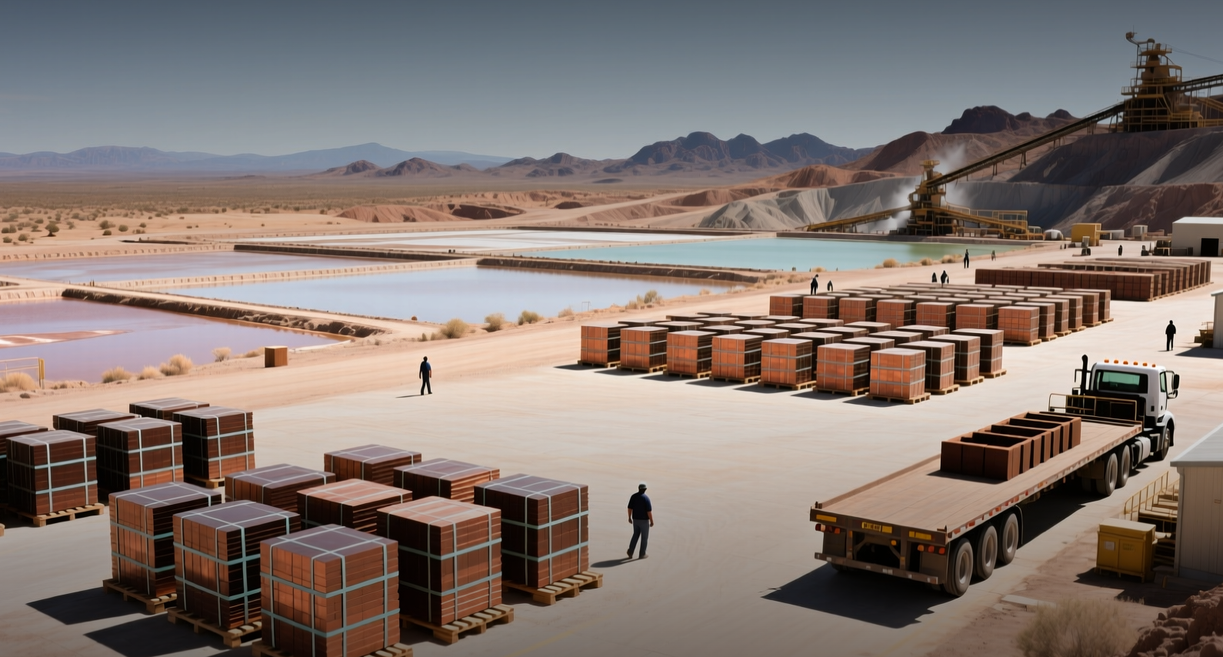
Gunnison Copper Corp. declared commercial production at its Johnson Camp Mine in Cochise County, Arizona, in September 2026, after the operation poured 1,304,448 pounds of copper cathode in August, the most in any month since the restart. "Following record production of more than 1.3 million pounds of copper in August, the continued operating performance through September demonstrates the progress we have made in establishing sustained operations at Johnson Camp," Craig Hallworth, President and Chief Executive Officer of Gunnison Copper, said. The Toronto-listed company (TSX: GCU, OTCQB: GCUMF, FSE: 3XS0) said Johnson Camp produced a further 894,767 pounds of cathode between September 1 and September 17, keeping output above the operating threshold required to make the commercial-production designation stick. The August figure was the highest monthly total since operations restarted, and the September run rate implies roughly 1.6 million pounds on a full-month basis if sustained. **Key Takeaways:** - Gunnison Copper declared commercial production at Johnson Camp Mine in September 2026 after record August output. - August cathode production reached 1,304,448 lbs; September 1–17 added 894,767 lbs, above the operating threshold. - Johnson Camp is funded by Nuton LLC and ramps toward nameplate capacity of 25 million lbs annually. ## Arizona cathode, no offshore smelting Johnson Camp produces 99.999% pure copper cathode from Arizona ore, converting metal to finished cathode on site rather than shipping concentrate to overseas smelters. That distinction matters for a US market where domestic refined copper supply remains thin relative to consumption: the mine's 25-million-pound nameplate capacity equals roughly 0.9% of the 2.8 billion pounds of refined copper the United States consumed in 2024, according to US Geological Survey data. For scale, Freeport-McMoRan's Morenci operation in the same state produces several hundred million pounds of copper annually, making Johnson Camp a small but fully domestic addition to the refined supply chain. The asset is fully funded by Nuton LLC, a Rio Tinto venture, which carries the stage 2 work program and the deployment of Nuton's leaching technology at the site. Gunnison's flagship Gunnison Project, roughly 1.9 miles from the Johnson Camp processing facilities, holds a Measured and Indicated resource of 846 million tons grading 0.33% total copper, containing 5.19 billion pounds of metal, per the NI 43-101 technical report with an effective date of March 18, 2026. A preliminary economic assessment on that project, also dated March 2026, put NPV8% at $2 billion, IRR at 23% and payback at 3.9 years. ## The Q4 test is throughput, not the milestone Commercial production converts Johnson Camp from a restart-stage asset into an operating mine, which changes how the market values it: revenue recognition begins, and the Nuton funding structure faces its first real test of whether the leach circuit can hold grade and recovery at scale. The gap between the September run rate and the 25-million-pound nameplate is the number to watch. At 1.6 million pounds a month, annualized output would be roughly 19 million pounds, or about 77% of capacity — close enough that the remaining ramp is a matter of leach kinetics and solution flow rather than new capital. Copper prices provide the backdrop. LME copper has traded in a broad range through 2026 as Chinese demand growth cooled against supply tightness at major mines, and US producers have benefited from a domestic premium tied to tariff and supply-security policy. Gunnison's pitch rests less on the copper price than on the location of the metal: cathode produced and finished in Arizona, sold into US defense, energy and technology supply chains without crossing a border for processing. The next hard data point is Q4 production. Gunnison has not yet disclosed October output or a formal 2026 production guidance range, and the company's ability to keep monthly cathode volumes above the operating threshold through year-end will determine whether September's designation reads as a genuine inflection or a well-timed announcement. This article is for informational purposes only and does not constitute investment advice.
Sep 22 2026, 12:52
Hyperscale Data carves out Patriot BTC to split mining from AI
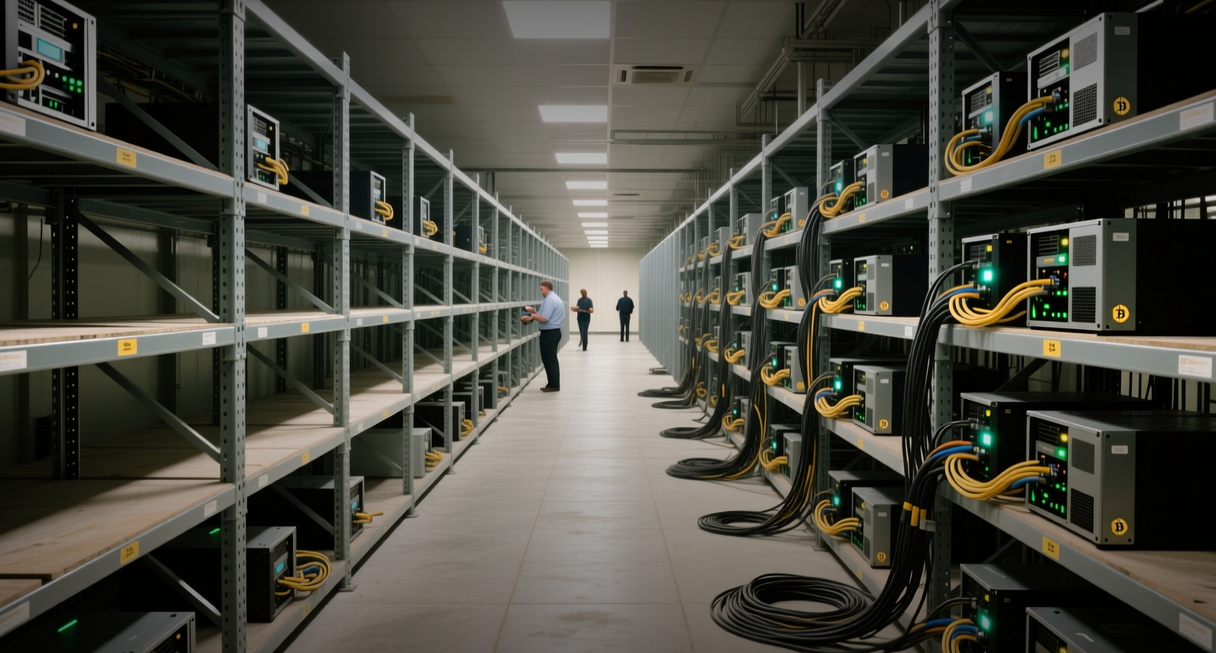
A new subsidiary called Patriot BTC would absorb every operating asset behind Hyperscale Data's crypto mining business — the Montana data center, its miners and supporting equipment — under a plan the company announced Sept. 22, 2026, leaving the Michigan campus to stand alone as an AI data center. The Las Vegas-based operator, listed on NYSE American as GPUS, said it has not approved a transaction structure, a capitalization or a timeline for the move. "Bitcoin mining and AI data center development have different capital requirements, operating priorities and value drivers," Milton "Todd" Ault III, Executive Chairman of Hyperscale Data, said. "Separating the businesses is intended to give each a clearer mandate and allow us to remain focused on positioning the Michigan facility for a potential sale, public-company transaction or internally funded development." The carve-out would leave Patriot BTC holding two asset groups: the Montana data center and associated infrastructure, and the miners and equipment that generate Bitcoin. Management may recommend that the board pursue a transaction placing Patriot BTC inside a publicly traded entity, whether through a separation or another structure, though the company said it has not selected one. Any deal would need board approval, compliance with federal and state securities laws, NYSE American listing requirements, and resolution of tax, accounting and capitalization questions. Hyperscale Data said it will disclose Patriot BTC's capitalization, the final asset list and its reporting structure as those are determined. The split formalizes a retreat that has been underway for months. Hyperscale Data ceased Bitcoin mining at the Michigan facility on Sept. 2, 2026, and has been redirecting capital toward AI hosting. In August it set up a Bitcoin-backed lending program through the Morpho protocol, borrowing roughly $30 million at 4.9% to fund Michigan expansion, and in July it said it expects to sign an AI data center and neocloud services agreement with a California-based AI company. Omnipresent Robotics began installing OPR-R2 robots at the Michigan site the same month. The company reported higher preliminary first-half revenue on July 29 and reaffirmed guidance for the first half of 2026. The strategic logic rests on a valuation gap that has widened across the sector. AI data center operators with contracted capacity and named hyperscaler tenants command revenue multiples that Bitcoin miners — whose cash flow moves with hash price and power costs — do not. Hyperscale Data's own shares have fallen 79.29% year to date to $0.1901, a decline that reflects both the mining exposure and the company's small-cap structure. Splitting the two would let investors underwrite the Michigan campus on AI hosting economics while valuing Montana on mining economics, a sum-of-the-parts argument the company has effectively made without committing to numbers. Peers illustrate the spread. Core Scientific and Applied Digital have both been re-rated as their capacity shifted from mining toward AI and high-performance computing contracts, while pure miners such as Riot Platforms and CleanSpark continue to trade on Bitcoin price and production metrics. Hyperscale Data's Michigan campus competes for the same AI tenants as those operators, and its ability to sign a named customer — the California agreement remains unsigned — is the variable that would move the AI-side valuation most. The structure also carries execution risk. Patriot BTC does not yet exist, and the company has not said how it would be capitalized or whether existing GPUS holders would receive shares. A spin-off, a reverse merger into a listed shell and a sale of the mining assets are all still open, and each produces a different outcome for shareholders. The company separately expects the divestiture of its Ault Capital Group subsidiary to occur in 2027, meaning GPUS holders face two corporate separations running on overlapping timelines. For investors, the near-term read is limited. The announcement contains no financial terms, no valuation and no date, so there is nothing yet to model. GPUS closed 4.57% higher at $0.1901 on Sept. 21, 2026, and added 1.33% pre-market, a move consistent with a headline reaction rather than a re-rating. The re-rating case depends on the next disclosure: Patriot BTC's capitalization, the final asset contribution and whether the Michigan facility lands a signed AI customer or a buyer. This article is for informational purposes only and does not constitute investment advice.