Edgen AI operates independently of, and is not controlled by Aspen Digital Financial Limited.
Augustus raises $180M to build clearing bank for stablecoin era
 Edgen Crypto·Jul 21 2026, 15:30
Share to
Share to
Copy link

[1] Augustus raises $180 million to build a clearing bank for the AI and stablecoin era (https://www.coindesk.com/business/2026/07/21/ ...)[2] Augustus Announces $180M Series B at $1B Valuation to Give International Fintechs and Banks Access to the US Dollar (https://www.prnewswire.co.uk/news-releases/au ...)[3] Tiger Global leads round for bank startup Augustus (https://seekingalpha.com/news/4615827-tiger-g ...)[4] Augustus Announces $180M Series B at $1B Valuation to Give International Fintechs and Banks Access to the US Dollar - PR Newswire (https://www.prnewswire.com/news-releases/augu ...)
Related News

Jul 21 2026, 19:07
XRP Ledger nears 10 million agentic payments after x402 Foundation entry
**The XRP Ledger has processed more than 1 million agentic payments in roughly four weeks and is on track to hit 10 million, as Ripple takes a governance seat alongside Visa and Mastercard in the standard that lets AI agents pay each other.** XRP Ledger agentic transactions are approaching 10 million after surpassing 1 million in roughly four weeks, each costing a fixed $0.0002. "The x402 Foundation brings together 40 major organizations to build an open payment standard for AI agents, and Ripple's membership puts XRP and RLUSD inside that standard from day one," a Ripple spokesperson said. Ripple joined the x402 Foundation as a Premier Member on July 14, the same day the Linux Foundation formally launched the nonprofit to govern the protocol. The membership caps months of infrastructure work, including the June release of the XRPL AI Starter Kit — a developer toolkit that gives AI agents wallets and lets them pay in XRP or RLUSD without human approval. Mastercard also named Ripple as one of more than 30 launch partners for its own agent-payments network in the same period. The competitive backdrop matters. Coinbase's Base network has processed more than 119 million x402 payments, and Solana about 35 million, both with a year's head start and most volume settled in USDC. XRPL's 1 million transactions are early-stage by comparison, but the foundation is network-neutral — meaning XRP competes alongside USDC under the same protocol. Foundation membership gives Ripple a governance role in how the standard evolves, which matters more at this stage than raw transaction counts. ## What Ripple Brought Before the Membership The foundation membership follows deliberate infrastructure work rather than arriving as a standalone announcement. In June, Ripple released the XRPL AI Starter Kit, including an MCP documentation server, an agent wallet skill, and a payment tutorial that guides developers from initial setup to a confirmed XRPL transaction supporting x402 payments in XRP and RLUSD. Ripple-backed t54.ai followed with the XRPL AI Hub, providing resources for developers building AI-powered applications on the ledger. The XRPL's technical characteristics suit the use case. Transactions achieve deterministic finality in three to five seconds. Fees are predictable and fixed at approximately $0.0002. Agents can operate non-custodial wallets funded with XRP or RLUSD, paying for APIs, storage, and cloud computing without relying on banks, and can retain XRP earned from completed tasks to fund future operations. ## Where XRP Sits Against USDC in the x402 Race The x402 Foundation's broader membership underscores how seriously the largest technology and payments companies are treating the machine-economy payment layer. AWS, American Express, Cloudflare, Fiserv, Shopify, the Solana Foundation, and the Stellar Development Foundation are all Premier Members. The standard the foundation governs will likely become the default payment infrastructure for AI agents across the internet within this decade. Where XRP and RLUSD land in that standard's adoption curve depends on whether Ripple can convert its governance position and developer toolkit into the kind of institutional-grade transaction volume that USDC currently holds on Base. RLUSD, Ripple's dollar-backed stablecoin with a $1.26 billion market cap, gives agents a steady dollar to price things in, while XRP is the native asset the whole ledger runs on. Every payment uses a small amount of XRP in fees, agent wallets must hold XRP in reserve to function, and XRP can move liquidity between currencies when an agent needs it. The more agents transact on the ledger, the more of that activity runs through XRP. If AI agents become mainstream users of blockchain infrastructure, demand for assets that can settle payments quickly and cheaply could increase. XRP's low fees and three-to-five-second settlement time make it technically competitive, but sustained growth will depend on whether Ripple can convert its governance role, developer tools, and institutional partnerships into meaningful transaction volume rather than announcements alone. This article is for informational purposes only and does not constitute investment advice.
Jul 21 2026, 18:59
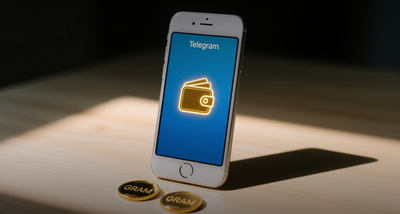
Telegram plans Gram wallet for 1 billion users after Toncoin rebrand
Telegram will roll out a native non-custodial Gram wallet to its more than 1 billion monthly active users this summer, founder Pavel Durov said on Tuesday, calling it the "largest rollout of a non-custodial crypto wallet in human history." "This summer will see the largest rollout of a non-custodial crypto wallet in human history. Instant zero-fee crypto transactions for over a billion users are about to become reality," Durov wrote on his official Telegram channel. The wallet will be native to GRAM, the token formerly known as Toncoin that was rebranded on June 15 with 81.22% community approval. GRAM traded at $1.53 as of Tuesday, up 8.4% in 24 hours with a $4.17 billion market capitalization, according to CoinGecko. The token ranks 25th among all cryptocurrencies but remains down more than 54% over the past year. The price move followed Durov's post, which marks his most aggressive step yet toward making Gram the default currency inside the messaging app. The announcement revives a promise Durov first made in November 2022, when he said Telegram would build non-custodial wallets and a decentralized exchange after FTX's collapse — a version that never shipped at scale. What changed is control: Telegram replaced the TON Foundation as the network's primary steward in May, became its largest validator, and cut transaction fees roughly sixfold. The structural shift means Telegram now owns the validator set, the token brand and the distribution channel, removing the dependency on third parties that stalled earlier efforts. **What the wallet rollout means for GRAM** The new wallet is separate from Wallet in Telegram, the custodial multi-chain product built by The Open Platform that has more than 150 million registered users. Andrew Rogozov, founder of TOP, said the two products will coexist for different audiences. "Telegram Wallet serves as a simple gateway into crypto, whereas Wallet in Telegram is built for users seeking advanced trading, investment, and asset management capabilities," Rogozov told BeInCrypto. Converting even 1% of Telegram's user base into active wallet holders would produce roughly 10 million participants, a figure comparable to the active user counts of several top-10 blockchain networks. The technical foundation for the zero-fee claim rests on TON's Catchain 2.0 consensus upgrade, which went live on April 9 and cut block times from roughly 2.5 seconds to about 400 milliseconds, reducing settlement to approximately one second. Skeptics remain. Blockstream CEO Adam Back recently questioned GRAM's inflation mechanics after Durov compared the token favorably with Bitcoin. Projected annual inflation rose from roughly 0.6% to about 3.6% following the network changes. Self-custody at Telegram's scale is also untested — whether a billion users activate the wallet rather than simply receiving it will determine the rollout's real impact. The wallet rollout is plausibly step five of a publicly stated seven-step roadmap that began with the Toncoin-to-GRAM rebrand. Durov has now promised this product twice. The difference is that he finally owns every piece required to deliver it. This article is for informational purposes only and does not constitute investment advice.

Jul 21 2026, 18:12
Kalshi's precious metals perpetuals face 45-day CFTC review
**Kalshi is pushing crypto-style perpetual futures into gold, silver and platinum, challenging CME Group's dominance in precious metals trading.** Kalshi filed with the Commodity Futures Trading Commission to offer perpetual futures on gold, silver and platinum, expanding the crypto-native derivative structure into traditional commodities under a 45-day regulatory review. "Perpetual contracts could provide lower costs and additional tools for managing risk," Udesh Jha, chief risk officer at Kalshi, said. The contracts would have no expiration date, allowing traders to maintain exposure without regularly rolling positions into new futures contracts. The company plans to initially offer trading 24 hours a day from Monday through Friday, matching the operating hours of the underlying precious metals markets. Kalshi became the first regulated US venue permitted to offer crypto perpetuals in May, a decision that prompted CME Group to sue the CFTC in June, arguing the contracts should be classified as swaps rather than futures and subjected to stricter regulation. The filing pits Kalshi directly against CME, which is launching continuous gold futures trading this week. The CFTC recently blocked a separate CME proposal for round-the-clock oil futures while continuing to review the exchange's application. Jha said perpetuals and traditional futures serve different market needs, arguing that perpetual contracts could provide lower costs for managing risk. Perpetual futures originated in crypto markets and have become increasingly popular because they provide leveraged exposure without a fixed settlement date. Their prices are typically kept close to the underlying asset through periodic funding payments. Demand for perpetual contracts tied to traditional assets has grown as platforms such as Hyperliquid expanded into gold, oil and other real-world markets. The products gained further attention during the Iran war, when crypto-based venues allowed traders to maintain exposure to oil while traditional futures markets were closed — a use case Kalshi's precious metals contracts could replicate for gold and silver traders. Kalshi is also evaluating perpetual products tied to foreign exchange and equities, having previously identified metals, currencies and energy as areas with growing demand. The company's expansion into traditional asset classes represents a convergence of crypto-native financial engineering with regulated US markets. **Regulatory Battle Lines** The CME lawsuit, filed in June, argues that Kalshi's crypto perpetuals should be classified as swaps rather than futures, which would subject them to stricter regulation under the Commodity Exchange Act. Kalshi has said the lawsuit would not change its approach. The dispute comes as traditional exchanges respond to growing demand for extended trading hours, with CME's continuous gold futures launch this week placing it in direct competition with Kalshi's proposed products. The CFTC's 45-day review window gives the regulator until early September to approve or reject the precious metals contracts. If approved, Kalshi would become the first US venue to offer regulated perpetual futures on both crypto and traditional commodities. This article is for informational purposes only and does not constitute investment advice.