Edgen AI operates independently of, and is not controlled by Aspen Digital Financial Limited.
Thales order intake jumps 21% to €12.47B as defence spending surges
 Edgen Stock·Jul 23 2026, 05:39
Share to
Share to
Copy link

[1] Thales Books Strong Orders as Defense, Aerospace Businesses Keep Growing (https://www.wsj.com/business/earnings/thales- ...)[2] Thales posts jump in first-half orders on surge in defence spending (https://www.aol.com/articles/thales-posts-jum ...)[3] Thales Soars: Order Intake Surges Amid Rising Global Conflicts (https://www.devdiscourse.com/article/internat ...)[4] TE Connectivity expects 15% sales growth in FY2026 while outlining $1.4B Astrodyne TDI acquisition (https://seekingalpha.com/news/4616804-te-conn ...)
Related News
Jul 23 2026, 06:59
Trump's Saudi nuclear deal drops nonproliferation safeguards in 30-year pact
**The Trump Administration signed a civilian nuclear agreement with Saudi Arabia on Wednesday that permits domestic uranium enrichment and rejects the IAEA's most stringent inspection protocol, breaking a two-decade US nonproliferation standard.** The 30-year pact, signed by Energy Secretary Chris Wright and Saudi Energy Minister Prince Abdulaziz bin Salman, allows US companies to build an enrichment facility in the kingdom following a two-year joint study into commercial viability. Saudi Arabia will not be required to adopt the International Atomic Energy Agency's Additional Protocol, which permits short-notice inspections of undeclared nuclear sites — a condition the UAE accepted in its 2009 nuclear deal with Washington. "The agreement upholds the highest standards of nuclear safety and nonproliferation," Wright said in a statement, without addressing the kingdom's rejection of the Additional Protocol. The deal marks a significant departure from what nonproliferation experts call the "gold standard" — a framework that prohibits domestic enrichment and plutonium reprocessing while mandating enhanced IAEA inspections. The UAE's Barakah nuclear plant, built with South Korean assistance under a 2009 "123 agreement," operates under those conditions. Saudi Arabia's deal includes neither restriction. **Why enrichment matters** Uranium enrichment is the most proliferation-sensitive stage of the nuclear fuel cycle. While enrichment alone does not produce a weapon — a nation must also master synchronized high-explosives technology — it creates the feedstock necessary for a bomb. Iran's enrichment program, which the US and Israel are currently targeting through military operations, demonstrated how civilian enrichment infrastructure can approach weapons-grade capability under the guise of peaceful purposes. Crown Prince Mohammed bin Salman has said the kingdom would pursue nuclear weapons if Iran develops one. Saudi Arabia already signed a mutual defense pact with nuclear-armed Pakistan in September 2025, after which Pakistan's defense minister said the country's nuclear program "will be made available" to the kingdom if needed — a statement widely interpreted as a warning to Israel, the Middle East's only suspected nuclear-armed state. **Regional proliferation risk** The weakened safeguards create a precedent that other US allies may follow. Turkey and Egypt have long expressed interest in nuclear energy, and the UAE — which accepted the gold standard as a condition of its 2009 deal — may now face pressure to renegotiate its commitments. The last time a Middle Eastern nation secured enrichment rights under a US civilian nuclear agreement was Iran's 1957 Atoms for Peace program, which ultimately contributed to Tehran's nuclear infrastructure. The deal now goes to Congress, where it faces scrutiny from lawmakers on both sides. Overturning it would require a two-thirds majority to override a presidential veto — a high bar in a politically divided chamber. The two-year enrichment study provides a procedural buffer, but critics argue it is a Washington dodge that delays rather than resolves the core nonproliferation question. For US nuclear contractors, the agreement opens a multi-billion dollar market in Saudi Arabia's civilian power program. For oil markets, the deal shifts Saudi energy strategy toward nuclear diversification, potentially reducing crude burn for domestic power generation over the long term. But the immediate risk premium in Middle East crude — already elevated by the ongoing US-Israel campaign against Iran — may rise further as the region's nuclear landscape becomes more contested. This article is for informational purposes only and does not constitute investment advice.
Jul 23 2026, 06:58
Chaff, a 70-year-old trick, returns in Ukraine's drone war
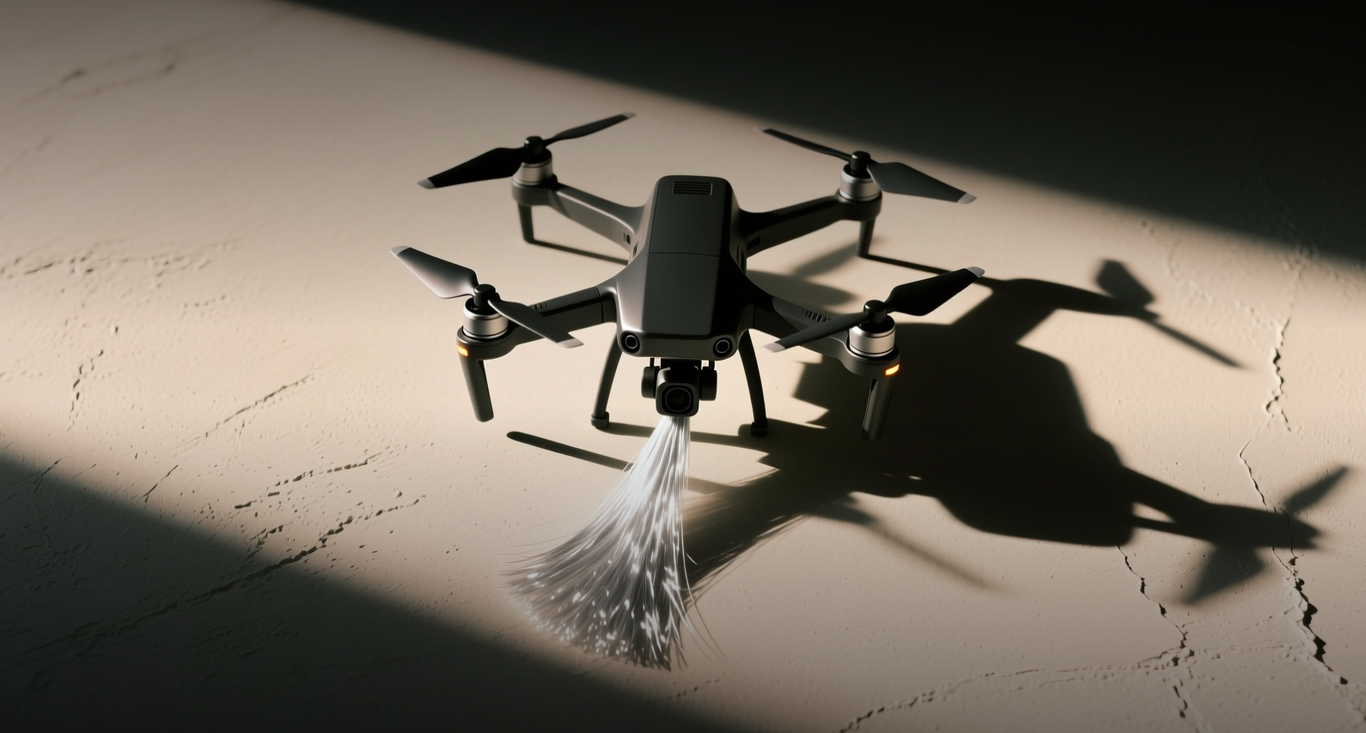
When Ukrainian drones struck Russia's Omsk refinery in July, they flew through undefended airspace — a luxury that will not last as Moscow densifies its radar networks, making chaff an increasingly vital countermeasure. "Chaff creates uncertainty across radar systems and complicates decision-making, forcing defenders to waste expensive interceptor missiles," said Robert Brüll, chief executive officer of FibreCoat, a company developing compact chaff systems for drones. The Omsk refinery, Russia's largest, had no air-defense coverage because Moscow considered the Siberian city beyond Ukraine's reach. The July strike knocked out its only primary refining unit. Chaff — tiny aluminum-coated glass fibers engineered to resonate at specific radar frequencies — has been used on military aircraft and warships since World War II but is only now being adapted for drone-scale deployment. Ukraine's deep-strike capability depends on getting drones through increasingly dense air-defense networks. Without countermeasures like chaff, each long-range mission becomes a high-risk gamble. With it, Ukraine can disguise the direction, size and makeup of an attack, splitting defenders' attention and improving the odds that strike packages reach their targets. The drone war in Ukraine shifted in 2023 with the mass adoption of first-person-view drones for tactical strikes a few kilometers beyond the front line. Now, long-range systems can hit targets hundreds of kilometers away — logistics hubs, ammunition depots, aircraft on the ground and defense-industrial facilities. But range alone is not enough. The utility of these drones depends on their ability to penetrate defended airspace. Chaff addresses this problem at a fraction of the cost of the missiles it confuses. When ejected from a drone, the fibers form a reflective cloud that produces radar returns strong enough to mask other aircraft or trick radar-guided missiles into locking onto the wrong target. Ukrainian deep-strike units already combine strike drones with unarmed decoys, but chaff offers a more scalable solution — one drone can release chaff to hide another, and a swarm can use the technique to confuse defenders about the attack's true direction. **The Economics of Countermeasures** The cost asymmetry is central to chaff's appeal. Radar-guided interceptor missiles can cost hundreds of thousands of dollars each, while chaff is cheap to produce and requires no sophisticated guidance systems. For Russia, defending against chaff-equipped drones means either investing in more expensive counter-countermeasure technology or accepting higher intercept failure rates — both unfavorable outcomes. The next step, according to Brüll, is making the countermeasure practical at drone scale. His company is among those developing compact chaff systems small and light enough for long-range unmanned aircraft, a capability once limited to manned jets and warships. The broader strategic context favors Ukraine's adaptation. Major General Mykhailo Drapatyi took over as Ukraine's commander-in-chief on July 21, bringing one of the military's most battle-tested commanders to its top post. On the diplomatic front, President Donald Trump promised during a July meeting in Ankara with President Volodymyr Zelensky to license Patriot missile production to Kyiv, addressing Ukraine's critically low interceptor stocks. The last time a low-cost countermeasure reshaped a conflict was the proliferation of man-portable air-defense systems in the 1980s, which forced a fundamental shift in how air forces operated. Chaff, if successfully scaled for drones, could have a similar effect on the economics of modern air defense — making it far more expensive for the defender than the attacker. *This article is for informational purposes only and does not constitute investment advice.*

Jul 23 2026, 06:57
Epstein-linked model scout Daniel Siad found dead at 69 in France
**The death of a French modeling scout whose name appeared more than 2,000 times in the Jeffrey Epstein files has denied alleged victims a criminal trial, as French prosecutors opened an inquiry into the circumstances.** Daniel Siad, 69, was discovered Monday evening by his 28-year-old roommate at his home in Colombes, a northwest suburb of Paris, the Nanterre prosecutor's office said. An autopsy has been ordered to determine the cause of death, with early reports suggesting possible cardiac arrest. "The stigma cast upon him — and by extension, his loved ones — and the daily pressure and anxiety he endured undoubtedly played a role," Ménya Arab-Tigrine, Siad's lawyer, said in a statement. "We must await the autopsy results to confirm whether his body simply gave out. He has died, and he was innocent." Siad had been under investigation since February 2026 on charges of organized human trafficking and conspiracy to commit a crime, French prosecutors confirmed. The probe remains active despite the termination of proceedings against him following his death, with authorities seeking to "identify all individuals potentially involved." Several women had filed criminal complaints accusing him of rape and human trafficking, including former Swedish model Ebba Karlsson, 56, who alleged Siad raped her in the south of France in 1990. Emails released by the U.S. Department of Justice showed Epstein paid Siad tens of thousands of dollars. In one 2014 exchange, Siad wrote to Epstein: "I had 2 girls from Sweden, a Slovakian, 2 French and a Russian." Epstein replied he would reimburse expenses. In another message, Siad sent a photo of a woman he described as having "potential" as a model or assistant. "Too old," Epstein responded. Siad consistently denied wrongdoing, telling CNN in a recent interview he "trusted" Epstein and believed him to be "a professional person." He claimed his relationship with the late financier was "strictly professional" and that he never witnessed any abuse. The death echoes that of Jean-Luc Brunel, another French modeling agent and Epstein associate, who was found hanged in his Paris prison cell in 2022 while awaiting trial on charges of raping minors. Epstein himself died by suicide in a New York jail in August 2019 while awaiting federal sex trafficking charges. "We are at a loss for words to describe the anger and sadness we feel," lawyers for several alleged victims said in a statement. Anne-Claire Lejeune, who represents six women who filed complaints against Siad, told French media her clients were "devastated, shocked and angry" that Siad died before he could be questioned by investigators. Lisa Brinkworth, co-founder of Victorious Angels, a group supporting alleged victims of Epstein associates, said the failure of French authorities to arrest Siad before his death was "beyond comprehension." She noted the case mirrors Brunel's death, where survivors were also denied their day in court. The Paris prosecutor's office confirmed Siad had been under surveillance including phone taps, but said there was insufficient evidence to justify an arrest before his death. The investigation into Epstein's network in France continues. *This article is for informational purposes only and does not constitute investment advice.*