Edgen AI operates independently of, and is not controlled by Aspen Digital Financial Limited.
Scancell to list on Nasdaq via Neuphoria merger and $89m financing
 Edgen Stock·Jul 23 2026, 08:12
Share to
Share to
Copy link

[1] Scancell to join Nasdaq through Neuphoria merger and $89 million funding package (https://www.proactiveinvestors.co.uk/companie ...)[2] Scancell to join Nasdaq through Neuphoria merger and $89 million funding package - Proactive financial news (https://www.proactiveinvestors.com/companies/ ...)[3] REG - Scancell Holdings - Merger and Financing - TradingView (https://www.tradingview.com/news/reuters.com, ...)[4] Scancell to Merge with Neuphoria and Secure Up to $89m for Phase 3 Melanoma Trial - TipRanks (https://www.tipranks.com/news/company-announc ...)
Related News
Jul 23 2026, 09:40
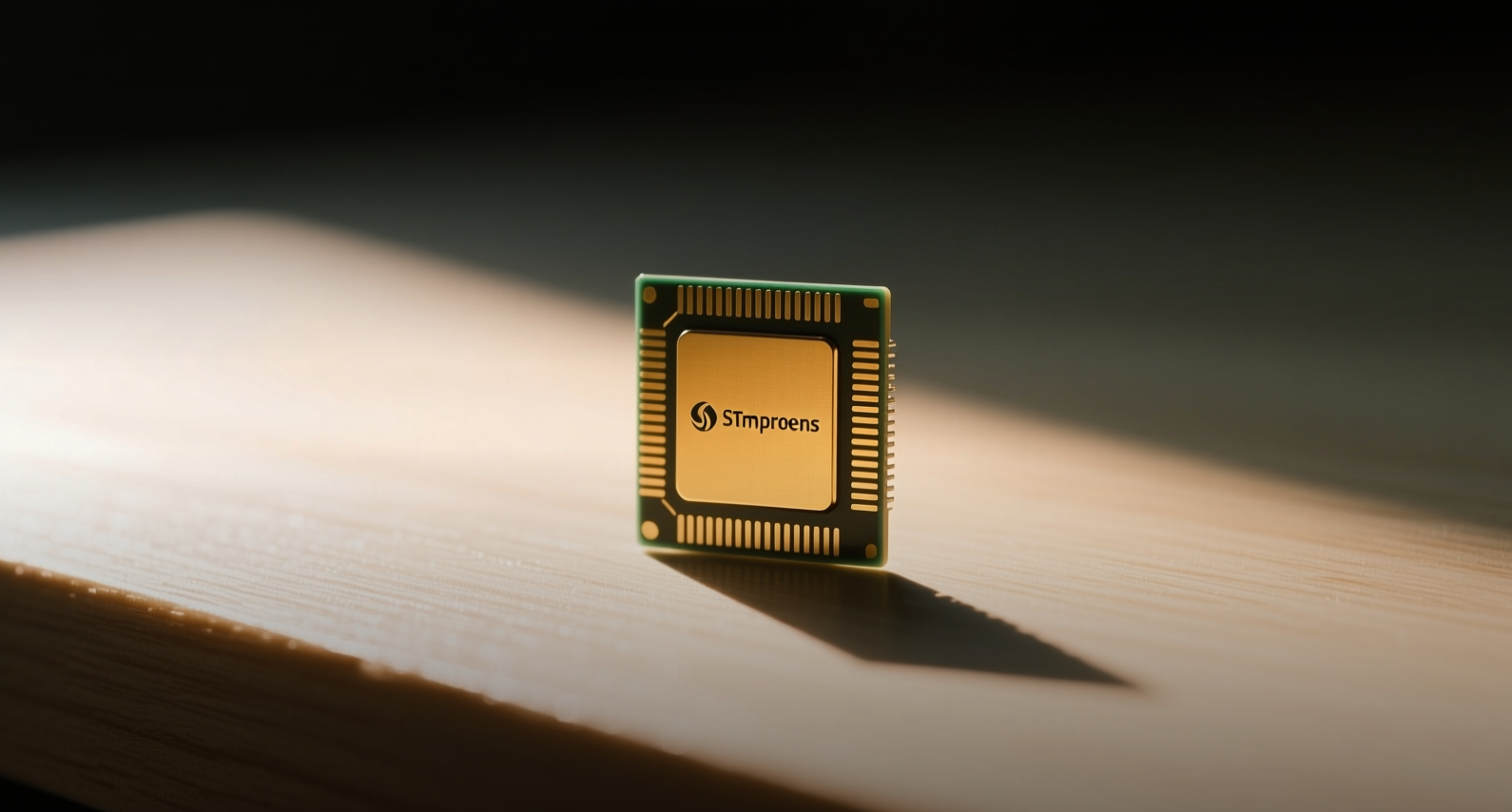
STMicroelectronics beats Q2 estimates as AI data center demand surges
STMicroelectronics NV posted second-quarter revenue above the midpoint of its own guidance, as demand accelerated across every end market with particularly strong momentum in AI data centers, optical connectivity and industrial applications. "Demand accelerated across all end markets in the second quarter, driven by broad-based recovery and strong AI-related tailwinds," the company said in its earnings release. The Geneva-based chipmaker said its data center business is benefiting from rising investment in AI infrastructure, while optical connectivity demand is being fueled by the expansion of high-speed networks. The company beat both top-line and bottom-line estimates for the quarter ended June 30, according to consensus figures. STM also issued a third-quarter revenue outlook that surpassed Wall Street's expectations, signaling that the demand recovery is broadening beyond the AI data center segment into industrial and automotive end markets. The results mark a turning point for STMicroelectronics, which had been navigating an inventory correction across the semiconductor industry through much of the past year. The company's exposure to industrial chips and microcontrollers — products used in factories, cars and consumer devices — makes its performance a bellwether for the broader chip cycle beyond just AI. Rival Texas Instruments also reported better-than-expected results this week, with revenue jumping 23 percent year over year to $5.46 billion, reinforcing the narrative of a cyclical recovery. STM shares closed at $65.77 on Wednesday, up 0.52 percent, and have gained about 10 percent since the start of the year. The stock trades at roughly 22 times forward earnings, a discount to pure-play AI chipmakers like Nvidia Corp. but in line with diversified analog and microcontroller peers such as Infineon Technologies AG and NXP Semiconductors NV. The company's data center push is gaining traction as hyperscalers — including Microsoft Corp., Amazon.com Inc. and Alphabet Inc. — continue to pour capital into AI compute infrastructure. Alphabet reported an 82 percent jump in Google Cloud revenue to $24.77 billion in its own quarterly results Wednesday, underscoring the scale of AI-related spending. For STM, the question is whether it can convert that infrastructure buildout into sustained revenue growth beyond the current cycle, particularly as it targets $3 billion in data center revenue by 2028. *This article is for informational purposes only and does not constitute investment advice.*

Jul 23 2026, 09:39
Relx reports 7% underlying revenue growth as AI tools drive gains
Relx reported H1 underlying revenue growth of 7%, with AI-enabled analytics tools driving profit gains across three of its four divisions. "The results reflect broad-based growth across all four business areas, supported by deeply embedded AI-enabled analytics and decision tools," Chief Executive Erik Engstrom said. Adjusted operating profit rose 9% on an underlying basis to £1.73 billion, ahead of the £1.72 billion consensus estimate. Adjusted EPS increased 11% at constant currency to 68.6 pence. The adjusted operating margin expanded 70 basis points to 35.5%. Shares rose 2.1% to 2,505 pence in London trading. The company raised its interim dividend 7% to 20.9 pence and completed £1.75 billion of its planned £2.25 billion share buyback program. | Metric | Actual | Consensus | Beat/Miss | |--------|--------|-----------|-----------| | Revenue | £4.87B | £4.91B | -0.8% | | Adj. Operating Profit | £1.73B | £1.72B | +0.6% | | Adj. EPS | 68.6p | — | — | Revenue reached £4.87 billion, up 2.7% on a reported basis and 7% on an underlying basis, just shy of the £4.91 billion Bloomberg consensus. Pretax profit rose 4.6% to £1.59 billion. Cash conversion was 98%, and free cash flow exceeded £1.1 billion. **Risk, STM and Legal Lead Profit Growth** The Risk division delivered 8% underlying revenue growth and 10% underlying adjusted operating profit growth, driven by demand for financial crime compliance and digital fraud solutions. More than 90% of Risk revenue comes from machine-to-machine interactions, Engstrom said. Scientific, Technical & Medical posted 6% underlying revenue growth and 8% underlying profit growth, supported by the rollout of LeapSpace, an AI-enabled research workspace. Active users of LeapSpace nearly doubled between March and June, and article submissions rose more than 20%. Legal was the fastest-growing division, with 10% underlying revenue growth and 13% underlying profit growth. About 90% of new sales are now from the AI-enabled Lexis+ with Protégé platform, while roughly three-quarters of renewal value comes from the same platform. Exhibitions delivered 6% underlying revenue growth but only 2% profit growth, partly because of travel disruption and the rescheduling of some events to the second half. Events in the Middle East represent about 3% of divisional revenue, or less than 0.5% of group revenue. **AI Costs Remain Manageable** Chief Financial Officer Nick Luff said token costs associated with AI usage remain less than 1% of the company's overall cost base. Relx sees managing those costs for customers as a competitive advantage, supported by how it configures its technology and pre-processes underlying content. For the full year, Relx expects continued strong underlying revenue growth in Risk, STM and Legal, with profit growth exceeding revenue growth in each division. The company also expects strong growth in adjusted EPS on a constant currency basis. The guidance raise signals management expects AI-driven demand to sustain its growth trajectory. Investors will watch the Q3 trading update for further evidence of AI platform adoption and margin expansion across the divisions. This article is for informational purposes only and does not constitute investment advice.

Jul 23 2026, 09:36
U.S. trade deficit swells to $103.65 billion, second-highest since Liberation Day
**The U.S. trade deficit widened for a second straight month in May, reaching $103.65 billion as imports rebounded and exports cooled, challenging the Trump administration's tariff-driven strategy to narrow the gap.** The U.S. trade deficit widened to $103.65 billion in May, the second-highest monthly total since the Liberation Day tariff rollout in March 2025, as a surge in computer parts and oil imports outpaced a decline in gold and machinery exports. "The May data shows trade flows are reverting to pre-tariff patterns despite record-high duties," said Elena Fischer, trade policy analyst at Edgen. "Front-loading distortions have faded, and underlying demand for imported goods remains strong." The May deficit followed a revised $82.46 billion shortfall in April and compares with $58.42 billion in February, before the Liberation Day tariffs took effect. Exports fell 4.49% from April to May, while imports rose 3.79%, according to Census Bureau data. Gold exports plunged $5.93 billion, or 25.19% month over month, after a speculative rally in 2025 that briefly made gold the most valuable U.S. export category. The widening deficit poses a political challenge for President Donald Trump, who has deployed tariffs at levels not seen since the Smoot-Hawley era to shrink the trade gap. Since the Supreme Court struck down his emergency-powers tariffs in February, the administration has shifted to Section 122 and Section 301 authorities, imposing a 25% tariff on Canadian goods and a 25% levy on Brazilian imports. Yet the deficit has set records in seven of the past nine years and topped $1 trillion in each of the last five, suggesting structural factors — not policy — drive the imbalance. **Imports Surge on AI Demand and Oil** Three import categories each rose more than $1 billion in May. Computer parts imports jumped $1.84 billion, or 15.44% from April, to the highest monthly total in at least two years — a surge tied to the artificial intelligence data-center buildout. Digital storage devices rose $1.65 billion, a 35.14% increase that also marked a two-year high. Crude oil imports added $1.26 billion, up 9.09%, as prices climbed after the U.S. military engagement with Iran began four months ago. On the export side, the decline was concentrated in gold, computers and computer parts. Gold shipments fell 67.74% from March's peak, when bullion prices topped $5,500 an ounce amid financial-market turbulence tied to the trade war and conflicts in Ukraine and Gaza. Most gold exports transit through JFK International Airport to Switzerland and the United Kingdom for processing. **Tariff Strategy Under Pressure** The May data shows that short-term trade disruptions from tariff shocks tend to fade, and the deficit reverts to its structural baseline. The U.S. current-account deficit reflects a domestic economy that consumes more than it produces, a condition no tariff regime has reversed since the 1980s. Trump's latest tariff threats — including a 50% levy on Canada, 25% on Brazil, and 100% on generic drugs from manufacturers not investing in the U.S. — have yet to produce measurable import substitution. Most include carve-outs that limit their impact, and past pronouncements have often been walked back. The administration is also exploring Section 338 of the 1930 Smoot-Hawley Act, a provision never before used. The U.S. trade deficit with China has fallen more than 60% from its 2018 peak, but deficits with other trading partners — Mexico, Vietnam and the European Union — have expanded to fill the gap. Through the first five months of 2026, the total deficit remains lower than the same period in 2021 but is trending upward after a relatively narrow first quarter. *This article is for informational purposes only and does not constitute investment advice.*