Edgen AI operates independently of, and is not controlled by Aspen Digital Financial Limited.
Johnson faces Senate as CFPB overhaul costs consumers $26.5 billion
 Edgen Stock·Jul 23 2026, 11:08
Share to
Share to
Copy link


[1] Trump's new pick to run consumer finance watchdog to face Senate (https://www.reuters.com/legal/litigation/trum ...)[2] CFPB nominee Johnson agrees to Capital One recusal (https://www.yahoo.com/news/politics/articles/ ...)[3] Democrats slam Vought over CFPB ‘trauma’ (https://www.yahoo.com/news/politics/articles/ ...)[4] Elizabeth Warren says Trump's CFPB overhaul has cost Americans billions (https://finance.yahoo.com/economy/policy/arti ...)[5] Senate report: Trump’s CFPB overhaul cost consumers $26.5 billion (https://finance.yahoo.com/economy/policy/arti ...)
Related News

Jul 23 2026, 12:12
Syntec Optics joins Russell 3000, boosting visibility among 34 new holders
Syntec Optics Holdings Inc. has been added to the Russell 3000 Index, putting the stock in the path of passive fund flows tracking the benchmark. The inclusion took effect at the opening of U.S. equity markets on June 29, with the Rochester, New York-based company announcing the milestone on July 23. Syntec is scheduled to receive education on the Russell indexes on July 24. "Because Syntec is in this index, major investment funds and larger investors around the world now automatically have the company on their radar screens to own, generally bringing attention and credibility," the company said in a statement. FTSE Russell, which operates the index family, assessed Syntec as meeting the criteria for inclusion among the 3,000 largest publicly traded U.S. companies. The Russell 3000 is a benchmark favored by institutional investors for its broad coverage of the U.S. economy, and membership means the stock is now automatically held by exchange-traded funds and mutual funds that track the index. Syntec is one of the nation's largest bespoke manufacturers of high-precision optics and photonics, employing nearly 180 people. The company supports applications ranging from low-Earth-orbit satellites to advanced defense platforms and AI data centers. Light-based technologies account for roughly $16 trillion of the $106 trillion in global economic output, according to company estimates. The company reported Q1 2026 revenue of $6.5 million, down 7.9% from a year earlier. Despite the decline, institutional interest has been building: 34 funds added shares in the most recent quarter, including TEMA ETFS LLC, which built a $7.7 million position, and Goldman Sachs, which added 88,782 shares. Only six funds reduced their positions during the same period. Index inclusion typically triggers forced buying by passive funds that track the Russell 3000, increasing trading volume and potentially supporting the stock price. The reconstitution also enhances a company's profile among active managers, which can lead to expanded analyst coverage and improved liquidity over time. For Syntec, the timing aligns with growing demand for optical components in defense and space applications, segments that have seen increased government spending. This article is for informational purposes only and does not constitute investment advice.
Jul 23 2026, 12:10
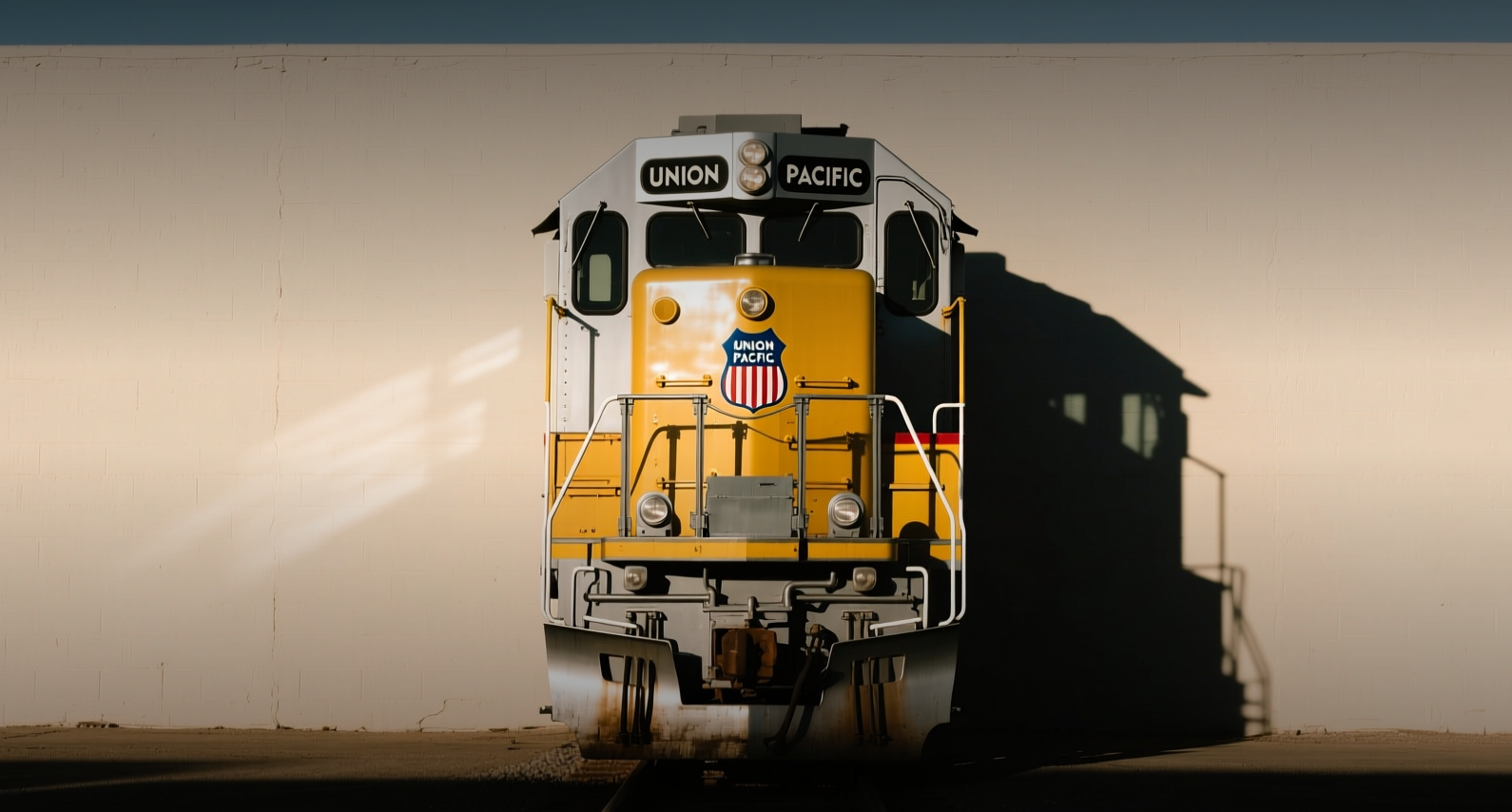
Union Pacific beats with $3.41 adjusted EPS as rail volumes rise 2%
Union Pacific Corp. reported second-quarter net income of $2.0 billion, or $3.36 a share, up 7% from a year earlier, as freight revenue rose 12% to $6.5 billion on higher fuel surcharges, volume growth and core pricing gains. "Strong execution and volume growth enabled another successful quarter and record financial results," Chief Executive Officer Jim Vena said. Adjusted diluted earnings per share of $3.41 topped the $3.03 reported in the year-ago period, a 13% increase. Operating revenue reached $6.9 billion, up 12%, while operating income rose 9% to $2.8 billion. The reported operating ratio — operating expenses as a percentage of revenue — came in at 59.7%, up 70 basis points from a year earlier, with higher fuel prices adding 120 basis points of unfavorable impact. Total carloads rose 2% to 2.2 million, with grain and grain products up 12%, automotive up 11% and metals and minerals up 3%. Intermodal revenue surged 26% to $1.4 billion, while premium revenue climbed 21% to $2.1 billion. Average revenue per car increased 8% to $3,014. The railroad posted record workforce productivity of 1,176 car miles per employee, up 5%, and freight car velocity improved 5% to 231 daily miles per car. The Omaha, Nebraska-based railroad raised its full-year outlook, saying it now expects high-single-digit earnings per share growth, consistent with its three-year compound annual growth rate target of high-single to low-double digits through 2027. The company affirmed its pricing strategy of dollars in excess of inflation dollars and maintained its capital plan of $3.3 billion. Free cash flow for the first half of 2026 totaled $1.8 billion, up from $1.1 billion a year earlier. The guidance raise signals management expects demand to continue strengthening across its bulk and industrial segments. Investors will watch the company's progress on its proposed merger with Norfolk Southern, which Vena said is ready to move forward in the regulatory process. This article is for informational purposes only and does not constitute investment advice.

Jul 23 2026, 12:07
Toyota, Honda and Hyundai control 86% of surging hybrid market
**Three Asian automakers that never abandoned hybrid technology now control 86% of America's fastest-growing vehicle segment.** Hybrid vehicles captured a record 15.4% of US new-car sales in the first half of 2026, up nearly 20% from a year earlier, as consumers gravitated toward fuel-sipping powertrains while elevated gas prices and lingering EV range anxiety pushed buyers toward the middle ground. "The only growth we're seeing is in hybrid market share," Elizabeth Krear, CEO of the Center for Automotive Research, said. "All other propulsion systems have lost market share year to date." Toyota sold more than 600,000 hybrids in the period across its Toyota and Lexus brands, giving it half the market, according to Baum & Associates. Hyundai Motor Group — encompassing Hyundai, Genesis and Kia — edged past Honda for the No. 2 spot, as the three Asian automakers together control 86% of US hybrid sales. Hybrids now account for 31% of American Honda's total volume, the company said, and it set a US hybrid sales record in the first half. The shift has upended the competitive order in the world's second-largest auto market. General Motors, which has bet heavily on battery-electric vehicles and offers just one hybrid — the Corvette E-Ray — has seen its US sales volumes pressured as Toyota's hybrid-heavy lineup pushes it closer to the top-selling automaker. Baum & Associates projects hybrids will reach a quarter of the US market by 2030, while pure EVs will account for 9.5%. **Why Hybrids Won** Toyota and Honda stuck with hybrid technology even as Tesla and legacy automakers pivoted to pure EVs, a strategy that drew criticism from activists and shareholders. Toyota argued it could reduce carbon emissions more effectively at scale by producing millions of fuel-efficient hybrids with smaller batteries rather than a limited number of EVs with large ones. "Toyota had a very much a North Star strategy," Krear said. "Hybrids deliver that meaningful fuel savings without requiring changes in driving habits or charging infrastructure." The persistence paid off. Honda, which posted its first loss in nearly 70 years as a public company in 2026 partly due to a $16 billion charge on EV restructuring, is now planning a new hybrid system designed for larger vehicles to defend its position. "At that point, there's really nothing to stop us in terms of battling it out with anybody in terms of hybrids," Gary Robinson, vice president of auto strategy at American Honda, said. **California Leads the Pivot** In California, the largest US market for plug-in vehicles, hybrids accounted for nearly one in four new registrations in the second quarter, outpacing EVs at 17.8%, according to the California New Car Dealers Association. The state's average gasoline price of $5.52 a gallon — well above the national average of $4.02 — has accelerated the shift, as has the end of federal EV tax credits under President Donald Trump. Used EV prices have surged 12% to an average of $38,342 since the Iran conflict pushed oil above $100 a barrel, according to Cox, narrowing the affordability gap that had long favored combustion cars. Still, pure EV sales in the US rose 15% quarter over quarter in the second quarter to 247,226 units, driven by new models from Toyota, Subaru, Kia and Hyundai, suggesting the segment is finding organic demand even without federal subsidies. **Investment Angle** The hybrid boom creates a clear divergence in automaker fortunes. Toyota, trading at a premium to Detroit peers on the strength of its hybrid margins, is positioned to extend its lead as hybrids approach 25% market share by the end of the decade. Hyundai Motor Group's broad hybrid rollout across SUVs and large vehicles gives it a growth vector that pure-play EV makers like Tesla and Rivian lack in the near term. For GM and Ford, the data signals that a hybrid strategy — not just an EV roadmap — may be necessary to defend US market share as consumer preferences shift decisively toward the middle ground. This article is for informational purposes only and does not constitute investment advice.