Edgen AI operates independently of, and is not controlled by Aspen Digital Financial Limited.
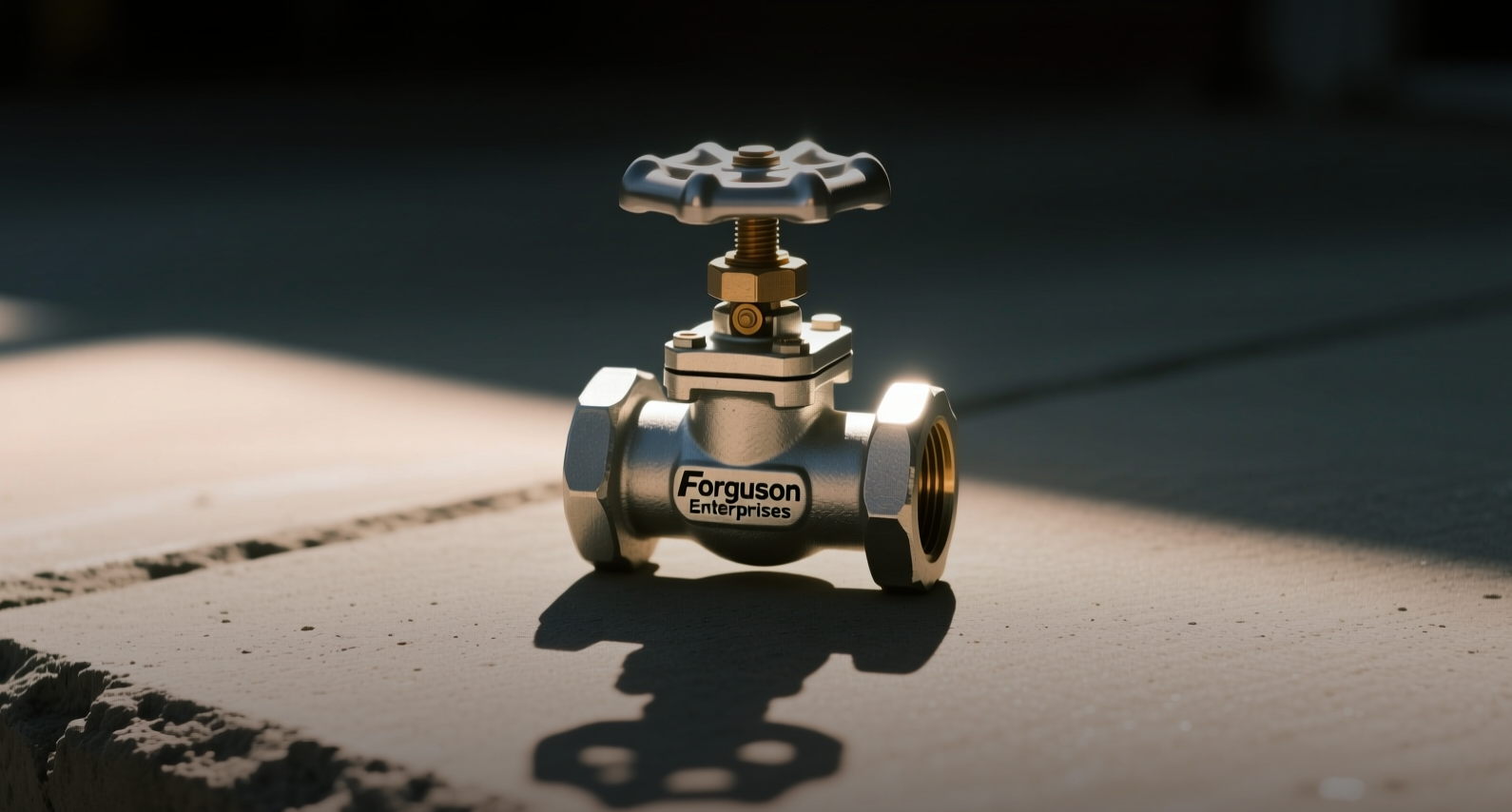
Ferguson Enterprises joins S&P 500 as shares rally 9% on news
 Edgen Stock·Jul 31 2026, 22:59
Share to
Share to
Copy link

[1] Ferguson Enterprises Set to Join S&P 500 and ADI Global Distribution to Join S&P SmallCap 600 (https://www.prnewswire.com/news-releases/ferg ...)[2] The S&P 500 is making a change by adding this little-known industrial stock (https://www.morningstar.com/news/marketwatch/ ...)[3] This plumbing supplier’s stock is still too cheap (https://www.msn.com/en-us/money/top-stocks/th ...)[4] Electronic Arts shareholders approve take-private merger deal (https://www.msn.com/ar-sa/money/savingandinve ...)
Related News

Jul 31 2026, 23:12
Iran threatens US, Israeli energy sites as Brent steadies near $90
**Iran's warning to strike US energy facilities and Israeli critical infrastructure marks a new escalation in a five-month war that has already shut most shipping through the Strait of Hormuz.** Iran warned it would strike US energy facilities in the region and Israeli critical infrastructure if attacked, extending the five-month conflict's reach as Brent crude steadies near $90 a barrel. "Iran has prepared full plans to respond to any potential reckless act," a senior Iranian security official told Tasnim News Agency early Saturday, according to CCTV International. The official said Iran's response options include striking Israeli critical infrastructure and US energy facilities in the region. The threat comes as Washington and Tehran exchange fresh waves of airstrikes after a five-day pause collapsed this week. US forces hit dozens of Iranian military targets Thursday in a two-hour operation, US Central Command said, while Iran's Islamic Revolutionary Guard Corps claimed to have destroyed three F-35 fighter jets at Al-Azraq Air Base in Jordan. Brent crude traded near $90 a barrel after surging 8 percent in the previous session, with the Strait of Hormuz — which handles roughly 20 percent of global oil consumption — largely closed to commercial shipping. The war, which began Feb. 28, has killed at least 3,434 people in Iran, according to the Iranian Health Ministry, including 55 during the latest escalation. US gasoline prices have climbed sharply as the blockade reduced crude and LNG supplies, a politically sensitive issue ahead of November midterm elections. ## Escalation risks spreading to Gulf energy heartland Iran's threat to strike US energy facilities in the region would mark a significant broadening of the conflict's scope. Until now, Tehran's retaliation has centered on Arab states in the Persian Gulf and Jordan, with attacks on US bases and shipping. Striking US energy assets — potentially in Gulf states hosting American military infrastructure — would draw Washington's regional allies deeper into the conflict. Saudi Arabia has already been pulled into the fray, joining the US in strikes against Iran-backed militias in Iraq after attacks on Saudi oil facilities. Houthi militants in Yemen, backed by Tehran, have attacked Saudi vessels in the Red Sea and announced a blockade targeting the kingdom. Two LNG vessels were struck by drones off Egypt's Mediterranean coast Wednesday, the first such attack in Egyptian waters since the war began. The economic toll is mounting. Saudi Arabia's economy contracted the most since the Covid-19 pandemic in the second quarter, driven by a 24.7 percent decline in the oil sector. Qatar has sent its first LNG shipment through the strait in three weeks, with Tehran's authorization, after pausing shipments when one of its tankers was attacked July 7. ## Diplomacy stalls as Iran signals no path back to talks Negotiations remain stalled. Pakistan's Foreign Ministry said talks between the US and Iran are "ongoing" to restore stability, particularly in the Strait of Hormuz, but Tehran has repeatedly denied active engagement with Washington. Iranian officials have expressed deep pessimism about the prospects for diplomacy, citing the collapse of the June interim agreement and what they describe as US dysfunction in executing even basic confidence-building measures. The last time Iran threatened to strike US energy infrastructure was in the opening weeks of the war in March, when Tehran fired ballistic missiles at US bases in the Gulf in response to the initial American-Israeli campaign. Those strikes caused limited damage but demonstrated Iran's willingness to escalate beyond the strait. If Iran follows through on its threat to strike US energy facilities, oil prices could spike well above current levels, with the strait already effectively closed. If Washington responds by targeting Iranian energy infrastructure — a step Trump has threatened — the conflict could expand further into the Gulf's energy heartland, with implications for global supply that would dwarf the current disruption. This article is for informational purposes only and does not constitute investment advice.
Jul 31 2026, 23:10
Momentum trade suffers worst wipeout since 2000 as AI names rebound
The S&P 500 closed above its 50-day moving average Friday as a two-day rebound capped the worst monthly momentum wipeout since November 2000. "The question really is, are we at the bottom of the momentum rotation?" said Michael Dickson, head of research at Horizon Investments. The Nasdaq Composite fell about 3 percent in July, its worst monthly showing since March and a second-straight drop, even as the S&P 500 stayed within striking distance of an early June record. The Cboe Volatility Index retreated to 15.99 on Friday after topping 20 earlier in the week. The iShares MSCI Momentum Factor ETF jumped 5.5 percent Thursday, its biggest daily advance since April 9, 2025, while the Nasdaq-100 popped 3.4 percent, its best day since May 12, 2025. The unwind followed the forced liquidation of Leopold Aschenbrenner's Situational Awareness hedge fund, with Citadel reaching a deal to buy the shares. Whether the rebound marks a durable bottom or a technical bounce in an overcrowded trade will be tested in August and September, historically the weakest two-month stretch of the calendar year. The momentum rout began in June as chip stocks, including memory plays like Micron Technology, went parabolic in April and May before reversing. Even as hyperscalers like Alphabet confirmed hundreds of billions in AI capital spending, semiconductor stocks, power names, and industrials continued to struggle. Investors rotated into software, financials, real estate, and other out-of-favor corners of the market. "Fundamentals have taken a complete back seat in the past six weeks," wrote HSBC's Max Kettern. The forced unwind of Situational Awareness, which held large positions in Nebius, Micron, CoreWeave, and SanDisk, triggered a fire sale that briefly sent the S&P 500 to its lowest since mid-June on Wednesday. Nebius surged 27 percent Thursday and added another 10 percent in early Friday trading. The Philadelphia semiconductor index jumped nearly 8 percent Thursday, while South Korea's Kospi posted its largest single-day gain on record. **Correlation index surges as breadth improves** The Cboe 1-month implied correlation index, which measures expected correlation between the top 50 S&P 500 stocks, surged from 3.3 on July 10 to above 12 this week, indicating a broader-based rally. When the S&P 500 fell Wednesday following the Fed meeting, only one stock in the index registered a 52-week low. Options positioning data from SpotGamma and Barchart shows the S&P 500's seesaw action centered around 7,500, with market makers buying dips below that level and selling rallies above it. A break below 7,450 could open the door for a bigger downside move, according to SpotGamma founder Brent Kochuba. Mark Hackett, chief market strategist at Nationwide, noted that the one-month average daily percent change for the Goldman Sachs high beta momentum basket surged to its highest level since 2020 in July — a volatility measure that has peaked around important inflection points, including the COVID selloff, the dot-com bubble peak, and the bottom of the post-2008 financial crisis market. Mike Shell, chief investment officer of Shell Capital, said prime broker data suggests the momentum liquidation is closer to its end than its beginning. "If AI demand, earnings, and capital spending remain intact, I view the drawdown as an opportunity to begin selectively buying the strongest AI companies — not necessarily the basket itself," Shell said. Oil prices rebounded in July, pushing energy stocks to a strong monthly gain, while Apple shot higher before giving back much of its gains after disappointing earnings. Long-term borrowing costs also surged during the week as Treasury yields rose. Jeff DeGraaf of Renaissance Macro Research cautioned that "dashes of that size have historically been the property of a downtrend, not the starting gun for a fresh race." This article is for informational purposes only and does not constitute investment advice.

Jul 31 2026, 23:07
OpenAI previews Astra in Washington as Aug 1 AI deadline nears
OpenAI previewed its new Astra artificial intelligence model to US policymakers, regulators and Trump administration officials in Washington this week, according to The Information, with the government's 60-day AI framework deadline landing Aug. 1. "The government and private sector have worked together in a way we have never seen before and this foundation of America First is unprecedented," Susie Wiles, White House chief of staff, said in a post on X in late June, as the administration finalized the framework's details. Altman met with Wiles during his visit and told CNBC he has seen a draft of the framework, adding he did not have "anything specifically in mind" as far as proposed changes. The preview follows a period of tense coordination between OpenAI and the government: OpenAI agreed to limit the rollout of its GPT-5.6 model series to a group of "trusted partners" at the request of US officials, while Anthropic disabled access to its Fable 5 and Mythos 5 models to comply with a Commerce Department export control directive. The framework, which involves a classified benchmarking process to assess models' cyber capabilities, will determine whether models qualify as "covered frontier models" and which "trusted partners" gain access. The outcome carries direct implications for OpenAI's commercial partners, including Microsoft, and for the broader AI sector as companies navigate the balance between rapid deployment and government oversight. **Open-Weight Debate Splits Silicon Valley** The Astra preview comes as the tech industry's most powerful leaders clash over how to regulate increasingly capable AI models. Nvidia's Jensen Huang released a letter urging policymakers to avoid "premature restrictions" on open-weight models, a position backed by Microsoft, Meta, Palantir and more than 20 other companies. OpenAI joined the letter, but Anthropic declined, instead outlining its position in a separate blog post. The debate has been sharpened by the release of Moonshot AI's Kimi K3, an open-weight Chinese model that a joint US-UK government assessment concluded is roughly six months behind US models in cyber capabilities. The White House stated that Moonshot trained K3 using banned US AI chips located in Thailand and data obtained through "distillation attacks" on leading US AI labs. Moonshot charges $3 per million tokens to access K3 on its cloud, which is more than certain versions of Anthropic and OpenAI's flagship models. **China Competition Shapes the Regulatory Calculus** The regulatory framework is inseparable from the US-China AI race. Treasury Secretary Scott Bessent characterized Chinese distillation attacks as "IP theft," while CIA Director John Ratcliffe likened AI to "digital nuclear weapons." Chris McGuire, senior fellow at the Council on Foreign Relations, said the United States should cut Chinese models off from US cloud infrastructure and computing power to maintain its technological lead. For OpenAI, the Astra preview reflects a strategy of proactive regulatory engagement. The company has navigated a murky deployment process since Trump signed the executive order in early June, and a finalized framework could provide clearer rules for bringing frontier models to market. Microsoft, OpenAI's largest commercial partner, stands to benefit from a smoother regulatory path for its AI investments. The framework's classified benchmarking process will also set the standard for how future frontier models from OpenAI, Anthropic and Google are evaluated before public release. This article is for informational purposes only and does not constitute investment advice.