Edgen AI operates independently of, and is not controlled by Aspen Digital Financial Limited.
CPC suspends oil loadings after drone attacks on 2 tankers
 Edgen Stock·Jul 19 2026, 08:06
Share to
Share to
Copy link

[1] Caspian Pipeline Consortium oil loadings suspended after drone attacks on tankers, CPC says (https://www.reuters.com/business/energy/caspi ...)[2] CPC's oil-terminal infrastructure is operating normally following drone attack in the Black Sea - Marine News Magazine (https://www.marinelink.com/blogs/blog/cpcs-oi ...)[3] Oil Tanker Attacked By Drone In The Black Sea - Marine News Magazine (https://www.marinelink.com/news/oil-tanker-at ...)[4] CPC operations continue uninterrupted after drone attack near Black Sea terminal (https://www.azernews.az/region/261249.html ...)[5] Oil tanker damaged by drone strikes near CPC terminal in Black Sea (https://www.bundle.app/en/breaking-news/oil-t ...)
Related News

Jul 19 2026, 18:37
Amazon's $44B quarterly capex dwarfs Shopify's $5M as strategies diverge
**Amazon and Shopify reported Q1 2026 results that beat revenue estimates, yet their capital strategies reveal two fundamentally different bets on where commerce and AI money flows next.** Amazon (NASDAQ: AMZN) posted $181.5 billion in revenue, up 16.6%, with AWS accelerating to 28% growth — its fastest pace in 15 quarters. The cloud unit generated $37.6 billion as Amazon's custom chip business, spanning Trainium, Graviton and Nitro, crossed a $20 billion annual revenue run rate with triple-digit growth. Advertising reached $70 billion on a trailing twelve-month basis, giving Amazon a second engine beyond retail. Shopify (NASDAQ: SHOP) reported $3.17 billion in revenue, growing 34.3% — faster than Amazon's top line. Gross merchandise volume surpassed $100 billion for the first time, reaching $100.74 billion, up 35%. Merchant Solutions revenue rose 39% to $2.42 billion, and operating income nearly doubled to $382 million. A $941 million mark-to-market equity hit pushed GAAP net income to negative $581 million, though underlying profit stood at $360 million. "The divergence in capital allocation is stark," said Rachel Kim, analyst at Edgen. "Amazon is building an AI utility with pre-sold capacity, while Shopify is proving you can scale commerce without owning the infrastructure." The numbers back that framing. Amazon poured $44.2 billion into capital spending in Q1, up 76.7% from a year earlier. Polymarket traders assign a 98.5% probability that full-year 2026 capex exceeds $170 billion, and 86.5% odds it surpasses $200 billion. Amazon has more than $225 billion in revenue commitments tied to Trainium alone, with major AI developers signing on for substantial capacity — meaning much of the spending is chasing contracted demand rather than speculative buildout. Shopify took the opposite path. It spent $5 million on capex in Q1, generated $476 million in free cash flow, and repurchased $491 million in shares under a fresh $2 billion buyback program. Merchant lending originations hit $1.349 billion, turning Shop Capital into a meaningful financial services line. **The valuation gap reflects the risk each strategy carries** Amazon trades at roughly 31 times trailing earnings, making it the cheaper AI infrastructure bet among hyperscalers. Shopify commands a 121 trailing P/E, leaving little room for consumer spending weakness that could pressure its small and medium business merchant base. Amazon guided Q2 revenue to $194 billion to $199 billion. Shopify expects revenue growth in the high-twenties percentage range with mid-teens free cash flow margin. The key variable for Amazon is whether Bedrock token growth and Trainium deployments begin pulling AWS margins higher despite the capex drag. For Shopify, the watchpoint is credit losses inside its $1.35 billion lending book if SMB spending softens. Post-earnings, the market split its verdict. Amazon slipped 5% as investors weighed the spending trajectory. Shopify recovered 16.2% from its post-earnings dip, though shares remain down 22.3% year to date. For investors, the choice comes down to time horizon. Amazon offers AI infrastructure exposure at a reasonable multiple with $225 billion in pre-committed chip revenue. Shopify offers faster growth and capital efficiency but at a valuation that prices in near-perfect execution. The second half of 2026 will test whether Amazon's capex begins converting to cash flow and whether Shopify's merchant lending book holds up under any consumer strain. This article is for informational purposes only and does not constitute investment advice.

Jul 19 2026, 18:36
CSRC convenes symposium July 20 to bolster China market stability
**China's securities regulator will convene listed companies, securities firms and fund managers on July 20 to gather feedback on stabilizing the capital market.** The China Securities Regulatory Commission will host listed companies, securities firms and fund managers on July 20 to solicit opinions on promoting stable and healthy capital market development, according to CCTV Finance and Securities Times. "The symposium shows the CSRC is taking a consultative approach to address structural challenges in China's capital markets," said Kevin Ip, an analyst covering China macro at Edgen. "The participation of issuers, intermediaries and institutional investors suggests the regulator wants broad-based input before any policy adjustments." The CSRC announced the symposium on July 19, bringing together the three main pillars of the market ecosystem. The consultation follows a period of subdued performance in Chinese equities, with the CSI 300 index under pressure from a prolonged property downturn, weak consumer sentiment and cautious foreign capital flows. The symposium's recommendations could inform the next round of capital market reforms, potentially including adjustments to IPO pace, refinancing rules or trading costs. Any concrete supportive measures announced after the meeting would likely boost A-share markets and improve sentiment toward China-dedicated exchange-traded funds. The CSRC has deployed multiple tools this year to support markets, including curbing program trading, tightening short-selling rules and guiding state-backed funds to increase equity allocations. The July 20 symposium extends this effort by directly soliciting feedback from market participants on what additional measures may be needed. Chinese equities have trailed global peers in 2026, with the Shanghai Composite Index and CSI 300 both lagging the S&P 500's advance. Foreign investors have been net sellers of Chinese stocks through Stock Connect in several months this year, weighing on sentiment despite relatively low valuations compared to developed markets. The timing of the symposium — mid-year, before the third-quarter earnings season — gives the CSRC room to incorporate industry feedback into policy adjustments before year-end. Market participants will watch for any announcements on stamp duty reductions, IPO approval timelines or further Stock Connect enhancements, any of which could provide a near-term boost for Chinese equities. This article is for informational purposes only and does not constitute investment advice.
Jul 19 2026, 18:07
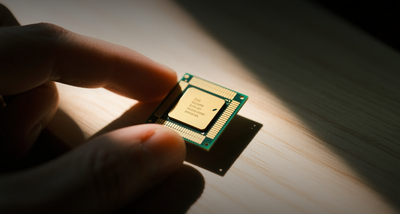
Apple's 15x memory efficiency push threatens Micron's record profits
**Apple's pursuit of a 15x reduction in on-device AI memory demands could upend the pricing power behind Micron's historic earnings surge.** Apple is in talks with AI startup PrismML to cut on-device memory demands by as much as 15x, a technology that threatens the memory-chip shortage fueling Micron's 74% gross margins and $25.11 per share in quarterly earnings. "DRAM and NAND industry demand continues to significantly exceed industry supply. We expect tight conditions to persist beyond calendar 2027," Sanjay Mehrotra, chief executive officer of Micron, told analysts on the company's June 24 earnings call. Micron's fiscal Q3 2026 revenue surged 345.7% to $41.46 billion, with non-GAAP earnings per share of $25.11 — up more than 1,200% from a year earlier. The company guided Q4 revenue to $50 billion with gross margins near 86%. It has shipped more than $1 billion in HBM4 revenue and locked 16 strategic customer agreements covering roughly $100 billion in remaining performance obligations. Shares trade at $853.20, down 14% from a week ago but still up 199% year to date. If Apple or other tech giants adopt memory-efficient AI processing, the pricing power that has driven Micron's rally could erode. The memory processor market is still projected to grow from $230 billion in 2025 to more than $1 trillion next year, but any efficiency breakthrough in on-device AI could compress the segment most exposed to Apple's product cycle. Apple raised prices on many devices by $200 or more this year to offset rising memory costs, and it may increase iPhone prices for the same reason later this year. The company's incentive to find alternatives is clear. PrismML claims its technology reduces memory usage for AI models by up to 15x while delivering responses as much as 8x faster. No deal has been finalized, but the talks signal Apple's intent to reduce its dependence on expensive memory chips for on-device AI features like Siri. **The competitive landscape** Micron's peers confirm the industry's pricing power. Sandisk posted fiscal Q3 non-GAAP EPS of $23.41 on revenue up 251% year over year, with gross margins at 78.4%. Western Digital, now a pure hard-disk-drive business after the Sandisk spinoff, grew revenue 45.5% to $3.34 billion with gross margins above 50% for the first time in years. Both companies ride the same AI storage tailwind, though at lower absolute margins than Micron. **What it means for investors** Micron's bull case rests on a structural supply shortage that CEO Mehrotra says extends beyond 2027. The company is spending roughly $27 billion in capital expenditures this fiscal year to build cleanroom capacity in Idaho and New York. KeyBanc raised its price target to $1,750 during the recent pullback, implying more than 100% upside from current levels. The bear case centers on two risks: Chinese competitor CXMT's $8.5 billion IPO, which could add DRAM supply, and the possibility that major customers like Apple find ways to do more with less memory. Even if PrismML's technology takes years to scale, the direction of travel is clear — tech giants are motivated to reduce memory costs, and any success could compress the margins that have made Micron one of the best-performing semiconductor stocks of 2026. This article is for informational purposes only and does not constitute investment advice.