Edgen AI operates independently of, and is not controlled by Aspen Digital Financial Limited.
BlackRock's digital assets chief joins 1 million BTC treasury summit
 Edgen Crypto·Sep 15 2026, 04:06
Share to
Share to
Copy link


[1] BlackRock's digital assets chief to speak at Bitcoin Treasuries Conference in New York City (https://cryptobriefing.com/blackrock-bitcoin- ...)
Related News
Sep 15 2026, 04:09
Solana lifts transaction size 3.3x as infrastructure races to migrate
Solana's mainnet began accepting Transaction V1 on Sept. 14, raising the maximum transaction size from 1,232 bytes to 4,096 bytes and letting zero-knowledge proofs, large multisig wallets and confidential transfers execute atomically in a single transaction. The change is opt-in for users but mandatory for the validators, RPC providers and SDKs that have to parse the wider format. "Larger transactions remove the main reason complex operations had to be split across multiple instructions, which is where partial execution failures came from," said a Solana core contributor involved in the rollout, who asked not to be named because the migration is ongoing. "The constraint now is tooling, not the protocol." The 3.3-fold expansion is the first change to Solana's transaction envelope since the network's launch format, and it arrives five days after the feature was scheduled for activation. Solana's native token SOL traded at $101.56, up 0.67% over 24 hours, according to CoinGecko data as of 14:00 UTC, with the wider crypto market flat — Bitcoin at $77,705 and Ether at $2,499.83. The upgrade matters because Solana's failure rate has been a persistent drag on its throughput story. A separate measurement of 36 Solana mainnet blocks on Sept. 14 found 33.2% of non-vote transactions failed, with individual blocks ranging from 13.2% to 66.1%. Most of those failures trace to slippage limits and expired blockhashes rather than size limits, but the atomicity that larger transactions enable directly addresses the partial-execution class of failure that DeFi protocols on Solana have had to engineer around. ## What 4,096 bytes actually unlocks The practical effect is concentrated in three areas. Zero-knowledge proof verification, which previously had to be split across multiple transactions with intermediate state written to the chain, can now run in one atomic call. Large multisig wallets — the kind used by DAOs and institutional custodians — can fit every signature into a single transaction instead of batching approvals across several blocks. Confidential transfers, which carry heavier payloads, become viable without fragmenting the instruction set. For Solana DeFi, the change reduces the window in which a partially executed transaction can leave a position half-opened. That risk is what forces protocols to build guardrails — extra instructions, compute budget padding, and fallback logic — that consume the same block space the upgrade is meant to free up. Removing the need for those guardrails is where the efficiency gain compounds. The comparison to other layer-1 networks is where the narrative gets tested. Ethereum's transaction size is bounded by block gas limits rather than a fixed byte ceiling, and its rollup-centric roadmap pushes complex computation to L2s. Solana's approach keeps execution on the base layer and widens the envelope instead. Avalanche and Sui have taken different routes to the same problem, with subnet architecture and object-based parallel execution respectively. ## The migration burden lands on infrastructure Transaction V1 is opt-in at the user level, which means the upgrade's real adoption curve will be visible in infrastructure, not in headline transaction counts. Validators running older client versions, RPC providers that have not updated their parsers, and SDKs that assume a 1,232-byte ceiling all risk mishandling or rejecting oversized transactions. That fragmentation risk is the near-term cost of the upgrade. A dApp that ships V1 transactions before its RPC provider supports them will see failures that look identical to the slippage and blockhash errors already common on the network — which makes the migration harder to diagnose from the user side. The burden is transient by design, but it concentrates in the same tooling layer that Solana's developer experience depends on. The next scheduled intervention is Alpenglow, the consensus overhaul announced for October 2026, which targets a substantial reduction in time to finality. Node operators will need to prepare for that separately. For users, the sequence does not change: faster finality shortens the wait for confirmation, it does not convert a rejected instruction into a valid one. What to watch is whether V1 transaction share climbs in block data over the coming weeks. Until it does, the 4,096-byte ceiling is a capability the network has rather than one it is using — and the efficiency narrative that supports Solana's valuation against other layer-1s rests on the second, not the first. This article is for informational purposes only and does not constitute investment advice.

Sep 15 2026, 04:03
Polygon slips to $0.095 as Cumberland pulls 14.6M POL off exchanges
Polygon's POL changed hands at $0.095 on Monday, up 0.98% in 24 hours, after a wallet tied to market maker Cumberland moved 14.6 million tokens worth $1.41 million off Binance, Gate and Coinbase, according to analyst Nazoku. The withdrawal removed supply from visible order books but did not lift the token out of a four-day range between $0.094 and $0.099. "Desk withdrawals are inventory management first and directional bets second," Jason Wu, an on-chain analyst who tracks exchange flows, said. "Cumberland pulling POL off Binance tells you where the tokens are, not what the desk intends to do with them." The tokens were moved to a separate wallet after leaving the exchanges, Nazoku reported. Cumberland, which acts as a market maker across major venues, typically withdraws assets to rebalance inventory or to facilitate over-the-counter block trades for clients. Neither the destination wallet nor any subsequent transfer has been identified publicly. Sell-side pressure has not eased. FalconX deposited 14 million POL into Binance days earlier, and Polygon's Exchange Supply Ratio climbed to a two-week high of 0.00035 over the past week, a reading that tracks the share of circulating supply sitting on exchanges. Rising ESR readings mean more tokens are available for immediate sale. Volume confirms the pickup in activity. POL's total trading volume rose 158% to $83 million, with spot volume up 35% to $8.17 million — a $2.9 million increase over 24 hours — and futures volume up 15% to $38 million, a $6.1 million gain. The token was rejected at $0.98 four days ago and has printed lower closes since, bottoming at $0.94 before settling into its current band. Momentum indicators point the same direction as the flows. The positive directional index has declined for two consecutive weeks while the ADX made a bearish crossover, and the negative directional index has held flat rather than falling — a configuration that favors sellers. A continued drop in the DI puts $0.09 in play, with $0.089 the next level below. Holding $0.094 keeps a close above $0.099 as the upside target. The stakes extend past the chart. POL near $0.095 compresses the dollar value of Polygon's staking rewards and treasury holdings, and it drags on sentiment across Ethereum layer-2 tokens that have traded as a group. For Cumberland's counterparties, the more consequential question is whether the 14.6 million tokens reappear on an exchange or settle into self-custody — the first outcome adds to the supply already pressuring the order book, the second does not. This article is for informational purposes only and does not constitute investment advice.
Sep 15 2026, 00:30
House panel takes up bitcoin reserve bill with 20-year lockup
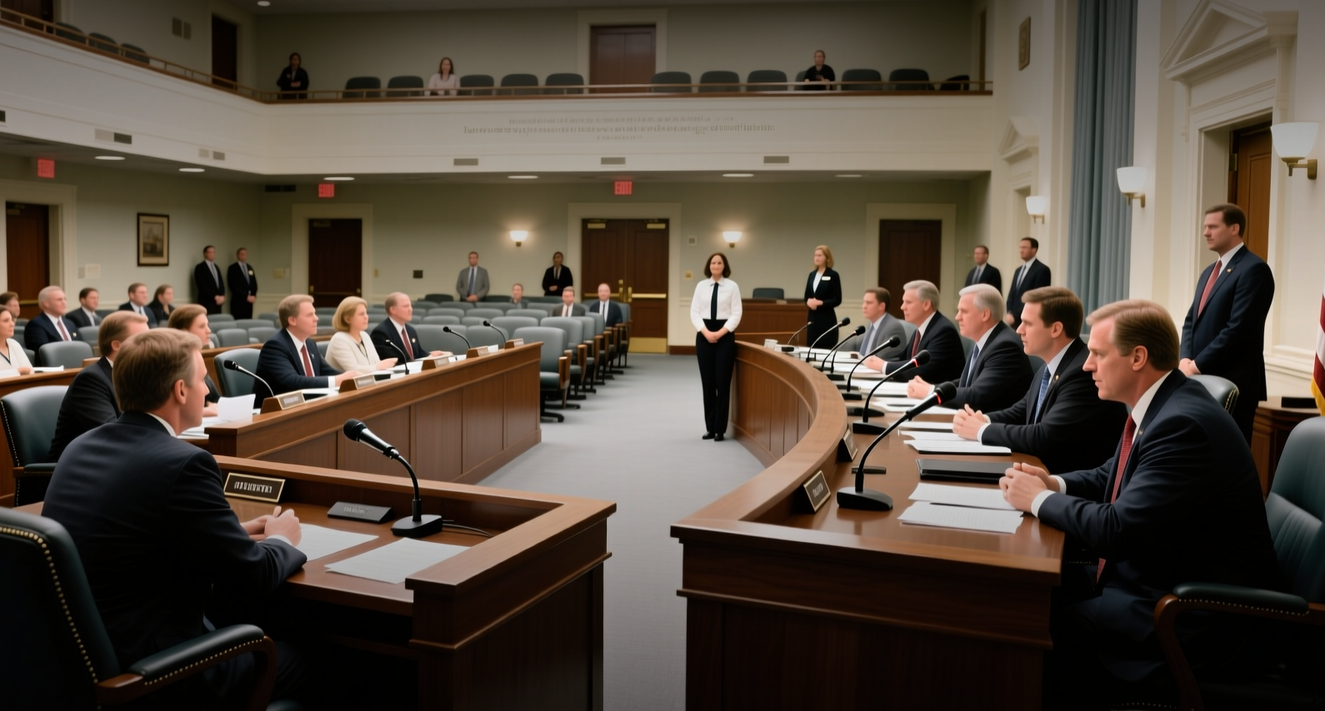
Washington would be legally barred from selling its seized bitcoin for two decades under legislation that gets its first congressional test on Wednesday, when the House Financial Services Committee marks up H.R. 8957, the American Reserve Modernization Act of 2026. The committee's memorandum lists the measure among nine scheduled for consideration from 10:00 a.m. ET in Room 2128 of the Rayburn House Office Building. Rep. Nick Begich (R-AK) introduced the legislation on May 21 with 23 co-sponsors, including Democratic Rep. Jared Golden of Maine, and the Digital Assets, Financial Technology, and Artificial Intelligence Subcommittee heard it on July 17. "Economic security is national security," Treasury Secretary Scott Bessent told the Senate Finance Committee in June, describing the reserve as "new technology" and "new ground" for the government. "We are proceeding with all deliberate speed," he said. The text directs the Treasury Secretary to stand up a Strategic Bitcoin Reserve within 180 days of enactment, with federal agencies providing a full accounting of their bitcoin and other digital assets within 60 days and transferring custody within 30 days once the reserve is operational. Deposits face a minimum 20-year holding period during which the coins cannot be sold, swapped, auctioned or otherwise disposed of. Treasury would publish quarterly proof-of-reserve reports covering holdings, transactions and private-key control, verified by an independent auditor and monitored by the Comptroller General. Non-bitcoin assets would sit in a separate Digital Asset Stockpile. The reserve would be built from coins already seized through criminal and civil forfeitures, so the bill authorizes no new market purchases and commits no taxpayer money. That structure is the source of its political durability and its limited near-term market effect: the government does not become a marginal buyer, but it also cannot become a forced seller. For an asset capped at 21 million coins, a statutory two-decade lock on the federal stack removes that supply from circulation for a generation. The markup is a committee-level step, not a floor vote. The bill would still need to pass the full House, clear the Senate and reach the president's desk, and the September 16 session is the first point at which members can amend the lockup, the audit cadence or the treatment of non-bitcoin holdings. Comparable state-level efforts have moved faster: Texas established an advisory committee focused on bitcoin reserves, and several other states have explored similar frameworks, leaving ARMA as an attempt to align federal policy with what is already advancing in state capitals. This article is for informational purposes only and does not constitute investment advice.