Edgen AI operates independently of, and is not controlled by Aspen Digital Financial Limited.
AVAX falls 4.9% to $6.57 as short sellers pile into falling market
 Edgen Crypto·Jul 24 2026, 02:54
Share to
Share to
Copy link

[1] Bears tighten grip on AVAX as open interest rises alongside falling prices (https://ambcrypto.com/bears-tighten-grip-on-a ...)[2] Hyperliquid Price Prediction 2026-2032: How High Will HYPE Go? (https://www.cryptopolitan.com/hyperliquid-pri ...)[3] Avalanche (AVAX) price drops nearly 5%, breakin... - Pluang (https://pluang.com/en/news-feed/bear-menguat- ...)[4] Will Avalanche (AVAX) Soar or Stumble in 2026? - Phemex (https://phemex.com/blogs/avalanche-price-anal ...)
Related News

Jul 24 2026, 05:35
Galaxy Digital prices $3.5 billion notes at 9.875% for data centers
Galaxy Digital Inc. raised $3.507 billion through a private offering of 9.875% senior secured notes to finance two data center buildings in Texas, the company said Wednesday. The notes, issued by indirect subsidiary Galaxy Helios Data Centers II LLC, will mature Aug. 1, 2031, and carry a 9.875% coupon payable semi-annually. They amortize at 4% of the original principal amount per year, with the first amortization payment due at least 10 months after project completion. Proceeds will fund the development of two buildings containing eight data halls with a combined 400 megawatts of utility capacity and 260 MW of critical IT capacity on a 260-acre site in Dickens County, Texas. The offering is expected to close July 28, subject to market conditions. The 9.875% coupon reflects the capital-intensive nature of AI and high-performance computing infrastructure, where developers are racing to secure power and land. Galaxy's broader 1.63 GW Helios campus positions the company among the largest data center developers in North America, competing with firms such as Digital Realty Trust Inc. and Equinix Inc. for institutional capital. The notes are secured by first-priority liens on substantially all assets of the issuer and guarantor Galaxy Helios II LLC, as well as equity interests held by the direct parent. They are being offered to qualified institutional buyers under Rule 144A and to non-U.S. persons under Regulation S, and have not been registered under the Securities Act. Galaxy Digital, headquartered in New York, operates across digital assets trading, advisory, asset management, staking, self-custody, and tokenization, in addition to its data center infrastructure business. The company trades on Nasdaq under the ticker GLXY. This article is for informational purposes only and does not constitute investment advice.
Jul 24 2026, 05:12
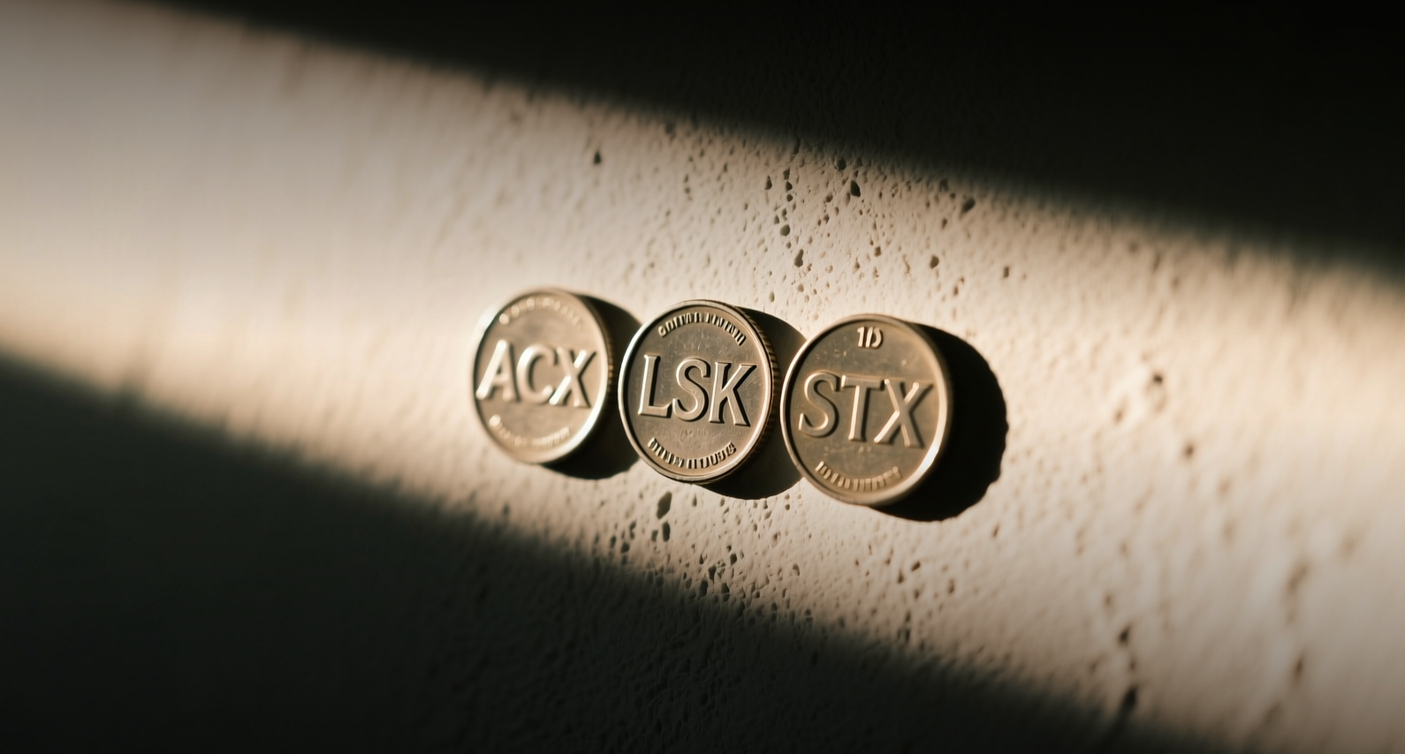
Binance flags 3 tokens for delisting as STX slides 10%
Binance added Across Protocol (ACX), Lisk (LSK) and Stacks (STX) to its Monitoring Tag on July 24, placing all three tokens under closer review for potential delisting from the world's largest crypto exchange. STX fell 10.4% to $0.150 on Binance, its lowest level since late 2020, while ACX slipped 2.6% to $0.041 and LSK dropped 3.85% to $0.085, according to CoinGecko data as of 14:30 UTC. "The Monitoring Tag is assigned to tokens that exhibit higher volatility and risk compared to other listed assets," Binance said in a statement. The exchange reviews tagged projects at regular intervals, weighing team commitment, development activity, trading volume, network stability and tokenomics changes, and can delist tokens that no longer meet its criteria. ACX hit an intraday low of $0.035, its weakest since March, while LSK fell to $0.074 on Binance, an all-time low. The tag does not guarantee removal — Binance previously added it to Beefy.Finance and Measurable Data Token in June 2025 and to FunToken and Orchid in March 2026, with all four confirmed for delisting in April 2026 alongside FIO Protocol and Wanchain. Trading volume across the three tokens rose sharply after the announcement as traders moved to reduce exposure, though Binance said spot trading and related services would remain unaffected. The monitoring designation follows separate structural changes at each project. Across Protocol approved a plan allowing holders to exchange ACX for equity in a new US company or accept a USDC buyout. Lisk migrated from its original layer-1 model to the Optimism Superchain, and its community considered burning 100 million LSK tokens, equal to 25% of the planned supply. Stacks continues developing Bitcoin-based smart contract products, with digital asset custodian Hex Trust adding support for STX and sBTC in 2025, expanding institutional access to the ecosystem. Binance did not set a date for its next review or provide a timeline for a delisting decision. Projects that demonstrate improved conditions can have the tag removed, while those that fail to meet the exchange's standards face removal from the platform — a move that would severely reduce liquidity and accessibility for all three tokens. This article is for informational purposes only and does not constitute investment advice.

Jul 24 2026, 03:39
Sky Protocol revenue tops $107M as sUSDS supply surges 149%
Sky Protocol generated $107.35M in Q2 gross revenue, up 10.5% year-over-year, as sUSDS supply surged 149% to $5.52B. "Sky Protocol delivered its second straight quarter above $100M in gross revenue, driven by strong collateral growth and sUSDS adoption," the Sky Frontier Foundation said in its Q2 2026 quarterly report published July 23. Protocol collateral reached $12.32B, up 45.5% from $8.47B a year earlier, against $12.22B in obligations. Net protocol revenue expanded 25.1% to $40.09M, with the net revenue margin widening to 37.3% from 33%. The protocol posted its fifth consecutive quarterly surplus at $33.29M and remitted $29.87M to Sky Reserves, bringing the reserve to $82.40M against a $150M solvency target. The results validate Sky Protocol's risk controls after the protocol operated without interruption during April's $292M Kelp DAO rsETH bridge exploit. Annualized gross revenue run-rate now stands at $429.4M based on Q2 monthly settlement cycles, with the protocol targeting continued reserve accumulation through its calibrated 3.6% Sky Savings Rate. Sky Protocol, the decentralized lending platform formerly known as MakerDAO, operates on Ethereum. Its yield-bearing token sUSDS maintained its position as the largest rate-bearing stablecoin by supply, with cumulative Sky Savings Rate distributions to holders crossing $250M on June 29. Total USDS supply stood at $10.04B at quarter end after peaking above $11.8B in early April, following the mid-quarter rate reduction from 3.75% to 3.6%. Prime Agent Vaults totaled $6.84B, approximately 55% of total protocol collateral, with $2.58B allocated across six institutional counterparties including Janus Henderson ($1.24B), BlackRock BUIDL ($713M), Anchorage ($260M), PayPal ($237M), Securitize ($102M), and Galaxy ($27M). All allocations are visible in real time on the Sky Protocol Financial Dashboard, which launched May 6. Distribution expanded during the quarter. Binance completed its upgrade from DAI to USDS with automatic one-to-one conversion of user balances, and sUSDS became accessible through Binance Wallet. SKY token became available on Revolut across the European Economic Area on April 30. Spark launched the Stablecoin FX Layer on Uniswap v4 on June 25, seeding $150M in initial liquidity and processing over $70M in volume in its first three days. Total SKY staked grew to 17.08B at quarter end, or 73.3% of circulating supply, up from 69.8% at the close of Q1. The protocol deployed $3.41M in USDS to open-market SKY buybacks during Q2, acquiring 51M SKY at an average price of $0.067, bringing cumulative program deployments past $121M since inception in February 2025. On April 24, Sky Frontier Foundation introduced Laniakea, an infrastructure framework designed to standardize how institutional capital deploys through Sky Protocol across smart contracts, risk and governance, data infrastructure, and legal and compliance. The framework aims to onboard institutional partners in weeks rather than months, targeting the more than $300B in stablecoin capital not currently earning any yield. This article is for informational purposes only and does not constitute investment advice.